 Bellingham Window
 Birch Bay's Coastal Climate Asks More of a Deck Than Most Places Do
Birch Bay sits right on the water, and that changes what a deck has to put up with year-round. Salt-laden air drifts off the bay and settles onto every exposed surface, driving rain comes in sideways during winter storms, and the long, damp Whatcom County shoulder seasons keep everything outdoors wet longer than homeowners further inland ever have to deal with. Add in a moss season that can stretch from fall through spring, and you've got a decking environment that punishes weak fasteners, untreated substructure, and boards that trap moisture instead of shedding it.
None of that is unusual for us. We work exteriors across Bellingham and Whatcom County, and Birch Bay's waterfront exposure is one of the more demanding conditions we build for regularly. A deck that performs well in a sheltered Bellingham backyard can fail years early out here if it wasn't built with the salt air and rain load in mind from the start.
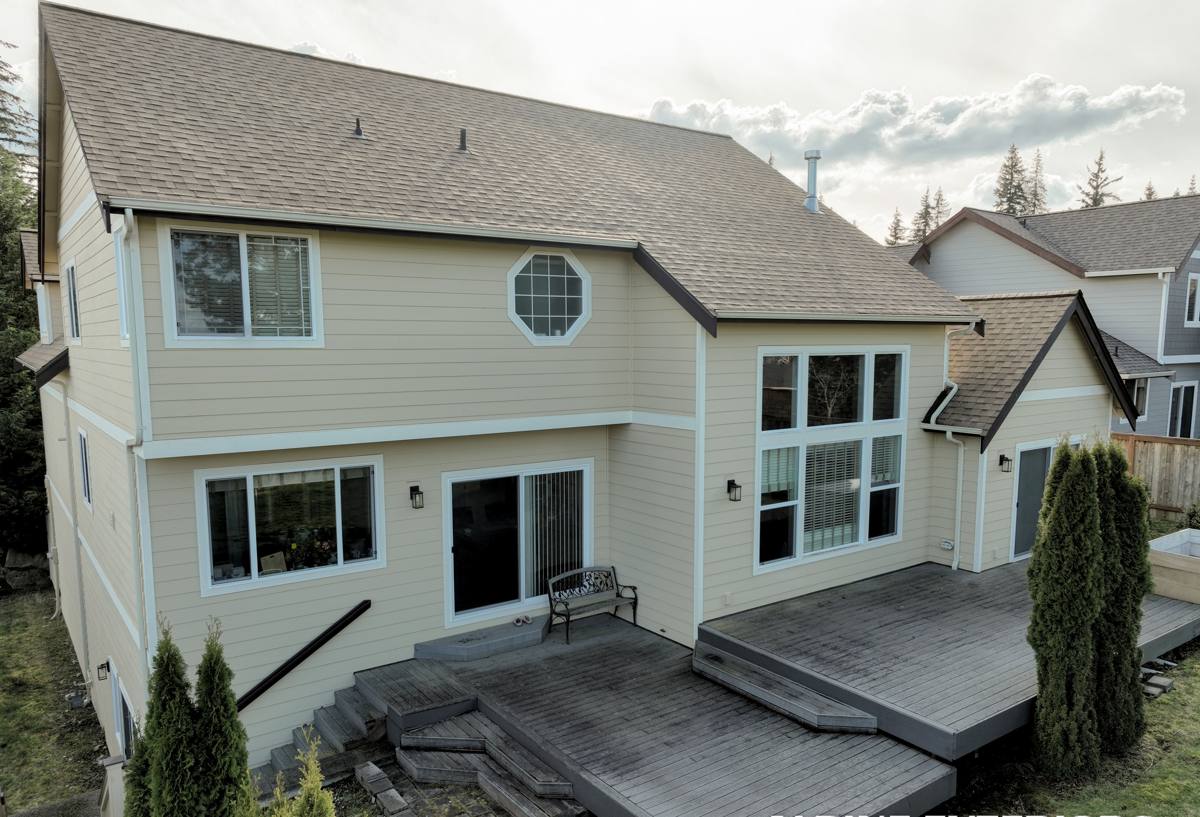
Why Composite Decking Fits Birch Bay Homes
Composite decking was developed to solve exactly the problems that coastal, wet climates create for wood decks: rot, splintering, warping, and constant refinishing. For a Birch Bay property, that translates into a few concrete advantages.
- No annual staining or sealing to keep salt air and moisture from working into the board
- Resistance to the swelling and cupping that wood picks up from repeated wet-dry cycles
- Consistent color and surface that doesn't gray or splinter the way exposed wood does near saltwater
- Better footing when the surface is damp, which matters through a long moss and rain season
- No rot risk at the board itself, which removes one of the biggest wood-deck failure points in this climate
Composite isn't zero-maintenance, and we won't tell you it is. It still needs periodic cleaning, and the substructure underneath still needs to be built correctly. But it removes the single biggest weak point of a wood deck in a salt-air environment: the wood itself.
What Composite Decking Won't Solve on Its Own
The boards get most of the attention, but they're only part of the system. A composite deck built on an undersized frame, with the wrong fasteners, or without proper drainage underneath will still develop problems in a Birch Bay setting — just different ones than a wood deck would. Corroded hardware, trapped moisture under the boards, and ledger connections that weren't flashed correctly are the failure points we see most often on decks that weren't built for this exposure, regardless of what decking material sits on top.
What a Correct Installation Involves Out Here
A composite deck built for Birch Bay's conditions needs a few things that a generic install in a drier, sheltered location might skip.
Substructure and Fasteners
Salt air accelerates corrosion on standard fasteners and framing hardware. We build the substructure with corrosion-resistant fasteners and connectors rated for coastal exposure, not the standard hardware that's fine for an inland deck but starts rusting within a few seasons this close to the water.
Drainage and Ventilation Underneath
Composite boards don't rot, but the framing underneath them still can if moisture gets trapped and can't escape. Proper board spacing, joist spacing, and airflow underneath the deck keep humidity from pooling under the surface — this matters more in Birch Bay's damp shoulder seasons than it would in a drier inland yard.
Ledger Attachment and Flashing
Where the deck attaches to the house is the single most common source of hidden water damage on any deck, wood or composite. Correct flashing at the ledger board keeps driving rain from working its way behind the siding and into the structure — a real risk during Birch Bay's windier storm systems.
Board Selection for Sun and Moisture
Not every composite board handles a marine environment the same way. We select boards and finishes with UV and moisture performance suited to a waterfront exposure, rather than defaulting to whatever's cheapest, so the surface holds its color and grip over time instead of fading or getting slick early.
Our Process for a Birch Bay Deck Project
- On-site assessment — we look at sun exposure, prevailing wind and rain direction, existing structure (if replacing a deck), and how close the site sits to the water.
- Design and material selection — board style, color, and railing options matched to the home and to the exposure level of that specific site.
- Permitting — we handle the permit and inspection requirements that apply to the project.
- Substructure build — framing, footings, and hardware sized and specified for coastal exposure, not a generic inland spec.
- Decking installation — boards, fascia, and railing installed to manufacturer spec so warranty coverage stays intact.
- Final walkthrough — we go over the finished deck with you and cover what maintenance actually looks like for your specific site and exposure.
Composite vs. Other Decking Materials in a Salt-Air Climate
| Material | Performance in Salt Air / Driving Rain | Maintenance Burden |
|---|---|---|
| Composite decking | Strong — resists rot, swelling, and salt-driven surface breakdown when installed correctly | Low — periodic cleaning, no staining or sealing |
| Pressure-treated wood | Moderate — treatment slows rot but doesn't stop moisture absorption or splintering over time | High — annual staining/sealing to keep protection intact |
| Cedar or other natural wood | Weaker — attractive but more vulnerable to moisture cycling and UV in this exposure | High — regular refinishing, more frequent board replacement |
| Aluminum decking | Strong against moisture but can develop surface corrosion issues near saltwater over the long term | Low, but material and install cost are typically higher |
Every material has trade-offs. We'll walk through them honestly for your specific site rather than pushing one option — the right call sometimes depends on budget, the look you want, and how close the deck sits to the water.
What Drives Cost on a Birch Bay Composite Deck
Composite decking costs more upfront than pressure-treated wood, but the gap narrows over the life of the deck once you factor in the staining, sealing, and earlier board replacement wood typically needs in this climate. A few things move the price on any given project:
| Factor | Why It Matters Here |
|---|---|
| Deck size and shape | More linear footage, more cuts, more complexity at corners and stairs |
| Height off grade | Taller decks need more substantial framing and railing work |
| Substructure condition | Replacing an old deck often means addressing framing or ledger issues before decking even goes on |
| Board and railing tier | Composite lines range from entry-level to premium, with different fade and stain resistance |
| Site exposure | Waterfront-facing sites in Birch Bay may warrant upgraded fasteners and hardware for corrosion resistance |
We'll give you a clear, itemized number after seeing the site — not a ballpark that changes once we're standing on the property.
Maintaining a Composite Deck Through a Birch Bay Moss Season
Composite decking is low-maintenance, not no-maintenance, and moss season is where that distinction shows up most. Moss and algae can grow on any decking surface that stays damp and shaded, composite included. A seasonal rinse and occasional scrub with a soft brush and mild cleaner keeps the surface from building up grime that holds moisture against the board. Keeping gutters and nearby drainage clear also matters more here than in a drier climate — standing water near the deck edge feeds the kind of moss growth Whatcom County winters are known for.
A Simple Seasonal Checklist
- Rinse debris and salt residue off the surface a few times a year, more often if the deck faces the water directly
- Sweep leaves and organic debris out of gaps between boards before they trap moisture
- Check railing and stair hardware annually for corrosion, especially on waterfront-facing sites
- Clear gutters and downspouts near the deck so runoff doesn't pool against the structure
- Address any soft spots in the substructure early rather than waiting for a visible problem on the surface
Why Local Experience in Birch Bay Matters
A contractor who mostly builds decks in drier, inland conditions is making educated guesses about what Birch Bay's salt air and storm exposure will do to their work. A crew that already builds here isn't guessing — we know which hardware holds up, where flashing details need extra attention, and how much drainage a substructure actually needs in a waterfront setting versus a sheltered Bellingham lot. That local knowledge is the difference between a deck that looks the same in year one and year ten, and one that starts showing corrosion or moisture problems within a few seasons.
Get a Straight Answer for Your Property
Every Birch Bay lot has its own exposure, drainage situation, and sun pattern, and that affects what the right deck build looks like. If you're weighing a new composite deck or replacing an aging wood one, we're glad to take a look and give you a straightforward, no-pressure estimate — just fill out the form below and we'll go from there.