 Bellingham Window
 Building Decks for Birch Bay's Coastline
Birch Bay sits right on the water, and that changes what a deck has to survive compared to one a few miles inland in Bellingham or Ferndale. Homes along the bay get more direct exposure to salt-laden air, wind-driven rain coming off the water, and long stretches of gray, damp weather that keep every horizontal surface wet for days at a time. A deck built with inland assumptions — standard fasteners, minimal drainage detailing, wood species chosen for looks instead of exposure — tends to show its age fast out here: rust streaks around screw heads, soft spots in framing, and a green film of moss and algae that never fully dries out between rains.
None of that means a deck can't hold up in Birch Bay for decades. It means the build has to account for salt air, standing moisture, and moss from the framing up, not just at the decking surface. That's the difference between a deck that needs real attention every few years and one that mostly just needs a rinse.
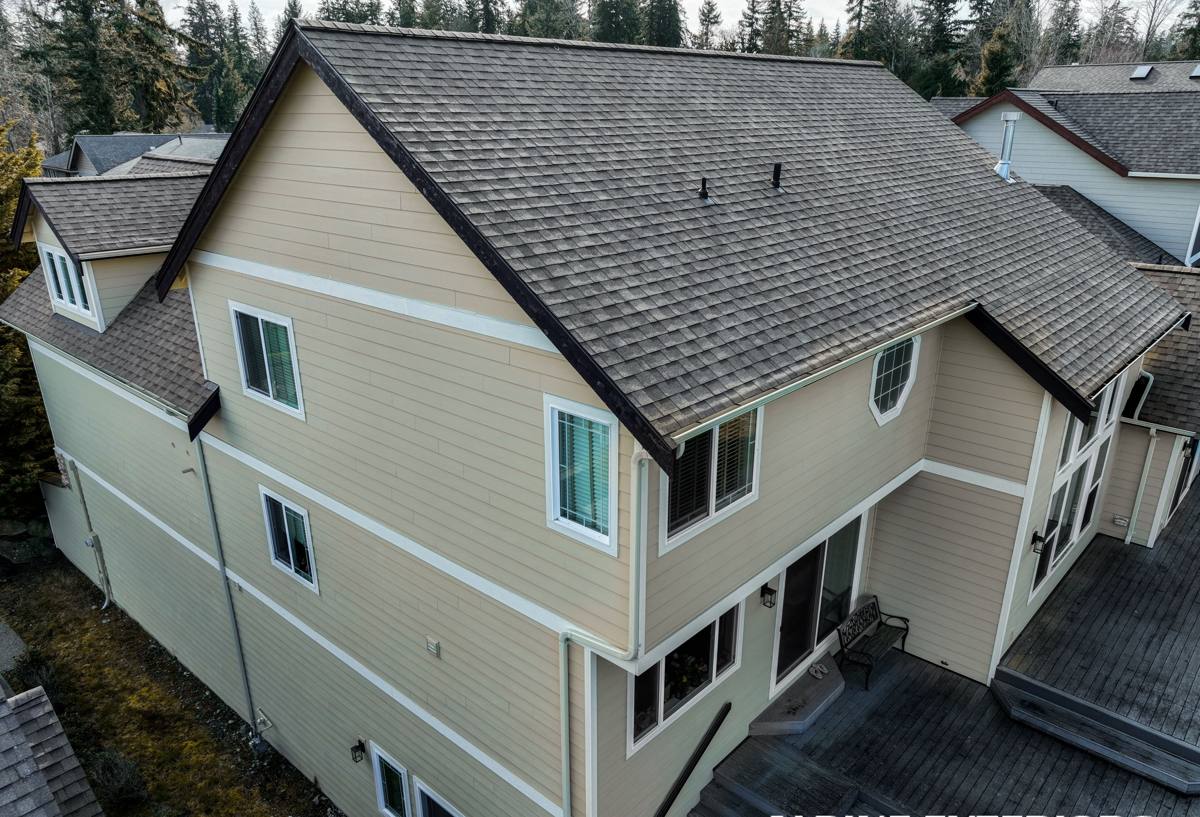
What Salt Air, Rain, and Moss Actually Do to a Deck
It helps to understand the specific failure patterns before talking about how to prevent them.
Salt Air and Corrosion
Airborne salt accelerates corrosion on any exposed metal — screw heads, joist hangers, bolts, railing brackets. Standard zinc-coated fasteners that would last for years inland can start showing rust streaks within a season or two this close to the water. Once a fastener corrodes, it loses holding strength long before it looks obviously bad, which is why deck hardware failures often catch homeowners by surprise.
Driving Rain and Moisture Retention
Wind off the bay pushes rain sideways into places a calmer climate wouldn't — under railings, into end grain, behind ledger boards. Combined with our long wet season, that means wood surfaces stay saturated longer, which is exactly the condition that leads to rot in framing and delamination or swelling in some decking products.
Moss, Algae, and the Long Wet Season
Whatcom County's moss season runs long — often eight months or more of conditions damp enough for moss and algae to establish on shaded or north-facing surfaces. On a deck, that growth isn't just cosmetic. Moss holds moisture against the decking surface, and on wood it accelerates decay; on composite, heavy buildup can make boards genuinely slippery and dangerous underfoot.
Choosing the Right Decking Material for a Bay-Front Lot
There's no single "correct" decking material for Birch Bay — the right call depends on sun exposure, how much shade the site gets, budget, and how much maintenance the homeowner actually wants to do. Here's how the common options hold up against salt air, rain, and moss specifically.
| Material | Salt Air Behavior | Moss/Algae Resistance | Maintenance |
|---|---|---|---|
| Pressure-treated wood | Fine if fasteners are corrosion-rated; wood itself is unaffected by salt | Needs regular cleaning and sealing to resist moss on shaded decks | Highest — annual cleaning, periodic sealing/staining |
| Cedar | Naturally rot-resistant; still needs coated or stainless fasteners | Moderate — grays and can host moss without upkeep | High — sealing every 1-2 years to hold color and resist moisture |
| Composite decking | Excellent — the board material itself doesn't corrode or rot | Can still grow surface algae in shaded, damp spots; cleans off easily | Low — periodic washing, no sealing or staining |
| PVC decking | Excellent — fully synthetic, unaffected by salt | Good — smoother surface sheds moss more easily than wood-grain composite | Low — occasional washing |
On lots that get heavy shade from surrounding trees or sit low relative to the water, we lean harder toward composite or PVC decking for the walking surface, because the maintenance gap between wood and synthetic widens fast in a shaded, damp microclimate. On sunnier, more exposed lots, a well-maintained cedar or treated wood deck can still make sense, especially if the homeowner wants that look and is comfortable with the upkeep.
Framing and Fasteners: Where Most Deck Failures Start
The decking boards are what you see, but the framing and fasteners underneath are what actually determine how long a deck lasts near the water. This is the area where cutting corners causes the most damage down the road, because problems stay hidden until they're serious.
Fastener Grade Matters More Here
Standard exterior screws are rated for general outdoor use, not sustained salt exposure. For Birch Bay work, we use fasteners and structural hardware rated for coastal or marine-grade exposure — typically stainless steel or heavy hot-dip galvanized, depending on the component — because the cost difference over the life of the deck is small compared to the cost of replacing corroded hardware in a finished structure.
| Hardware Type | Standard Grade | Coastal-Appropriate Grade |
|---|---|---|
| Deck screws | Zinc or ceramic-coated | Stainless steel (304 or 316) |
| Joist hangers/brackets | G90 galvanized | Heavy hot-dip galvanized or stainless |
| Bolts and lag screws | Zinc-plated | Hot-dip galvanized or stainless |
| Post bases | Standard galvanized | Heavy-gauge galvanized, properly flashed |
Ledger Attachment and Flashing
Where a deck attaches to the house, proper flashing keeps driving rain from working its way behind the ledger board and into the wall framing — a slow, hidden failure that's expensive to repair once it's found. We flash every ledger connection as standard practice, not as an upsell.
Footings, Drainage, and Grading Around Birch Bay Lots
A lot of deck problems don't start at the deck at all — they start with water that has nowhere to go. Low-lying and near-shore properties around Birch Bay can have higher water tables and slower-draining soil than you'd find further inland, which affects how footings are sized and set.
- Footings are set below frost depth and sized for the soil conditions on the specific lot, not a generic minimum
- Post bases are set above grade and clear of standing water, with gravel or drainage fill where soil drains poorly
- Grading under and around the deck is checked so water sheds away from the house and footings instead of pooling underneath
- Ground-contact areas under low decks get attention too, since poor airflow under a deck is one of the biggest contributors to hidden rot and moss growth
On decks built low to the ground, we also think about airflow underneath — a deck that's essentially sealed off from ventilation traps moisture and speeds up both rot and moss, even with good materials on top.
Railings, Stairs, and Hardware Exposed to the Elements
Railings and stair hardware take some of the harshest exposure on a deck because they're vertical, catch driving rain directly, and often include more metal connection points than the decking field itself. We match railing material and fastener choice to the same coastal standard as the rest of the structure — cable rail hardware, post connectors, and baluster fasteners in particular are worth upgrading, since these are common spots for early rust staining on standard-grade builds.
Our Process for a Birch Bay Deck Project
- On-site assessment — we look at sun exposure, shade patterns, existing drainage, and how close the build is to the water, since all of that shapes material and fastener recommendations
- Design and material selection — we walk through the tradeoffs honestly, including maintenance expectations, so the homeowner picks a material they'll actually be happy maintaining (or not maintaining) years from now
- Permitting — most elevated decks require a permit; we handle the paperwork and inspections through the applicable jurisdiction
- Footings and framing — sized to the soil and set with corrosion-rated hardware throughout
- Decking, railing, and stairs — installed with attention to fastening patterns and gapping that account for our wet climate and material expansion
- Final walkthrough — we go over the maintenance routine that fits the material chosen, so the deck ages the way it's supposed to
Maintenance Checklist to Keep a Birch Bay Deck Looking Good
Even a well-built deck needs some seasonal attention in this climate — the goal is a routine that fits the material, not a constant chore list.
- Sweep debris and standing leaves off the deck regularly, especially in fall and winter when moss growth accelerates
- Rinse or scrub shaded and north-facing areas at the start and end of moss season to keep growth from establishing
- Check railing posts and stair hardware once a year for early rust staining, which shows up before structural corrosion does
- Reseal or restain wood decking on the schedule appropriate to the product — don't wait until it looks obviously weathered
- Keep gutters and downspouts near the deck clear so roof runoff isn't adding extra water onto or under the structure
- Confirm airflow under low decks hasn't been blocked by landscaping, storage, or added skirting
Why Local Experience in Birch Bay Matters
A lot of deck-building fundamentals are the same anywhere. What changes in Birch Bay is the exposure profile — the combination of salt air, wind-driven rain, and a long moss season that hits certain lots harder than others depending on how close they sit to the water and how much shade surrounds them. A crew that's worked this stretch of Whatcom County knows which fastener grade actually holds up here, which shaded lots need a synthetic decking recommendation instead of wood, and where drainage and airflow tend to get overlooked on near-shore properties.
That local knowledge doesn't replace good fundamentals — solid footings, proper flashing, and quality materials matter everywhere. But applying those fundamentals with Birch Bay's specific conditions in mind is what keeps a deck looking and performing well ten and twenty years out, instead of needing early repairs that a coastal-appropriate build would have avoided.
If you're planning a new deck or replacing an aging one in Birch Bay, we're happy to take a look at your property and talk through what makes sense for your specific site. Reach out for a free, no-pressure estimate using the form below.