 Bellingham Window
 Roofing in Happy Valley Has Its Own Set of Problems
Happy Valley sits close enough to Bellingham Bay and the surrounding wooded hillsides that its roofs take a different kind of beating than roofs a few miles inland. Salt-laden air off the water accelerates corrosion on fasteners and flashing. Driving rain, pushed sideways by wind off the water, finds its way into laps and valleys that a calmer climate would never stress. And the tree cover that gives the neighborhood its character also means shade, moisture, and a long moss season that can run from fall through spring. None of this is unique to any one house — it's a function of geography, and it shows up on nearly every asphalt shingle roof in the area sooner or later.
We bring this up first because a roofing job done without accounting for these conditions can look fine at installation and still fail early. Whatcom County's climate isn't harsh in the way hail or extreme heat is harsh — it's harsh in a slow, cumulative way. Moisture that sits, algae that grows, and metal that corrodes are the real enemies here, and a correct asphalt shingle install has to work against all three from day one.
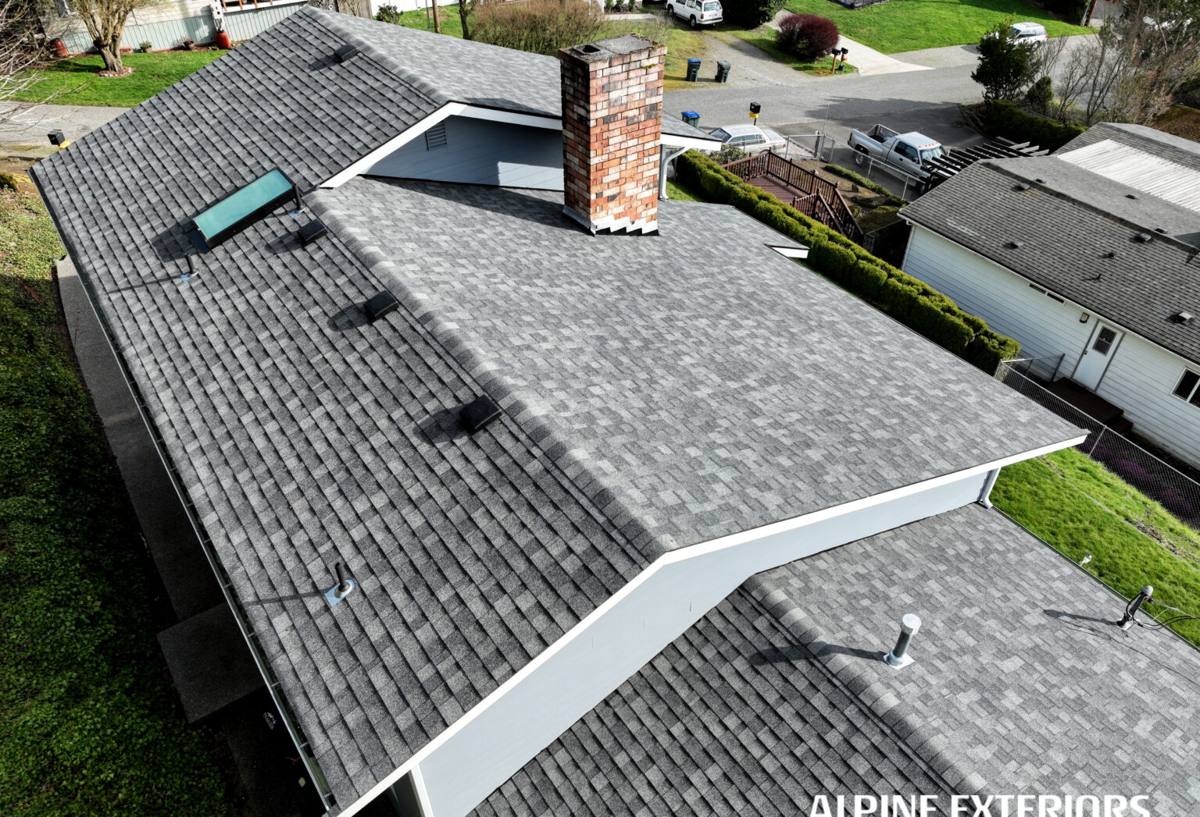
What Happy Valley Homes Actually Need From a Shingle Roof
Algae and Moss Resistance
Shaded roof sections and north-facing slopes in Happy Valley stay damp longer after rain than they would in a drier or sunnier neighborhood. That extended dampness is exactly what moss and algae need to take hold. Algae-resistant shingles — the ones with copper or zinc granules blended in — are worth the modest upfront cost here because they actively discourage growth instead of just resisting it passively. On heavily shaded lots, we'll also talk through zinc strip options at the ridge, which let rainwater carry trace metal down the roof plane and suppress regrowth over time.
Ventilation That Actually Moves Air
A roof deck that can't breathe traps moisture underneath the shingles, which speeds up rot in the sheathing and shortens the life of the shingles themselves from below. Balanced intake at the eaves and exhaust at the ridge is standard practice, but on homes with additions, skylights, or oddly shaped rooflines — common in older Bellingham-area neighborhoods — the ventilation path often got compromised somewhere along the way. Part of a correct re-roof is tracing that path and fixing it, not just replacing the surface.
Corrosion-Resistant Metal Everywhere Water Moves
Because of the salt air off the bay, we don't treat flashing, drip edge, and fasteners as commodity parts. Galvanized steel that would hold up fine twenty miles inland can start showing rust streaks within a few years this close to the water. We spec corrosion-resistant metal and fastener coatings as a baseline for Happy Valley work, not an upsell.
What a Correct Asphalt Shingle Job Includes
A shingle roof is only as good as the layers underneath it. Homeowners rarely see most of what actually determines whether a roof lasts 15 years or 30, so here's what we consider non-negotiable:
- Full tear-off to bare deck — no layering new shingles over old, which traps moisture and hides deck damage
- Deck inspection and replacement of any soft, delaminated, or water-stained sheathing before anything goes back down
- Ice-and-water shield membrane at eaves, valleys, and around penetrations — the areas most exposed to wind-driven rain
- Synthetic underlayment across the full deck as a secondary water barrier
- Properly lapped step flashing at every wall intersection, not caulk-and-hope patch flashing
- New drip edge at eaves and rakes, sized and fastened to shed water past the fascia
- Balanced intake and exhaust ventilation, corrected where the existing setup was inadequate
- Algae-resistant shingles installed to manufacturer nailing specs, not gun-speed guesswork
Skip any one of these and the roof may look identical from the street while quietly failing years ahead of schedule. This is where a lot of corner-cutting happens in roofing, because most of it is invisible once the shingles go down.
Our Process for Happy Valley Roof Replacements
1. On-Site Evaluation
We walk the roof, not just the yard. That means checking the deck from the attic side where possible, looking at flashing condition at every wall and penetration, and noting which slopes get the most shade and moss buildup. We also look at gutter and downspout condition, since a roof can be done right and still take on water damage if runoff has nowhere to go.
2. A Written Scope, Not a Guess
You get a clear breakdown of what's being replaced, what materials are specified and why, and what the ventilation and flashing plan looks like — before any tear-off starts. If your roof has particular trouble spots (a chronically mossy north slope, a valley that's leaked before), we address them by name in the plan.
3. Tear-Off and Deck Repair
Old materials come off down to the deck. Any damaged sheathing gets replaced and documented — we'll show you what we found and why it needed to go, rather than just billing for it after the fact.
4. Underlayment, Flashing, and Shingle Installation
Membrane and underlayment go down first, then flashing at every vulnerable point, then shingles installed to spec — proper nail placement, proper exposure, proper sealing along the courses that matter most for wind resistance.
5. Final Walkthrough
We walk the finished roof with you, cover care and maintenance specific to your property's shade and exposure, and make sure you know what a normal moss-prevention routine looks like going forward.
Shingle Options: What Actually Matters for This Climate
| Factor | Standard 3-Tab | Architectural / Laminate |
|---|---|---|
| Wind resistance | Lower — more prone to lifting in driving coastal wind | Higher — heavier profile holds down better |
| Algae resistance available | Limited options | Widely available with copper/zinc granules |
| Typical lifespan in this climate | Shorter, especially on shaded slopes | Longer, better suited to persistent moisture |
| Upfront cost | Lower | Moderate premium |
| Appearance | Flat, uniform | Dimensional, shadow-line look |
We don't push architectural shingles because they're more profitable — we spec them as our standard for Happy Valley because the wind and moisture profile here genuinely favors the heavier, better-sealed product. On a detached garage or outbuilding with less wind exposure, 3-tab can still make sense as a budget option.
Cost Factors Homeowners Should Understand
Every roofing quote should account for more than just square footage. The variables that actually move the price:
| Factor | Why it matters here |
|---|---|
| Roof pitch and access | Steeper slopes and limited access around mature trees slow the work and affect safety setup |
| Number of valleys and penetrations | Each one needs individual flashing work — more of them means more labor, not just more material |
| Deck condition | Hidden rot from years of moss and moisture isn't known until tear-off; a realistic quote flags this as a possible add |
| Ventilation corrections needed | Older homes often need intake or exhaust upgrades that add scope beyond a simple reshingle |
| Shingle tier chosen | Algae-resistant, higher wind-rated shingles cost more per square but reduce moss-related maintenance and premature failure |
Signs a Happy Valley Roof Needs Attention
- Dark streaking or green-black patches, especially on shaded or north-facing slopes
- Granules collecting in gutters or at the base of downspouts
- Shingles that look curled, cupped, or lifted at the edges
- Soft spots or sagging felt underfoot in the attic near the roof deck
- Daylight visible through the roof deck from inside the attic
- Water stains on interior ceilings, especially after wind-driven rain
- Rust streaking around flashing, vents, or metal roof edges
Moss on its own isn't an emergency, but it's a signal — if it's established enough to see from the ground, it's likely been holding moisture against the shingles for a while. Catching that early is a lot cheaper than dealing with the deck damage that follows if it's ignored for a few more seasons.
Why Local Experience in Happy Valley Matters
Roofing looks like a generic trade until you actually work the same neighborhoods year after year. We know which slopes in this part of Bellingham hold moss longest, which older homes commonly have inadequate ventilation baked in from a prior renovation, and how much wind-driven rain actually reaches a wall-to-roof intersection during a real Whatcom County storm — not a textbook one. That's the kind of judgment that doesn't show up in a spec sheet but shows up in how long a roof actually lasts.
We're not asking homeowners to take that on faith. It shows up in the details of our process: the ventilation corrections we flag that other estimates miss, the corrosion-resistant metal we specify as standard rather than an add-on, and the shingle tier we recommend based on your specific slope and shade conditions rather than a one-size answer.
Maintenance That Extends Roof Life Here
A well-installed asphalt shingle roof in Happy Valley still benefits from basic upkeep given the local conditions:
- Keep gutters clear so water isn't backing up under the eave edge during heavy rain
- Trim back overhanging branches to reduce shade and debris buildup on the roof surface
- Have moss and algae growth treated gently (not pressure-washed, which damages granules) before it spreads
- Schedule a visual inspection every couple of years, especially after a hard winter storm season
- Address small flashing or sealant issues promptly — they're inexpensive to fix early and expensive once water gets behind them
If you're dealing with moss buildup, an aging roof, or you just want an honest read on what condition your roof is really in, we're glad to come out and take a look. The estimate is free, there's no pressure, and you'll get a clear, specific answer about what your roof actually needs — use the form below to get started.