 Bellingham Window
 Why Birchwood's Climate Is Hard on Siding
Birchwood sits within Bellingham's stretch of the Pacific Northwest marine climate, which means siding here works overtime compared to siding in drier parts of the country. Whatcom County gets long stretches of driving, wind-blown rain from fall through spring, and that rain doesn't just fall straight down — it hits walls at an angle, drives under poorly flashed trim, and sits in shaded corners for days at a time. Add in tree-lined streets and mature landscaping common to established Birchwood lots, and you get siding that stays damp longer than it would on an open, sun-exposed lot.
Then there's moss. Whatcom County's moss season isn't a few weeks — it's most of the year. Anywhere siding stays shaded and damp, moss and algae get a foothold, and once established they hold moisture directly against the wall surface. Bellingham's proximity to Bellingham Bay and the greater Puget Sound also puts a mild but real salt-air component into the mix, which is harder on fasteners, trim caps, and lower-grade finishes than most homeowners expect from a "green" city that isn't right on the open coast.
None of this is unusual or alarming — it's just what siding has to be engineered and installed for in this part of Washington. The problem isn't the climate. It's siding products and installations that weren't built with this climate in mind.
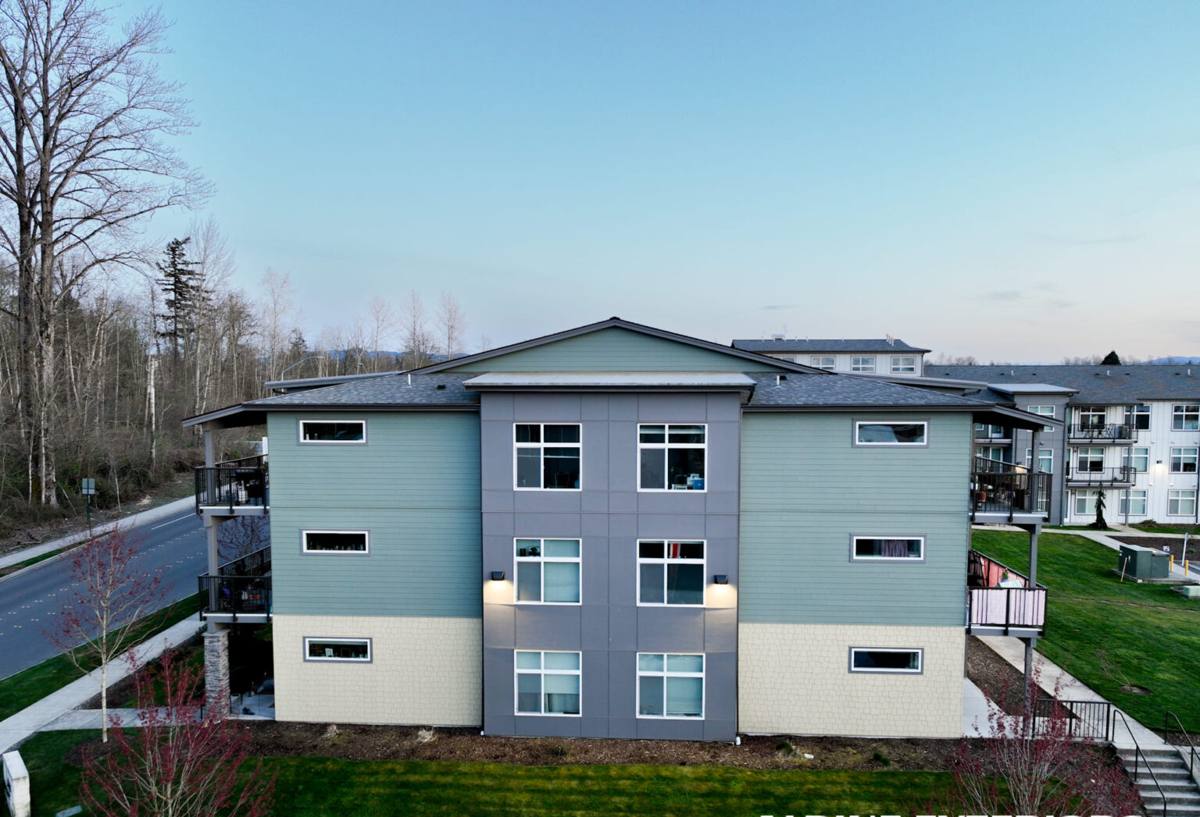
What James Hardie Fiber Cement Is Built to Handle
James Hardie fiber cement siding is made from cement, sand, and cellulose fiber, engineered specifically to resist the things that wear out other siding materials in wet climates. It doesn't absorb water the way wood or wood-composite products do, it won't rot, and it isn't a food source for pests or fungus the way untreated wood trim can be. That matters directly in a place like Birchwood, where siding spends a large share of the year damp.
It's also dimensionally stable — it doesn't swell, warp, or cup with repeated wet-dry cycles the way wood and some engineered wood products can. Over a Bellingham winter, a wall goes through dozens of moisture cycles. Products that move with every cycle eventually open up gaps at seams and fastener points; fiber cement holds its shape and keeps those joints tight for the long haul.
Fire Resistance as a Bonus, Not the Selling Point
James Hardie siding is also non-combustible, which is a genuine benefit for homeowners, though it isn't the main reason it performs well in Birchwood. We mention it because it's a real, verifiable property of the material — not a marketing add-on.
Choosing the Right Hardie Product Line for This Climate
James Hardie engineers its siding by climate zone, and Whatcom County falls into the HZ5 zone — the product engineering designed for regions with real seasonal rainfall, humidity, and freeze-thaw cycling, as opposed to the HZ10 formulation built for extreme year-round tropical moisture. HZ5 products are formulated and tested for exactly the kind of wet, temperate conditions Birchwood sees most of the year.
Within HZ5, Hardie offers several product lines and profiles — lap siding, panel siding, and shingle-style siding — each suited to different home styles. What line makes sense for a given Birchwood home usually comes down to the home's age, its existing trim details, and what look the homeowner wants, not just the climate. We walk through those options during the estimate rather than defaulting to one product for every house.
What a Correct Installation Involves
Fiber cement siding is only as good as its installation. A correctly installed Hardie system and a poorly installed one can look nearly identical on day one and perform very differently five years later, especially in a climate that tests every seam and fastener the way Bellingham's does.
A Drainage Gap Behind the Siding
Modern fiber cement installation calls for a rain screen or drainage gap between the siding and the water-resistive barrier, so any moisture that gets past the siding face can drain and dry out instead of sitting against the sheathing. In a climate with Bellingham's rainfall totals, skipping this step is one of the most common causes of hidden moisture problems behind siding that looks fine from the street.
Flashing and Fastening Done to Spec
Every window, door, and horizontal trim transition needs proper flashing so water is directed out and away from the wall assembly, not down behind it. Fasteners need to be the correct type, spaced and set to Hardie's published specifications — over-driven or under-driven nails are a common source of premature siding failure, and it's a detail that's easy to rush and hard to spot after the fact.
Caulking Where It Belongs, and Nowhere Else
Caulk has a specific, limited job in a fiber cement installation — sealing designed joints, not compensating for gaps that shouldn't be there in the first place. Over-reliance on caulk is often a sign of an installation that's cutting corners on flashing and fitting.
ColorPlus Factory Finish vs. Field-Applied Paint
One of the most practical decisions on a Birchwood project is finish: James Hardie's factory-applied ColorPlus finish, or field-painted siding after installation. Both are legitimate options, but they perform differently in a climate this wet.
| Factor | ColorPlus Factory Finish | Field-Applied Paint |
|---|---|---|
| Application process | Baked on in a controlled factory setting, multiple coats | Applied on-site, dependent on weather window |
| Typical finish warranty | Longer, product-specific coverage | Typically the paint manufacturer's standard warranty |
| Touch-up needs in a wet climate | Lower, color holds evenly over time | More frequent, especially on sun/rain-exposed elevations |
| Moss and mildew resistance | Consistent factory coating across the board | Depends on paint quality and prep |
| Color matching for future repairs | Easy to match from the same product line | Can drift over time with different paint batches |
We install ColorPlus on the large majority of Birchwood projects for exactly these reasons — it's one less maintenance item in a climate that already asks a lot of exterior surfaces.
Our Process for a Birchwood Hardie Installation
We start with an on-site walk of the home, not just a materials estimate. That means looking at sun and shade exposure on each elevation, tree cover that keeps certain walls damp longer, drainage around the foundation, and the condition of the existing siding and trim. Moss buildup or soft trim on the north or shaded side of a house tells us something useful before we ever price the job.
During installation, we remove the old siding down to the sheathing, inspect for hidden moisture damage, correct anything we find before covering it back up, and install the water-resistive barrier and drainage gap before the Hardie siding goes on. Every home gets flashed and fastened to manufacturer specification, not shortcuts based on what's fastest. At the end, we walk the finished job with the homeowner and register the manufacturer warranty properly.
Why a Crew That Already Works Birchwood Matters
Birchwood has a mix of home ages and styles, and a lot of established landscaping that shapes how sun, shade, and moisture move across each property. A crew that's worked the neighborhood before already has a feel for which elevations tend to hold moss, how existing trim details on older homes need to be handled, and what the City of Bellingham's permitting process requires for exterior work — none of which is something you want a crew learning for the first time on your home.
Local experience also means faster, more accurate estimates. We're not guessing at how Whatcom County's rain and humidity will treat a given installation choice — we're applying what we've already seen hold up, and what hasn't, on homes like yours.
Living With Hardie Siding in a Moss-Prone Climate
Correctly installed Hardie siding is low-maintenance, not zero-maintenance. A little seasonal attention goes a long way in Whatcom County's climate.
- Rinse siding gently once or twice a year, focusing on shaded, north-facing, and tree-covered walls where moss and algae take hold first
- Keep gutters clear so overflow doesn't run down the siding face repeatedly during heavy rain events
- Trim back shrubs and branches that keep siding damp or in constant shade
- Check caulked joints around windows and trim annually and have any cracked or missing caulk redone promptly
- Watch for soft or discolored trim boards, which usually signal a moisture issue worth investigating before it spreads
- Avoid pressure washing directly at seams and edges, which can force water behind properly installed siding
What Drives Cost on a Birchwood Project
Every home is different, but the same handful of factors drive most of the cost variation we see on Hardie installations in this neighborhood.
| Factor | Why It Matters |
|---|---|
| Home size and wall complexity | More corners, gables, and trim details mean more labor and cut waste |
| Existing siding removal | Tear-off and disposal of old material adds time, especially with multiple layers |
| Hidden moisture or sheathing damage | Repairs found once old siding comes off are priced as they're discovered |
| Product line and profile | Lap, panel, and shingle-style profiles carry different material and labor costs |
| Finish choice | ColorPlus factory finish versus field-painted siding affects both cost and long-term upkeep |
| Site access | Mature trees, tight lot lines, or difficult grading can add setup and staging time |
We give homeowners a real number after seeing the home, not a rough phone estimate — moisture damage in particular is impossible to price accurately until the old siding is off.
If you're weighing siding options for a Birchwood home, we're happy to take a look and walk you through what a correct James Hardie installation would involve for your specific house — no pressure, no obligation. Use the form below to request a free estimate.