 Bellingham Window
 James Hardie Siding, Installed for Blaine's Conditions
Blaine sits at the northern edge of Whatcom County, right on the water and close enough to the Canadian border that its weather runs a little harder than towns further inland. Salt air off Semiahmoo Bay and Drayton Harbor, driving rain that comes in sideways during winter storms, and a moss season that can stretch most of the year on shaded walls — these aren't occasional conditions here, they're the baseline. Siding on a Blaine home has to hold up to all three at once, year after year, which is why we install one product system rather than offering a menu of options at different price points.
This page is specifically about James Hardie fiber cement siding as a service for Blaine homes — what the product line actually includes, what a correct installation looks like in this climate, and how our process works from first estimate to finished job. We install James Hardie exclusively. That's a professional standard built on what holds up in coastal Whatcom County, not a sales position.
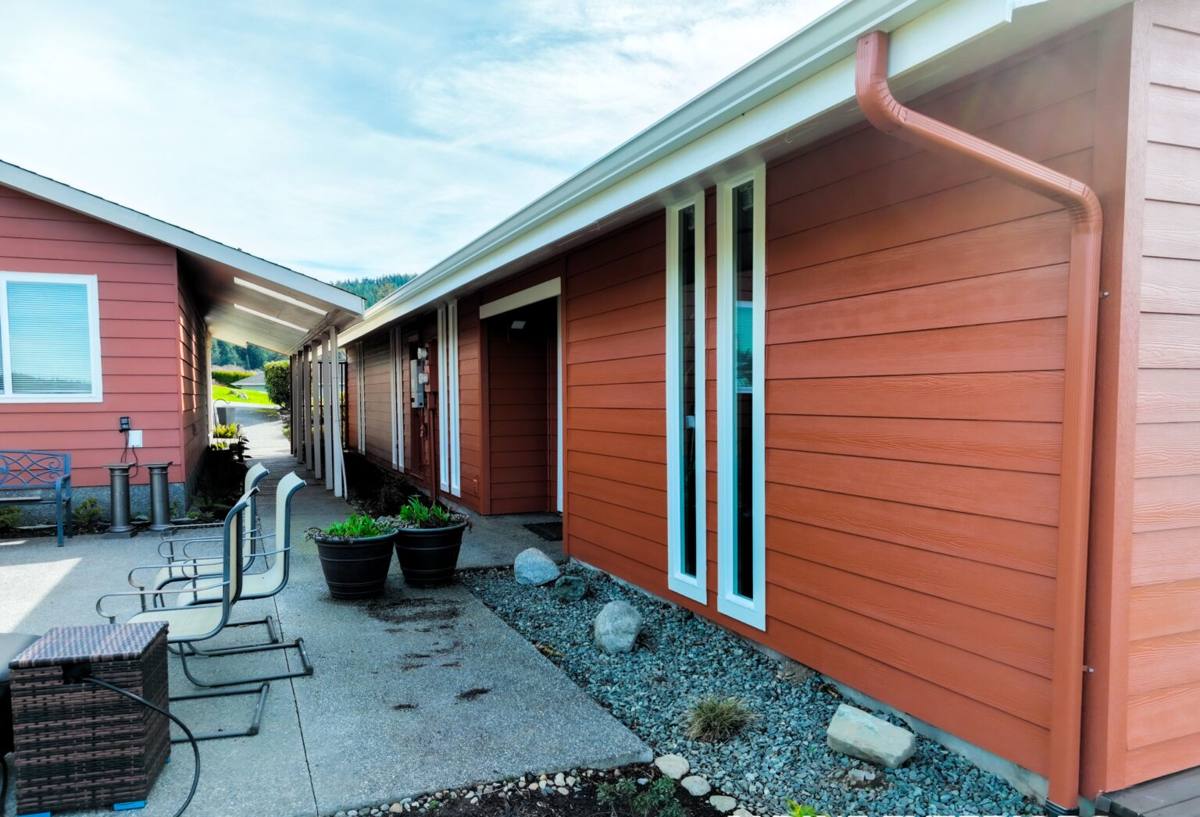
Why the Climate Here Shapes the Product Choice
Salt-laden air corrodes fasteners and exposed metal trim faster than it would in a dry inland climate, and it breaks down lower-grade paint and coatings well before their expected lifespan. Wind-driven rain off the water doesn't just fall on a wall, it gets pushed into seams, laps, and flashing joints, which means the assembly behind the siding has to be sealed and lapped correctly or moisture finds its way in regardless of what's on the surface. And a moss and mildew season that runs through most of the year, especially on north-facing or tree-shaded walls, punishes any material with surface porosity that lets growth take hold. Fiber cement doesn't solve all of this by itself — installation quality matters as much as the material — but it starts from a material that doesn't rot, doesn't feed a fire, and doesn't swell or delaminate the way some alternatives do under sustained moisture exposure.
The James Hardie Product System
James Hardie isn't a single product, it's a system of siding, trim, and soffit pieces engineered to work together. For a Blaine home, the right combination usually comes down to the look the homeowner wants and how exposed a given wall is to weather.
HardiePlank Lap Siding
The most common choice for full re-sides, available in a range of exposures and textures (smooth or cedar-grain). It gives a traditional horizontal lap look and is the baseline product most Hardie installs in this region are built around.
HardieShingle
Styled to look like traditional cedar shingle siding, often used as an accent on gables, dormers, or entryways rather than a full elevation. It's a common way to add texture to a home without moving to a full wood-look product that carries wood's maintenance burden.
HardiePanel (Board and Batten)
A vertical panel system that reads as modern board-and-batten. It shows up more on newer builds and additions in this area, and pairs well with horizontal HardiePlank on the same home for a two-texture look.
HardieTrim
Corner boards, frieze boards, and window/door casing that match the siding material, so trim doesn't become the weak point of an otherwise solid install. Mixing fiber cement siding with wood or composite trim is a common shortcut that reintroduces the exact moisture and rot risk the siding was chosen to avoid.
ColorPlus Technology
Hardie's factory-applied finish is baked on in a controlled environment rather than brushed on in the field. In a town with this much salt air and rain exposure, that matters: factory finishes hold their color and resist fading, chalking, and moisture intrusion at the paint layer far longer than field-applied paint typically does.
Product Line Comparison
| Product | Typical Use | Why It Fits Blaine |
|---|---|---|
| HardiePlank | Full-elevation lap siding | Proven system for wind-driven rain and salt exposure at scale |
| HardieShingle | Accent areas, gables, dormers | Cedar look without the moisture upkeep of real cedar shingle |
| HardiePanel | Vertical board-and-batten sections | Modern look, works as an accent alongside lap siding |
| HardieTrim | Corners, casing, fascia | Matches siding material so trim doesn't become the failure point |
HZ5 Engineering: Built for This Kind of Climate
James Hardie manufactures its siding in different formulations for different climate zones, and the HZ5 line is engineered for regions with sustained moisture and freeze-thaw cycling — a description that fits coastal Whatcom County well. It's a detail a lot of homeowners never hear about because it's decided at the ordering stage, not something visible once the siding is up. Using the correct HZ formulation for the region is part of what separates a spec-correct Hardie install from one that just happens to use Hardie material.
What Correct Installation Involves
Hardie siding is only as good as the installation behind it, and in a coastal town like Blaine, the details that get skipped are usually the ones that show up as problems two or three winters later. A correct install includes:
- A water-resistive barrier installed and lapped correctly behind the siding, not just stapled up as an afterthought
- Proper clearance between the bottom of the siding and grade, decks, patios, and roof lines so water has somewhere to go
- Corrosion-resistant fasteners driven to Hardie's spec — the wrong fastener in a salt-air environment is a slow, hidden failure point
- Caulked and sealed joints at trim, windows, and butt joints, using sealants rated for the exposure
- Correct nailing pattern and blind- or face-nailing per Hardie's published fastening schedule for the product and exposure
- Flashing integrated at every horizontal transition — window heads, roof-to-wall intersections, and any point where water naturally collects
- Field-cut edges primed or sealed before installation, since a factory finish only protects a factory edge
None of these are exotic requirements. They're standard Hardie installation practice, but in a lower-exposure inland climate a missed detail might not show consequences for a decade. In Blaine, driving rain and salt air shorten that timeline considerably.
Our Process for a Blaine Siding Project
- Walkthrough and assessment: we look at the current siding, any moisture damage or rot at trim and transitions, and the condition of the wall assembly underneath before quoting anything.
- Product and profile selection: we go over lap exposure, texture, trim style, and ColorPlus color options based on the home's style and the homeowner's preference.
- Written estimate: scope, product lines, and a realistic cost range, with no pressure to sign on the spot.
- Prep and tear-off: removing old siding, checking sheathing condition, and repairing or replacing any water-damaged framing before new material goes up.
- Water-resistive barrier and flashing: the part of the job that's invisible once it's done, and the part that determines whether the siding performs for the next 30-plus years.
- Installation to Hardie spec: siding, trim, and any accent panels installed with the fastening, clearance, and sealing details above.
- Final walkthrough: we go over the finished work with the homeowner before calling the job complete.
Cost Factors on a James Hardie Project
Every home is different, and we don't give ballpark numbers without seeing the job, but the factors that move a Hardie estimate up or down are consistent:
| Factor | Effect on Cost |
|---|---|
| Extent of tear-off and any rotted sheathing found underneath | Hidden damage repair adds cost that's hard to quote sight-unseen |
| House size and number of stories | More surface area and access complexity (staging, lifts) raises labor |
| Product mix (straight lap vs. lap plus shingle/panel accents) | Mixed profiles add material and cutting time |
| Trim detail and window/door count | More openings mean more flashing and trim work per square foot |
| Color | Standard ColorPlus colors vs. custom finishes affect material cost |
Maintenance and Longevity
Fiber cement siding is not maintenance-free, but the ongoing care is modest compared to wood-based products. A periodic rinse to keep salt residue and organic growth from building up, prompt caulk touch-ups at joints if they show wear, and keeping gutters and downspouts clear so water isn't dumping directly onto a wall section are the main items. Hardie backs the product with a strong transferable warranty when it's installed to spec, which is one more reason installation quality isn't optional — a warranty claim on a poorly installed job is a much harder conversation than one on a correctly installed one.
Why a Crew That Already Works Blaine Matters
Siding contractors who mostly work inland don't always have a feel for how much harder salt air and driving rain are on a wall assembly here, and it shows in details like fastener choice, clearance at grade, and how flashing gets handled at transitions. Working in Blaine and the surrounding coastal parts of Whatcom County regularly means those details aren't guesswork — they're standard practice because we've seen what happens when they're skipped. That local familiarity also means we're not learning the town's permitting and inspection process on your job.
If you're weighing a siding replacement or repair in Blaine, we're glad to take a look and give you a straightforward, no-pressure estimate — just fill out the form below.