 Bellingham Window
 Board & Batten Siding, Built for What Cordata Weather Actually Does
Board and batten has become one of the most requested looks in Cordata over the last few years — the clean vertical lines read as modern on newer builds and as classic farmhouse on older lots, and it works on everything from a full exterior to a single gable or porch accent. But the look is only half the job. In north Bellingham, board and batten siding has to survive salt-tinged marine air, long stretches of driving rain off the Sound, and a moss season that can run for most of the year in shaded, north-facing wall sections. A siding style that photographs well but traps moisture behind the battens will show problems within a few winters, not a few decades.
This page is about that one job, done right, in this one neighborhood: what Cordata's climate demands from a board and batten installation, what the correct build-up actually looks like, and why we only install it in James Hardie fiber cement rather than the wood, vinyl, or engineered-wood versions of the same look.
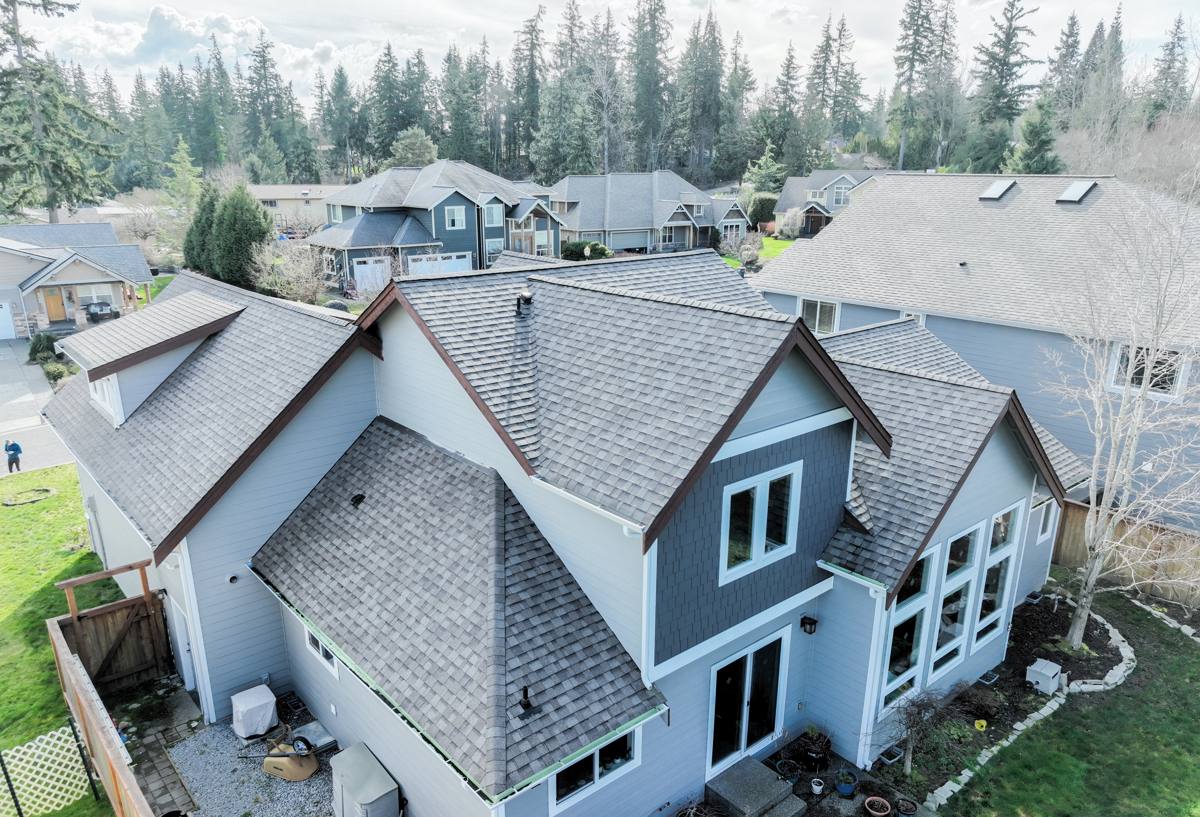
What Whatcom County Climate Does to Vertical Siding Over Time
Driving rain and wind-driven moisture
Bellingham's rain rarely falls straight down. Storms off the Strait of Georgia push water sideways into wall assemblies, and board and batten's vertical joints — the seams between boards and the battens that cover them — are exactly where wind-driven rain likes to find a way in. If those joints aren't flashed and sealed correctly, water tracks down behind the battens and sits against the wall sheathing, invisible until it shows up as a soft spot, a stain, or a musty smell inside.
Salt air and fastener corrosion
Cordata sits close enough to Bellingham Bay and the Salish Sea that salt-laden air is a real factor, not a coastal-town cliché. Salt air accelerates corrosion on exposed metal — fasteners, flashing, trim edges — faster than it would inland. A batten pattern relies on a lot of exposed fastener heads by design, so the fastener spec and finish matter more here than they would on, say, a house east of the Cascades.
A long, shaded moss season
Whatcom County's mild, wet winters and short daylight hours mean moss and algae growth can persist on north- and west-facing walls for most of the year, especially anywhere shaded by mature trees or a neighboring structure. Board and batten's raised battens create small ledges and shadow lines that hold moisture and organic debris longer than a flat wall would, so the material underneath needs to be genuinely rot-proof — not just painted to look that way.
Why We Only Install Board & Batten in James Hardie Fiber Cement
Board and batten is available in cedar, primed spruce, engineered wood (LP SmartSide and similar), vinyl panel systems, and James Hardie fiber cement. We install James Hardie exclusively, and in a climate like Cordata's, the reasoning is straightforward: fiber cement doesn't feed mold, doesn't swell and split at the batten seams the way wood does, and doesn't rely on a factory coating alone to keep moisture out of the substrate. Hardie's panel is cement, sand, and cellulose fiber — non-combustible, dimensionally stable when wet, and engineered specifically for the Pacific Northwest through Hardie's HZ10 climate-specific formulation, which is built around exactly the freeze-thaw and moisture cycling this region sees.
Hardie's ColorPlus factory finish is baked on under controlled conditions rather than field-applied, which matters most on a board and batten job because of how many cut edges and fastener points a batten pattern has compared to a flat lap installation. Every one of those points is a place where a job-site paint job would eventually chip and expose raw material to Cordata's rain and salt air. A factory finish with touch-up product matched to it holds up to that exposure far longer.
What a Correct Board & Batten Installation Actually Involves
Water-resistive barrier and flashing first
Before a single board goes up, the wall needs a continuous water-resistive barrier with properly lapped and taped seams, plus flashing at every horizontal transition — window and door heads, roof-to-wall intersections, and the base of the wall. On a board and batten job this step is not optional detail work; it's the layer that actually keeps wind-driven rain out if anything gets past the exterior boards.
Panel spacing, fastening, and the rain-screen gap
James Hardie's vertical panel system is installed with a drainage gap behind it — typically furring strips — so any moisture that does get behind the siding has somewhere to go and can dry out instead of sitting against the sheathing. Fasteners are placed and spaced to Hardie's published pattern, sized and coated to resist the corrosion that salt air accelerates, and never overdriven, which is one of the most common mistakes on rushed board and batten jobs.
Batten placement and seam sealing
The battens themselves cover the vertical joints between boards, and their job is purely to shed water away from that seam, not to be the only thing standing between the joint and the weather. Correct batten installation means consistent reveal spacing, tight fastening into structural framing where possible, and sealant only where Hardie's install guide calls for it — not as a substitute for proper flashing underneath.
Board & Batten Material Comparison for Cordata Homes
| Factor | James Hardie Fiber Cement | Cedar / Primed Spruce | Engineered Wood / Vinyl |
|---|---|---|---|
| Moisture & rot resistance | Will not rot; stable when wet | Vulnerable at cut edges and seams over time | Engineered wood can swell at exposed edges if coating fails |
| Salt air & fastener corrosion | Coated fastener specs designed for coastal exposure | Depends entirely on fastener choice and upkeep | Vinyl panels can warp with heat; hardware corrodes similarly |
| Moss & algae exposure | Non-organic substrate, easier long-term cleaning | Organic material feeds moss and mildew if damp | Surface film can trap moisture against the panel |
| Finish durability | Factory-baked ColorPlus finish, matched touch-up | Field-painted, needs repainting on a real schedule | Factory color, but limited touch-up and can fade or chalk |
| Fire resistance | Non-combustible | Combustible | Combustible |
This isn't a knock on wood or engineered wood as products — cedar in particular has a long track record when it's maintained on schedule. It's a statement of what we've chosen to stand behind on the wall assemblies we build in this climate, and why.
Our Process for a Cordata Board & Batten Project
- On-site assessment — we look at wall exposure, existing moisture damage, roofline transitions, and how much shade and moss pressure each elevation actually gets before recommending a scope.
- Tear-off and sheathing check — old siding comes off and we inspect the sheathing underneath for hidden rot before anything new goes up; this is where problems from a prior installation usually surface.
- Water-resistive barrier and flashing — installed and inspected before the first board goes on, with particular attention to window heads and roof intersections.
- Furring and drainage gap — set to create the rain-screen cavity behind the panels.
- Panel and batten installation — Hardie vertical panels fastened to spec, battens set with consistent spacing and proper fastening into framing.
- Trim, caulking, and final inspection — sealant only where called for, all fastener heads checked, and a final walk-through before we call the job done.
Why Hiring a Crew That Already Works Cordata Matters
A lot of siding problems in this area trace back to a crew that installed a product correctly for a drier climate but not for this one — the install guide doesn't change, but the consequences of skipping a step do. A crew that already works Cordata regularly knows which elevations in this neighborhood take the worst of the wind-driven rain, how much moss pressure to expect on a shaded north wall, and how salt air factors into fastener selection. That local pattern recognition doesn't show up in a manufacturer's install manual — it comes from doing this specific work, in this specific place, repeatedly.
It also matters for permitting and inspection familiarity within Whatcom County, and for being reachable afterward if a question comes up — not a name that shows up once for a job and is gone.
Keeping Board & Batten Siding in Good Shape in This Climate
- Rinse siding once or twice a year, focusing on shaded, north-facing sections where moss and algae build up fastest.
- Trim back tree branches and shrubs that keep a wall section damp and shaded longer than the rest of the house.
- Check caulking at trim edges and penetrations annually — sealant is a maintenance item, not a lifetime one.
- Look at fastener heads and trim corners each fall for early corrosion staining, especially on walls facing the water.
- Keep gutters and downspouts clear so runoff isn't sheeting down wall sections it wasn't designed to handle.
If you're weighing board and batten for a Cordata home, we're glad to come take a look, walk the specific elevations you're thinking about, and give you a straight read on scope and cost — no pressure, no sales script. Use the form below to request a free estimate.