 Bellingham Window
 Why Edgemoor's Waterfront Setting Is Hard on Siding
Edgemoor sits close to Bellingham Bay, and that proximity to the water shapes everything about how siding ages here. Salt-laden air moves in off the bay and settles onto exterior walls, especially on the water-facing sides of a home. Combine that with Whatcom County's long, wet fall-through-spring stretch of driving rain, and you get siding that's under near-constant moisture load for much of the year. Add the mature tree canopy that gives many Edgemoor properties their shade and privacy, and you've also got reduced sun exposure and airflow — exactly the conditions moss and algae need to take hold on a roofline or a wall.
None of that is unusual for Bellingham. But Edgemoor gets a concentrated version of it: more salt exposure than inland neighborhoods, more shade than open subdivisions, and often older homes with siding that was never engineered for this specific mix of conditions. A product that performs fine in a drier part of the state, or even a few miles inland, can struggle here.
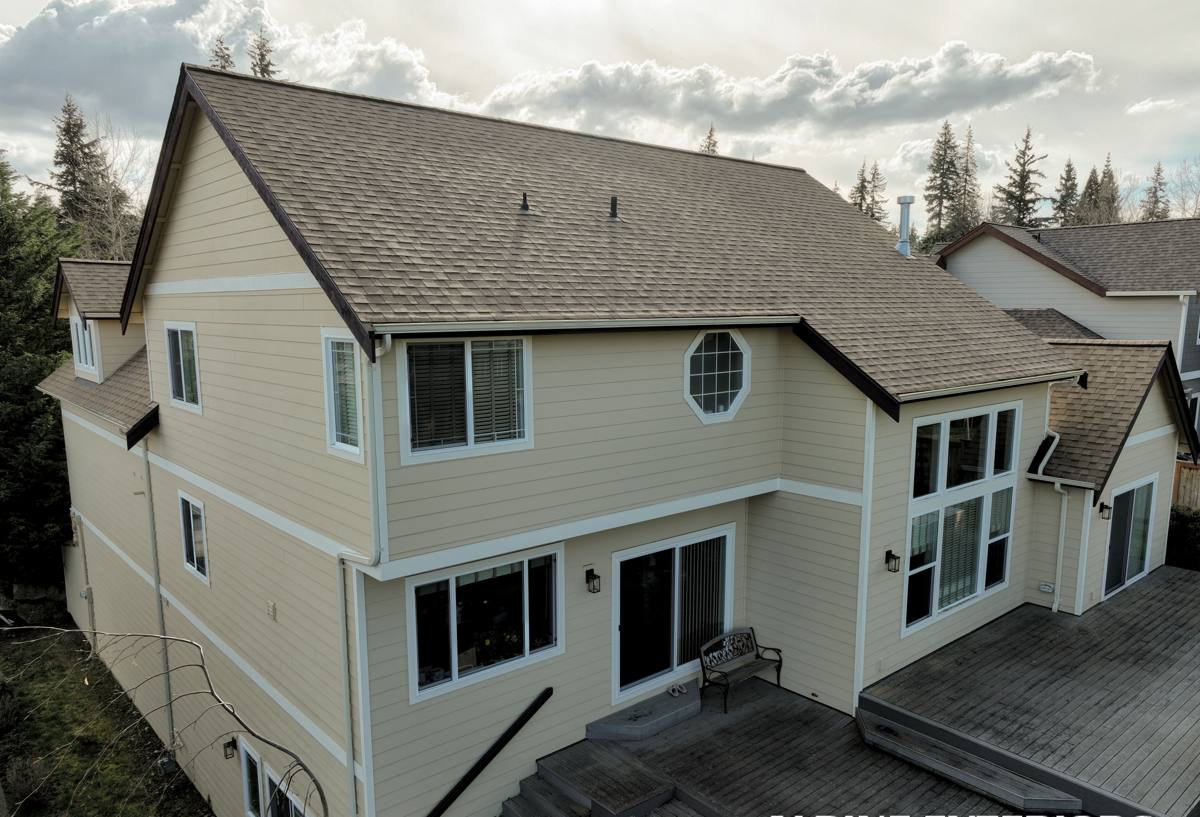
What Happens When Siding Isn't Built for This Environment
The failures we see most often in this neighborhood aren't dramatic — they're slow. Paint starts chalking and peeling years before it should because the substrate underneath is absorbing moisture. Trim boards swell and separate at the joints. Moss establishes on north-facing walls and shaded eaves, holding moisture against the surface long after a storm has passed. On lower-quality or improperly installed siding, that moisture eventually finds its way behind the cladding, and by the time it shows up as a soft spot or a stain on the interior wall, the sheathing underneath may already be compromised.
Salt air adds a second layer to this: it accelerates corrosion on fasteners, flashing, and hardware that isn't rated for coastal-adjacent exposure. A siding system is only as good as its weakest component, and in Edgemoor that's often the metal, not the cladding itself.
Why We Install James Hardie — and Nothing Else
We made a decision as a company to install only James Hardie fiber cement siding, and Edgemoor is a good example of why. Hardie's fiber cement doesn't absorb water the way wood-based products do, it won't support rot, and it's non-combustible — a real advantage on tree-shaded lots where wildfire risk gets discussed more each year in Western Washington. It also holds paint and factory finish far longer than primed wood or engineered wood siding in a wet, shaded climate, which matters directly to how often a homeowner has to think about repainting.
We don't install vinyl, LP SmartSide, Cemplank, Allura, primed spruce, or cedar. Each of those has a legitimate place in the market, but each also comes with a trade-off — moisture sensitivity, appearance changes over time, maintenance burden, or a shorter track record in a marine climate — that we're not willing to build a coastal Bellingham install around. Hardie's climate-engineered lines are specifically formulated for regions like ours, which is a big part of why we standardized on it.
The HZ5 Climate-Engineered Line
James Hardie makes region-specific formulations under its HZ5 designation, engineered for wetter, more variable climates like the Pacific Northwest. The moisture and freeze-thaw performance built into the HZ5 formula is a better match for Edgemoor's combination of rain, humidity, and salt air than a general-purpose fiber cement product would be.
ColorPlus Factory Finish vs. Field-Painted Alternatives
Hardie's ColorPlus finish is baked on at the factory under controlled conditions, which gives it better adhesion and UV resistance than paint applied on site after installation. In a shaded, damp neighborhood where field-applied paint tends to fail early, a factory finish backed by its own warranty is a meaningful advantage — fewer repaints, more consistent color over the life of the siding, and one less maintenance item for the homeowner to track.
What a Correct Hardie Installation Involves
James Hardie siding is only as good as the installation behind it. The product is engineered to perform for decades, but that performance depends on details that are easy to get wrong — and easy for a homeowner to miss on a final walkthrough. A correct install in a wet, salt-exposed setting like Edgemoor should include:
- Proper starter strip and clearance at the foundation line so the bottom edge of the siding never sits in standing water or direct soil contact
- Correct fastener spacing and depth — Hardie is specific about nail placement, and improper fastening is one of the most common causes of early failure
- Rain-screen or drainage plane detailing behind the siding so any moisture that gets past the cladding has somewhere to go
- Properly lapped and sealed flashing at every window, door, and roofline penetration, using corrosion-resistant hardware suited to salt air exposure
- Correct gaps at butt joints and trim, caulked with a high-quality, paintable sealant rated for exterior use — not just packed tight
- Field-cut edges primed or sealed per Hardie's specifications before installation, so raw cut edges aren't left exposed to moisture
Skipping any one of these doesn't show up on day one. It shows up in year three or four, as a stain, a soft spot, or premature paint failure — and by then it's a repair, not a punch-list item.
Our Process, Start to Finish
We start with an on-site assessment of the existing siding and the specific exposure of the home — which walls take the worst of the weather off the bay, where moss and shade are already a problem, where trim and flashing are showing their age. From there we scope tear-off (if the existing siding needs to come off rather than be built over), inspect the sheathing and moisture barrier underneath before anything new goes up, and address any rot or water damage we find before it gets covered by new siding. Then we install the Hardie system to spec — proper clearances, flashing, fastening, and joint detailing — followed by trim, caulking, and a final walkthrough with the homeowner. We clean up the site thoroughly; siding work generates a fair amount of debris and dust, and we don't consider the job done until that's handled.
Cost Factors for an Edgemoor Siding Project
Every home is different, but the same handful of factors drive most of the cost variation we see on Hardie projects in this neighborhood:
| Factor | Why It Affects Cost |
|---|---|
| Tear-off vs. re-side over existing siding | Removing old siding, disposing of it, and inspecting/repairing sheathing adds labor but is often necessary on older homes |
| Home size and wall complexity | More corners, dormers, and roofline intersections mean more flashing and cutting labor |
| Siding profile and color | Lap vs. shingle-style panels, and factory ColorPlus vs. standard finishes, carry different material costs |
| Existing moisture or rot damage | Damaged sheathing or framing found during tear-off needs repair before new siding goes on |
| Waterfront-side detailing | Walls facing the bay may need extra attention to flashing and drainage detailing given direct salt and rain exposure |
| Trim and accessory work | Window and door trim, fascia, and corner boards add material and labor beyond the field siding itself |
We walk through these factors on-site so a homeowner understands what's driving their specific estimate, rather than getting a number with no explanation behind it.
Why Local Experience in This Neighborhood Matters
A crew that already works in Edgemoor and the rest of Bellingham isn't guessing at how the weather here behaves — they've seen how salt air ages fasteners, how shade patterns affect where moss shows up first, and how the wet season here differs from a drier inland job. That familiarity shows up in small decisions during the install: which walls get extra flashing attention, where drainage detailing matters most, how to sequence work around Whatcom County's rain patterns so materials and open wall sections aren't sitting exposed longer than necessary. It also means straightforward logistics — a crew based in the area isn't adding travel time and mobilization costs to your project, and they're around afterward if a question comes up.
Maintenance: What to Expect After Installation
Hardie siding is low-maintenance compared to wood-based products, but "low-maintenance" isn't "no-maintenance," especially in a shaded, salt-air neighborhood. A realistic maintenance routine includes an annual rinse to clear salt residue, pollen, and organic buildup before it turns into moss or algae staining; periodic checks of caulking at joints and trim for cracking or separation; and keeping gutters and downspouts clear so water is directed away from the wall assembly rather than running down the face of the siding. None of this is heavy work, but staying ahead of it is what lets a correctly installed Hardie system reach its full lifespan.
If you're weighing a siding replacement or repair for a home in Edgemoor, we're happy to take a look and walk you through what we're seeing — no pressure, no sales script. Use the form below to request a free estimate.