 Bellingham Window
 Siding Built for Happy Valley's Conditions, Not a Generic Climate Zone
Happy Valley sits close in to Bellingham, on hilly, tree-covered lots that mix older homes with newer infill construction near Western Washington University. That combination of mature tree canopy, sloped terrain, and a mix of home ages means siding here takes a different kind of abuse than siding on an open lot out toward the water or up on a bald ridge. Shaded north walls stay damp longer. Runoff off steep driveways and hillside grading finds its way to foundation lines. And older homes often have siding details — trim, flashing, water table boards — that were correct for the products available decades ago but aren't doing the homeowner any favors today.
When we install siding in this neighborhood, we're not just matching a product to "Pacific Northwest weather" in the abstract. We're accounting for tree cover that keeps walls wet longer after a storm, grade changes that push water toward foundations, and a streetscape where a lot of homes were built or re-sided decades ago with materials that have since aged out.
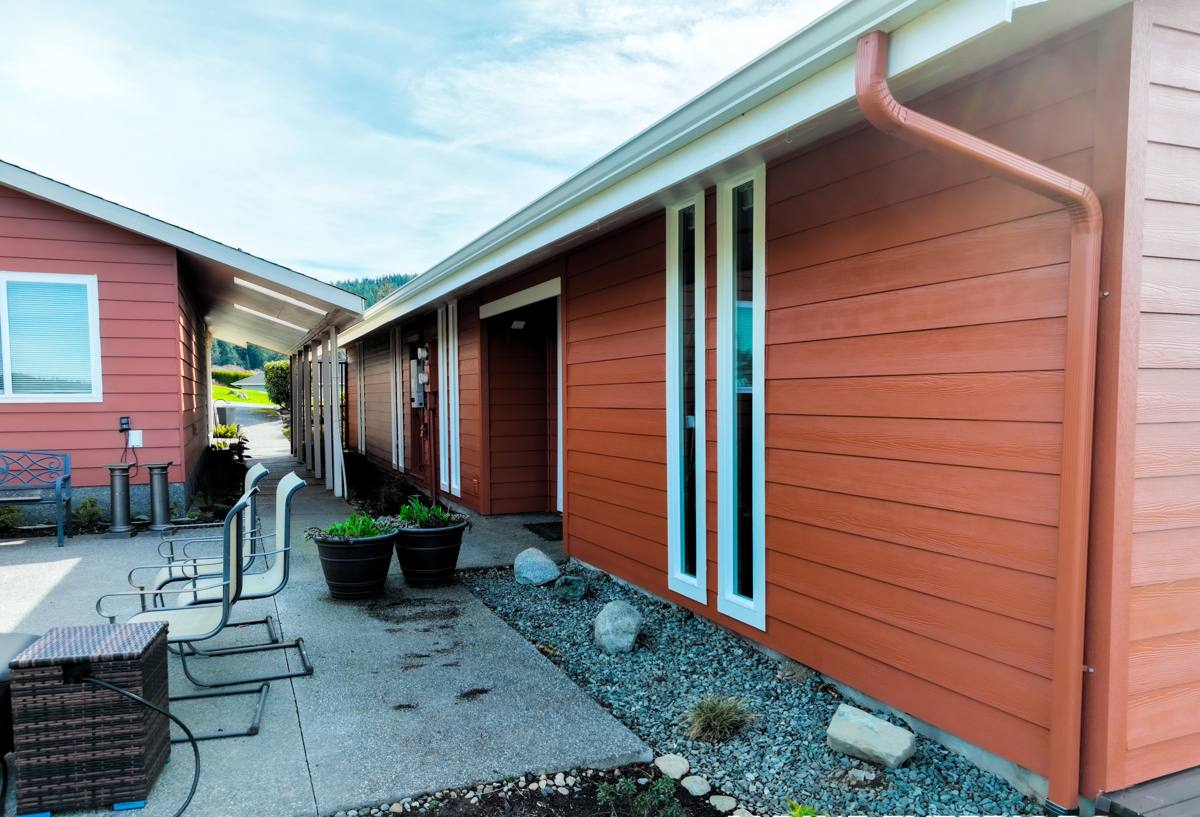
What Bellingham's Coastal Climate Actually Does to Siding
Whatcom County sits on Bellingham Bay with the Salish Sea close enough that salt-laden air is a real factor on siding, trim, and fasteners — not just near the waterfront, but carried inland on wind more than people expect. Add driving rain that comes in sideways during fall and winter storms, and a moss season that can run eight months or more in shaded, tree-covered spots like much of Happy Valley, and you've got three separate stressors working on a wall system at the same time:
- Salt air: accelerates corrosion on exposed fasteners, uncoated trim edges, and any metal flashing that isn't rated for it.
- Driving rain: pushes water past face-sealed siding systems and finds every gap in flashing, caulk, and butt joints — especially on walls facing the prevailing weather.
- Moss and algae growth: thrives in the shade and moisture that tree-covered lots hold onto, and it doesn't just look bad — sustained moss growth traps moisture against the siding surface and can shorten the life of the substrate underneath.
None of these individually are unusual for the Pacific Northwest. What matters is that Happy Valley's terrain and tree cover tend to combine all three at once on the same wall, which is exactly the kind of condition that separates siding that lasts thirty-plus years from siding that needs attention in ten.
What a Correct Siding Installation Actually Involves
Siding is a water management system first and a finish material second. A crew can hang a beautiful-looking product and still get the job wrong if the water management underneath isn't right — and on a shaded, damp lot, a wrong installation shows its problems faster than it would on a dry, sunny site.
The details that matter most here
- A drainage plane behind the siding — a weather-resistant barrier installed correctly, lapped shingle-style so water sheds down and out, not into the wall.
- Proper flashing at every penetration — windows, doors, hose bibs, light fixtures, and anywhere else something breaks the plane of the wall.
- Correct clearances — siding held up off decks, patios, and grade per manufacturer spec, so splashback and standing moisture don't sit against the bottom course.
- Fastener choice and placement — corrosion-resistant fasteners driven per spec, not overdriven or underdriven, because a fastener pattern that's wrong on day one becomes a callback in year three.
- Joint and seam treatment — factory-mitered or properly caulked and painted seams so water can't track behind panels at the joints.
On a shaded Happy Valley lot where a wall might stay damp for days after a storm, any one of these done wrong compounds the moisture problem instead of managing it.
Why We Only Install James Hardie Fiber Cement
We standardized on James Hardie fiber cement siding and don't install vinyl, LP SmartSide, or other fiber cement alternatives. That's a deliberate call, not a brand preference for its own sake. Hardie's fiber cement is non-combustible, holds paint and factory finish better than wood-based composite products over time, and doesn't have the expansion-contraction behavior that causes vinyl to buckle or gap in temperature swings. For a climate like Bellingham's — where a wall can go from soaked to freezing and back in the same week during winter — dimensional stability matters more than it does in a milder, drier region.
Hardie also builds climate-specific product lines (their HZ5 line is engineered for regions with freeze-thaw cycles and sustained moisture exposure, which fits Whatcom County), and backs the product with a long, transferable, non-prorated warranty when it's installed by a certified installer to their specification. That warranty is only as good as the installation behind it, which is why we treat the water management details above as non-negotiable, not optional upgrades.
Comparing How Siding Materials Hold Up in This Climate
| Factor | Vinyl Siding | Wood/Composite (e.g. LP SmartSide) | James Hardie Fiber Cement |
|---|---|---|---|
| Moisture resistance | Won't rot, but seams can let water track behind it | Engineered wood core is vulnerable if the factory seal is compromised | Cement-based core doesn't rot or absorb moisture into the substrate |
| Behavior in temperature swings | Expands/contracts, can warp or buckle | Moderate movement | Dimensionally stable across the range Bellingham sees |
| Salt air / coastal exposure | Generally stable, fasteners can corrode | Can be sensitive to prolonged moisture and salt exposure at edges | Fiber cement itself is inert to salt; use corrosion-resistant fasteners and flashing |
| Fire resistance | Combustible | Combustible | Non-combustible |
| Finish longevity | Color molded in, can fade/chalk | Factory or field-applied finish, needs upkeep | ColorPlus factory finish is baked on and warrantied against fading and peeling |
How Our Process Works on a Happy Valley Job
Every siding job starts with an on-site look at the specific wall conditions — not a generic estimate off a photo. On a lot like the ones common in Happy Valley, that means we're checking:
- Which walls sit in shade for most of the day and how that's affected the current siding or the sheathing behind it.
- How grading and drainage around the foundation direct water, and whether that's pushing moisture at the base of any walls.
- Tree proximity and overhang — branches dropping debris and organic matter onto siding and gutters accelerates moss and staining.
- Access — tight, sloped lots and close-set homes are common in this part of Bellingham, and we plan material staging and scaffolding around that up front rather than discovering it mid-job.
- What's already on the wall — tear-off scope, hidden rot, and whether existing trim and flashing details need to be rebuilt as part of the job, not just siding swapped in front of them.
From there, the installation itself follows the same sequence on every job: prep and any necessary sheathing repair, water-resistive barrier, flashing at every penetration, then Hardie panels or lap siding installed to manufacturer spec with correct fastening and clearances, followed by trim, caulking, and touch-up paint at cut edges.
What to Look for in a Properly Finished Job
- Consistent, tight reveal lines on lap siding with no visible waviness
- Butt joints staggered and either factory-mitered or properly flashed and sealed
- No caulk gaps at trim-to-siding transitions or window and door casings
- Siding held clear of decks, patios, and soil per the manufacturer's minimum clearance
- Fastener heads flush, not overdriven, and not visibly rusting within the first year
- Cut edges primed or painted, not left raw and exposed
Maintaining Hardie Siding on a Shaded, Damp Lot
Hardie siding is low-maintenance compared to wood or composite products, but "low-maintenance" isn't "no-maintenance," especially under tree cover. A rinse-down once or twice a year to knock back moss and organic buildup, keeping gutters clear so overflow doesn't run down the wall face, and trimming back branches that hold moisture against the siding will all extend the life of both the ColorPlus finish and the caulk lines. None of that requires pressure washing at close range, which can force water behind properly lapped siding and cause more harm than the moss it's removing.
Why Hiring a Crew That Already Works This Neighborhood Matters
A crew that's worked Happy Valley's streets before already knows the terrain challenges, the tree cover pattern, and the mix of older and newer homes that defines the area. That's not a small thing on a hilly, tightly built lot — it affects everything from how we stage materials and scaffolding to how we sequence tear-off and installation around weather windows in a wet climate. It also means we're not guessing at what Bellingham's permitting and inspection process expects, which keeps the job moving instead of stalling on paperwork.
We'd rather walk your specific walls, look at your specific shade and drainage pattern, and give you a straight answer about what your home needs than sell a one-size-fits-all package. If you're planning a siding project in Happy Valley or anywhere else in Bellingham, we're happy to come out for a free, no-pressure estimate and walk through exactly what we'd do and why.