 Bellingham Window
 Decking in Puget Has to Answer to the Weather, Not Just Look Good
Puget sits close enough to the water that homes here deal with a specific combination most inland Whatcom County properties don't: salt-laden air, driving rain that comes in sideways more often than straight down, and a moss season that can stretch from October well into April. A deck built with generic assumptions — the kind that work fine in a dry climate — tends to show problems within a couple of seasons here. Fasteners corrode faster. Moisture gets trapped under boards that don't have enough airflow. Moss and algae take hold on any surface that stays shaded and damp, which describes most decks on this side of Bellingham for a good chunk of the year.
None of that means composite decking is a bad fit for Puget. It's actually one of the better options for this climate when it's installed correctly. The problem is that "correctly" here means something more specific than it does in a lot of other places, and a lot of decking problems we get called out to fix trace back to a build that ignored local conditions rather than a bad product.
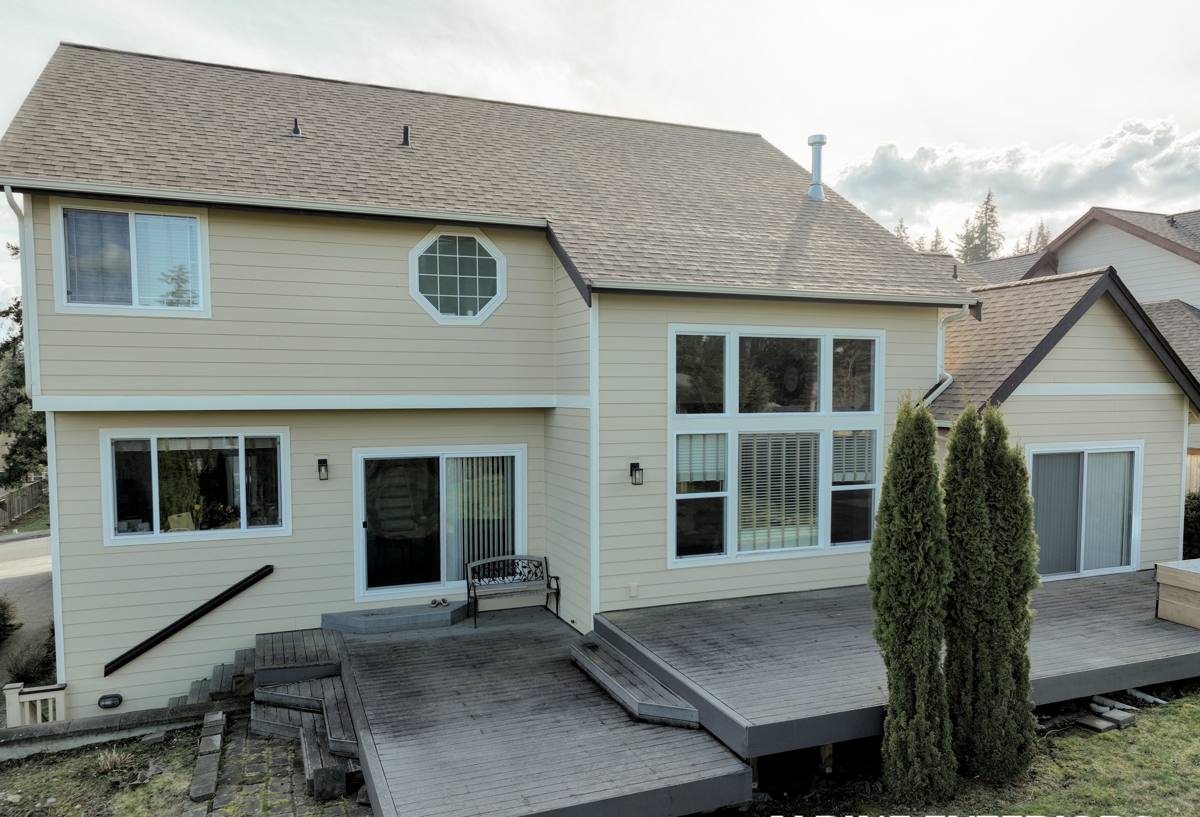
What Salt Air, Rain, and Moss Actually Do to a Deck
Salt Air
Even a few miles inland from Bellingham Bay, airborne salt accelerates corrosion on anything metal — screws, joist hangers, railing brackets, post bases. Standard zinc-coated fasteners can start showing rust streaks on composite boards within a year or two. That staining is permanent once it sets into the board surface, and it's one of the most common cosmetic complaints we see on decks that weren't built with coastal-grade hardware.
Driving Rain
Wind-driven rain doesn't just fall on a deck, it gets pushed under railings, into board gaps, and against ledger connections at the house. A deck that isn't detailed with proper flashing at the ledger board, and that doesn't have enough slope and drainage built into the substructure, will hold water in places you can't see until rot or corrosion shows up underneath.
Moss and Algae
Composite boards don't rot, but moss, algae, and mildew will still grow on the surface if a deck stays shaded and damp — which describes a lot of yards around Puget under mature trees or with north-facing exposure. Board texture, gap spacing, and airflow underneath the deck all affect how much moss takes hold and how easy it is to clean off.
What a Correct Composite Deck Build Actually Involves
Composite decking is often sold as low-maintenance, and the boards themselves are. But the board is only part of the system. The substructure, fasteners, and drainage details underneath do most of the work of keeping a deck sound through wet Whatcom County winters.
- Substructure material: Pressure-treated joists rated for ground contact where relevant, or composite/PVC substructure in high-moisture areas, set with proper spacing for the specific composite board being used — not a generic 16-inch spacing assumption.
- Joist protection: Joist tape or a comparable barrier over the top of every joist to keep standing water off the wood and slow fastener corrosion at the point of contact.
- Fasteners and hardware: Stainless steel or coated fasteners rated for coastal/high-moisture exposure, not standard exterior-grade screws that work fine 20 miles inland but corrode faster here.
- Ledger flashing: Proper flashing and a water-resistant barrier where the deck attaches to the house, so wind-driven rain can't work its way behind the ledger board.
- Slope and drainage: A slight slope away from the house and gaps that let water move through and off the deck rather than pooling.
- Ventilation underneath: Adequate clearance and airflow below the deck surface, especially on lower decks close to grade, so moisture doesn't sit trapped against the boards and framing.
- Hidden fastener systems: Where the board allows it, hidden fasteners reduce the number of exposed metal points that can streak or corrode over time.
Skip any one of these and the board can still look fine on day one. The failures show up two, three, or five years in — which is exactly why it matters who builds it, not just what material they use.
Composite vs. Wood vs. PVC for a Puget Deck
| Factor | Composite | Pressure-Treated Wood | PVC |
|---|---|---|---|
| Moisture resistance | High — won't rot, but surface can trap moisture if airflow is poor | Moderate — needs regular sealing to hold up to Puget rain | Very high — fully synthetic, least moisture-sensitive |
| Moss/algae resistance | Moderate — varies by board texture and cap type | Low — porous surface, moss takes hold easily | Moderate to high, depending on surface finish |
| Maintenance | Occasional wash-down, no staining/sealing | Annual sealing or staining recommended | Occasional wash-down, no staining/sealing |
| Upfront cost | Mid to upper-mid range | Lowest | Highest |
| Coastal hardware needs | Yes — corrosion-resistant fasteners required | Yes — same requirement | Yes — same requirement |
| Appearance over time | Holds color well with a quality cap | Grays and weathers without maintenance | Very stable, can look less wood-like |
We install all three, but composite is the option most Puget homeowners land on because it balances upfront cost against the maintenance burden of wood in a climate that doesn't give wood decking much of a break.
Our Process for a Puget Composite Deck
1. Site Assessment
We look at sun exposure, tree cover, prevailing wind and rain direction against the house, existing drainage, and how close the deck sits to grade. All of that shapes decisions on substructure material, ventilation, and board texture before we ever talk product lines.
2. Substructure and Framing
We build the frame to handle Whatcom County's wet season, not just a dry-weather standard — proper joist spacing for the board, joist tape, and hardware rated for coastal exposure.
3. Ledger and Flashing Details
Where the deck ties into the house, we flash it to keep wind-driven rain out of the wall assembly. This is the single most common point of hidden water damage on decks we've been called to inspect or repair.
4. Decking Installation
Boards go down with the fastening system appropriate to the product, with attention to gap spacing for drainage and expansion, and board layout that accounts for water flow off the deck surface.
5. Railing and Edge Work
Railings, fascia, and stair details get the same corrosion-resistant hardware standard as the field of the deck — no cutting corners on the parts that are hardest to inspect later.
6. Walkthrough and Cleanup
We walk the finished deck with the homeowner, cover basic care, and leave the site clean.
Guardrails, Footings, and Local Code
Deck projects in Bellingham and unincorporated Whatcom County are generally subject to permitting and inspection requirements, particularly for decks above a certain height or attached to the house structurally. Guardrail height, baluster spacing, footing depth, and ledger attachment are the areas most often flagged in inspections. We handle the permitting and code compliance side of a build so homeowners aren't left navigating that alone, and so the finished deck is inspected and signed off correctly rather than becoming a problem at resale.
Living With a Composite Deck in Puget's Climate
Composite decking cuts down on maintenance compared to wood, but "low-maintenance" isn't "no-maintenance" in this climate. A short seasonal routine keeps a well-built deck looking and performing the way it should:
- Sweep debris and standing leaves off the deck regularly through fall, when they trap moisture against the boards.
- Rinse or lightly scrub with a soft brush and mild cleaner a couple of times a year to keep moss and algae from establishing, especially in shaded corners.
- Check under the deck once a year for debris blocking airflow or drainage paths.
- Inspect railing posts and fastener points annually for any early rust staining, since it's far easier to address a corroding fastener than a stained board.
- Keep gutters and downspouts near the deck clear so runoff isn't dumping extra water onto or under the deck surface.
Why It Matters Who Builds Your Deck in Puget
A composite deck built to a generic standard can still fail early here — not because the product is wrong, but because the build didn't account for what this specific location does to a structure over time. A crew that already works in Puget and along Bellingham Bay has already seen which fastener grades hold up, which substructure details actually keep water moving off a deck, and where moss tends to take hold on local lots. That's the kind of judgment that doesn't come from a spec sheet — it comes from building and maintaining decks in this exact climate.
If you're planning a new composite deck or replacing one that's showing its age, we're glad to take a look and walk you through what your specific site needs. Reach out for a free, no-pressure estimate using the form below.