 Bellingham Window
 Sehome's Climate Is Hard on Decks
Sehome sits close enough to Bellingham Bay that salt-tinged air reaches the neighborhood on a regular basis, and that air does quiet damage to decks year after year. Salt exposure speeds up corrosion in fasteners, joist hangers, and any exposed metal hardware, which is often the first thing to fail on an older deck — long before the visible boards look bad.
Add to that the driving rain that comes through Whatcom County for much of the year, and you get a second problem: moisture that doesn't just fall straight down but gets pushed sideways into ledger boards, stair stringers, and the undersides of railings. Water that would run off a deck in a drier climate instead sits in joints, gaps, and end-grain cuts here, and that's exactly where rot starts.
Then there's moss. Bellingham's long, mild, wet season is ideal moss-growing weather, and a deck with any shade — from the house, a fence, overhanging trees, or just its own railings — will grow a moss layer if it isn't cleaned. Moss holds moisture directly against the wood surface for weeks at a time, which softens fibers, feeds rot, and turns boards slick and dangerous underfoot.
None of this means a deck in Sehome is doomed. It means a deck here needs to be built and repaired with these three things — salt air, wind-driven rain, and moss — treated as ongoing facts of life, not occasional nuisances.
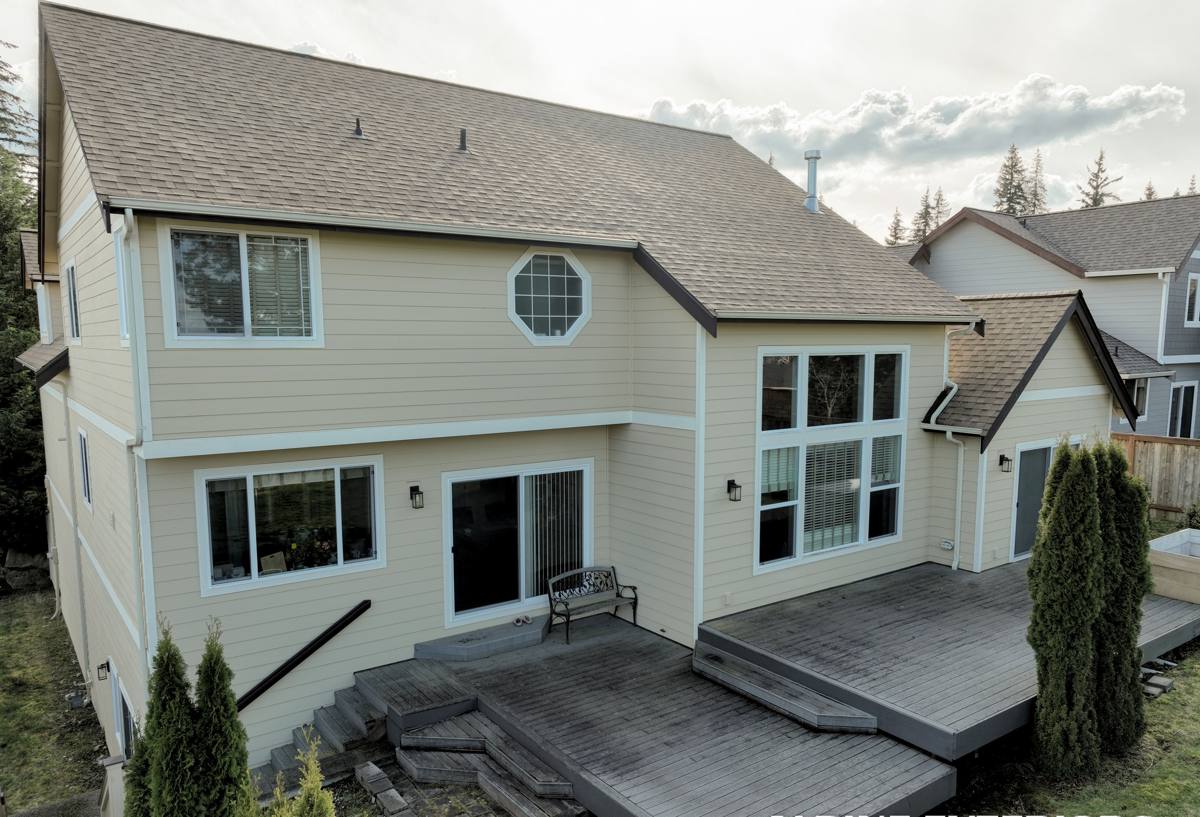
Signs a Sehome Deck Needs Repair, Not Just Cleaning
A lot of deck problems in this area get mistaken for cosmetic issues when they're actually structural warnings. Here's what we look for and what it usually means.
- Soft or spongy spots underfoot — almost always rot in the decking board or the joist beneath it.
- Rust streaks below fasteners or hardware — a sign the metal is corroding, which weakens its grip long before it visibly breaks.
- Gaps or movement where the deck meets the house (the ledger board) — one of the most serious issues we find, since a failing ledger connection is a structural safety problem, not a cosmetic one.
- Wobbly railings or posts — often a sign the post base has been sitting in trapped moisture.
- Persistent green or black staining that comes back quickly after cleaning — moisture is getting trapped somewhere it shouldn't, usually in a joint or under a board that isn't draining.
- Stairs that feel different from step to step — uneven flex usually means a stringer is compromised.
Any one of these on its own might be a small fix. Several at once, especially combined with the deck's age, usually means it's time for a proper inspection rather than a patch job.
What a Correct Deck Repair Actually Involves
Start below the surface
The most common mistake we see with past repairs is replacing the boards people can see while leaving the framing underneath untouched. If joists, beams, or the ledger connection are compromised, new decking on top of them just buys a little time before the same symptoms come back. A correct repair starts by checking the structure first: ledger attachment, joist condition, post and beam connections, and the hardware holding it all together.
Match the fix to the failure
Once we know what's actually wrong, the repair should match the scope of the problem. That might mean:
- Sistering a new joist alongside a rotted one instead of tearing out the whole frame
- Replacing corroded fasteners and hangers with hardware rated for coastal, high-moisture use
- Re-flashing the ledger board connection where it meets the house, since a failed flashing detail is often the root cause of hidden rot
- Rebuilding a section of decking where boards have cupped, split, or gone soft, rather than replacing the whole surface if the rest is sound
- Reinforcing or rebuilding railing posts where the base has rotted, which is a common failure point on older Bellingham-area decks
Don't skip the drainage details
A repair that ignores water management will fail again. That means gapping boards correctly for drainage, making sure flashing directs water away from framing instead of into it, and checking that the space under the deck isn't trapping moisture against structural wood. In a climate like ours, drainage detailing isn't optional — it's the difference between a repair that lasts a few seasons and one that lasts.
Repair or Replace? An Honest Comparison
Not every deck problem calls for a full rebuild, and not every deck is worth repairing indefinitely. Here's how we think through it with homeowners.
| Factor | Repair usually makes sense | Replacement usually makes sense |
|---|---|---|
| Framing condition | Joists and ledger are sound; damage is isolated | Rot has spread through multiple structural members |
| Age of the deck | Under 15-20 years, built to a reasonable standard | Older deck nearing the end of its practical life |
| Extent of damage | A few boards, one section, or specific hardware | Damage is widespread across the surface and frame |
| Original construction quality | Solid original build, just weathered over time | Known shortcuts in the original build (undersized framing, poor flashing) |
| Your plans for the deck | Happy with the current size, layout, and look | Wanting a different footprint, railing style, or material |
We'll always tell you honestly which category your deck falls into. A repair that's likely to fail again within a couple of years isn't a good use of your money, and we'd rather say so upfront than sell a patch job we don't believe in.
Our Deck Repair Process
- On-site inspection. We walk the deck, check the framing where we can access it, test railings and stairs, and look at the ledger connection closely — this is where we form our honest repair-or-replace opinion.
- Written scope and estimate. You get a clear explanation of what's wrong, what we recommend, and why — no vague line items.
- Structural work first. Any framing, ledger, post, or hardware issues get addressed before anything cosmetic.
- Surface and drainage work. Decking, railings, and stairs get repaired or replaced with attention to proper drainage and gapping.
- Final walkthrough. We check the deck's stability and finish quality with you before calling the job done.
Materials: What We Use and Why
Material choice matters more in this climate than in drier parts of the country, and we're upfront about the trade-offs rather than pushing one product as a cure-all.
Framing and fasteners
For structural repairs, we use lumber and hardware rated for exterior, high-moisture exposure, and we favor corrosion-resistant fasteners given how much salt air and rain this area sees. Cutting corners on hardware is one of the most common causes of repeat failures we're asked to fix.
Decking surface options
Wood decking has a natural look many homeowners want, but it requires regular sealing and cleaning to hold up against moss and moisture here — skip that maintenance and it will show it. Composite decking asks less of you in terms of upkeep and resists moisture and moss growth better, but it comes at a higher upfront cost and, like any product, performs best when installed with the manufacturer's spacing and ventilation requirements followed exactly. We'll walk through both honestly based on your budget, maintenance appetite, and how the deck is used.
Keeping a Repaired Deck in Good Shape
A repair holds up much longer if a few basic habits become routine. We share this checklist with every homeowner after a repair:
- Sweep off leaves, needles, and debris regularly, especially in fall
- Address moss as soon as it appears rather than letting it establish over a wet season
- Check the ledger board area and under railings once a year for early signs of moisture trouble
- Reseal or refinish wood decking on the schedule the product calls for — don't stretch it out
- Keep gutters and downspouts clear so runoff isn't dumping extra water onto or near the deck
- Trim back vegetation that's shading the deck and keeping it damp longer than it needs to be
Why It Matters to Hire a Crew That Already Works in Sehome
Deck problems in Sehome tend to follow patterns tied to the neighborhood's exposure, elevation, and age of housing stock, and a crew that's worked on decks here already knows what to check first — the ledger flashing, the moss-prone shaded corners, the hardware that corrodes faster near the bay. That familiarity means a faster, more accurate inspection and fewer surprises once repair work is underway.
It also means we're not guessing at what materials and techniques actually hold up under Whatcom County conditions. We've seen what fails here and why, and we build every repair to account for it rather than applying a generic approach that might be fine somewhere drier.
If your deck is showing any of the warning signs above, or it's just been a while since anyone looked at it closely, we're happy to take a look. Reach out for a free, no-pressure estimate using the form below — we'll tell you honestly what we find.