 Bellingham Window
 Sehome's Siding Problem Isn't Cosmetic — It's Moisture
Sehome sits close enough to Bellingham Bay to catch the salt-laden air that comes off the water, and close enough to the hillside and tree canopy around it to stay damp long after the rest of Whatcom County has dried out. That combination is hard on exterior siding in a specific way: it's not one bad storm that causes the damage, it's months of low-grade moisture exposure that never fully lets up. Wood-based and wood-adjacent siding products absorb that moisture cycle after cycle. Eventually they swell, the paint film fails, and rot sets in at the joints and bottom edges — usually before it's visible from the street.
We've replaced enough siding on homes in this neighborhood to know the pattern: north- and west-facing walls with less sun exposure hold moisture longest, areas under mature trees stay shaded and wet, and anywhere water is allowed to sit against the siding — behind shrubs, at grade, under gutters that overflow — is where failure starts first. Correct installation is less about the surface material and more about how the whole wall assembly handles water. That's the part homeowners rarely get shown, and it's the part that actually determines how long a siding job lasts.
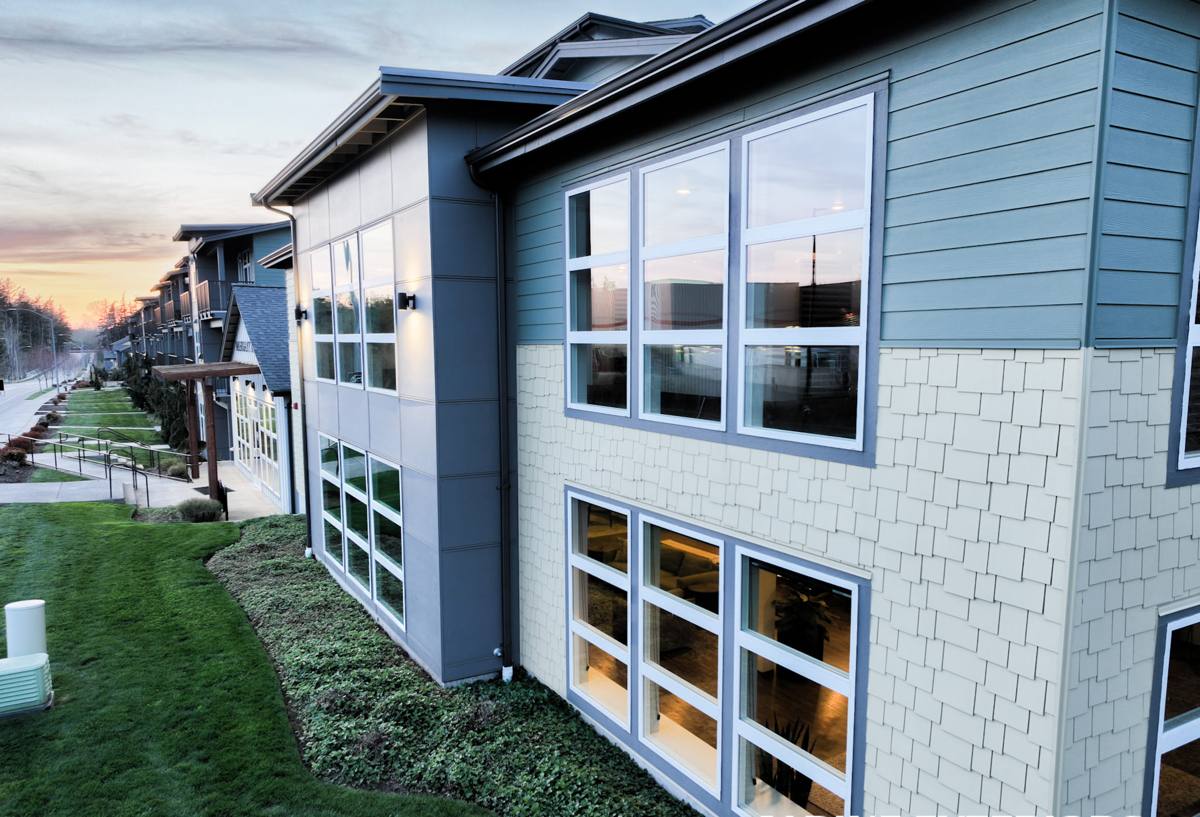
What Bellingham's Marine Climate Actually Demands From a Siding Job
Salt Air Accelerates Everything
Airborne salt doesn't just affect boats and cars near the waterfront. It settles on exterior surfaces, keeps them slightly hygroscopic (meaning they attract and hold moisture), and speeds up the breakdown of paint films, caulking, and fasteners that aren't rated for coastal exposure. A siding product that holds up fine forty miles inland can perform noticeably worse in Sehome simply because of what's in the air.
Driving Rain Finds the Gaps
Bellingham's rain rarely falls straight down — wind off the bay pushes it sideways into walls, which means siding here has to shed water horizontally, not just vertically. Any installation that relies on caulk alone to keep water out at seams, corners, and penetrations is working against the climate instead of with it.
Moss Season Is Longer Than People Expect
Whatcom County's moss and algae season effectively runs most of the year on shaded, damp surfaces. Siding that stays wet for extended periods — because of poor drainage, tight clearances to grade, or no gap behind the cladding — grows moss and mildew faster and holds it longer. That's a maintenance headache at best and a moisture entry point at worst.
The Part of the Job Most Homeowners Never See
A siding installation is only as good as what's behind it. On every job we do in this neighborhood, three things get more attention than the visible siding itself:
The Water-Resistive Barrier and Flashing
A continuous, properly lapped water-resistive barrier behind the siding, with correctly integrated flashing at every window, door, and roof-to-wall intersection, is what actually keeps water out of the wall cavity. Siding is the first line of defense, not the only one — if the barrier behind it is sloppy or interrupted, water that gets past the cladding (and some always does) has nowhere to go but into the framing.
A Drainage Gap Behind the Cladding
A rainscreen gap between the water-resistive barrier and the siding gives incidental moisture a path to drain and dry out instead of sitting trapped against the back of the panel. In a climate that stays damp as long as Bellingham's does, this gap is one of the cheapest, most effective upgrades in the entire installation — and one of the most commonly skipped.
Fastening and Clearances
Fiber cement siding has specific fastener spacing, embedment depth, and clearance requirements — from grade, from roof lines, from decks and patios — that are engineered into the manufacturer's installation instructions for a reason. Skipping them doesn't show up as a problem on day one. It shows up three or five years later as buckling, cracking at fastener points, or moisture staining at the bottom courses.
Why We Only Install James Hardie Fiber Cement
We don't install vinyl, LP SmartSide, Cemplank, Allura, primed spruce, or cedar. That's not a marketing position — it's a standard we hold because of what we've seen these products do (and not do) in exactly the kind of climate Sehome sits in. Wood and wood-composite sidings depend on an intact paint film and disciplined maintenance to keep moisture out; once that film fails in a damp, shaded spot, the substrate underneath is vulnerable. Vinyl sheds water fine but expands and contracts significantly with temperature swings, and it doesn't offer the same rigidity or fire performance as fiber cement.
James Hardie fiber cement is non-combustible, dimensionally stable across temperature and moisture swings, and available in HZ5 formulation — engineered specifically for wetter, colder climate zones like the Pacific Northwest. Its factory-applied ColorPlus finish is baked on under controlled conditions, which holds up better against UV and salt exposure than field-applied paint, and it carries a strong transferable warranty when installed to Hardie's published specifications. We stand behind it because it's the product we've seen perform, not because it's the only option on the market.
Sehome-Specific Conditions That Affect the Job
Every neighborhood has its own quirks, and Sehome's are shaped by its terrain and tree cover. Homes on sloped lots often have more complex water shedding around the foundation, which affects where flashing and clearances need extra attention. Mature trees — a defining feature of many older Bellingham neighborhoods — mean more shade, more debris in gutters, and more sustained dampness on the walls beneath them, which is exactly the moss- and mildew-prone condition described above. Older housing stock in and around the neighborhood also means we regularly find siding installed under older code or older assumptions about drainage, so a big part of an honest replacement job is correcting what's behind the old siding, not just swapping the surface material.
Our Installation Process
- On-site assessment — we look at existing siding condition, moisture damage, trim and flashing details, and how water currently moves around the home.
- Tear-off and substrate inspection — old siding comes off and we inspect sheathing for rot or moisture damage before anything new goes up. Damaged sheathing gets repaired, not covered over.
- Water-resistive barrier and flashing installation — a continuous barrier and correctly lapped flashing at every penetration, sized for our rain patterns.
- Rainscreen gap installation — furring or a drainage mat to keep the back of the siding ventilated and able to dry.
- James Hardie installation to manufacturer spec — correct fastener type, spacing, and clearances, per Hardie's published instructions for our climate zone.
- Trim, caulking, and final detailing — the visible finish work, done last so it isn't compromising the water management underneath.
- Walkthrough — we go over the finished job with the homeowner before calling it done.
What Drives Cost on a Sehome Siding Job
Every home is different, so we don't quote sight-unseen — but these are the factors that typically move a siding installation up or down in scope and cost:
| Cost Factor | What Drives It | Typical Impact |
|---|---|---|
| Existing siding removal | Layers of old material, or siding installed over siding | Medium |
| Sheathing/moisture repair | Rot found once old siding comes off | Low to High, hard to predict until tear-off |
| Trim and architectural detail | Corners, window surrounds, multiple rooflines | Medium |
| Site access | Hillside grading, mature trees, tight setbacks | Low to Medium |
| Siding profile and color | Lap vs. shingle profile, custom ColorPlus selections | Low |
| Rainscreen/drainage upgrade | Adding a ventilated gap where none existed | Low to Medium |
Rough industry-wide ranges for a fully tear-off-and-replace fiber cement job tend to run in the broad mid-to-upper single digits per square foot into the low double digits, depending on the factors above — we'll give you an actual number after we've seen the house, not before.
Why It Matters That We Already Work in This Neighborhood
Siding installation isn't just a product install — it's a building science job that has to account for the specific way water moves across a specific lot. A crew that's worked in Sehome and similar close-in Bellingham neighborhoods already knows what the tree cover does to drying times, what hillside lots do to grading and drainage, and what the local building department expects for permitting and inspection on exterior work. That local familiarity shows up in fewer surprises mid-job and a finished install that's actually built for the conditions it has to survive, not a generic installation dropped onto a coastal Whatcom County lot.
Signs Your Current Siding Is Already Failing
- Paint that's peeling, bubbling, or chalking heavily on north- or west-facing walls
- Soft or spongy spots when you press on the siding near the bottom courses
- Persistent moss or dark streaking that comes back within weeks of cleaning
- Visible gaps, warping, or buckling at seams and corners
- Water stains or discoloration on interior walls near exterior corners
- Caulk that's cracked, shrunk, or pulled away from trim and joints
If more than one or two of these apply, it's worth having someone look at what's happening behind the siding, not just the surface.
Maintenance After Installation
James Hardie siding is low-maintenance compared to wood or wood-composite products, but "low-maintenance" isn't "no-maintenance" in a climate like ours. A yearly rinse to clear salt residue and moss spores, keeping gutters clear so water isn't sheeting down the wall face, and trimming back vegetation that's holding moisture against the siding will keep a correctly installed job performing for decades.
If you're seeing any of the warning signs above, or you're just planning ahead for a home in Sehome, we're happy to take a look and give you a straightforward, no-pressure estimate — no upsell, just an honest read on what your home actually needs. Use the form below to get started.