 Bellingham Window
 Silver Beach's Climate Is Rougher on Siding Than It Looks
Silver Beach sits close enough to open water that homes here take on a steady dose of salt-laden air, wind-driven rain, and shade from mature trees that never fully lets the siding dry out. None of that is dramatic on its own. It's the combination, repeated for months at a stretch, that wears out the wrong siding material years before it should fail. Homeowners who've lived in the neighborhood a while usually already know which side of the house takes the worst of it — the side facing the water and prevailing wind, the shaded corner near the trees, the wall behind a hedge that never gets direct sun.
Whatcom County's marine climate means Bellingham gets a long, wet fall-through-spring stretch, and Silver Beach's proximity to the water adds salt exposure into the mix. Salt accelerates corrosion of fasteners and trim metal, driving rain finds any weak seam or gap in a siding system, and shade plus moisture is exactly what moss and algae need to take hold on a north-facing wall. A siding product and installation that ignore these three factors will show it within a few winters — not through dramatic failure, but through soft spots, peeling paint, swelling edges, and streaked, dingy-looking walls.
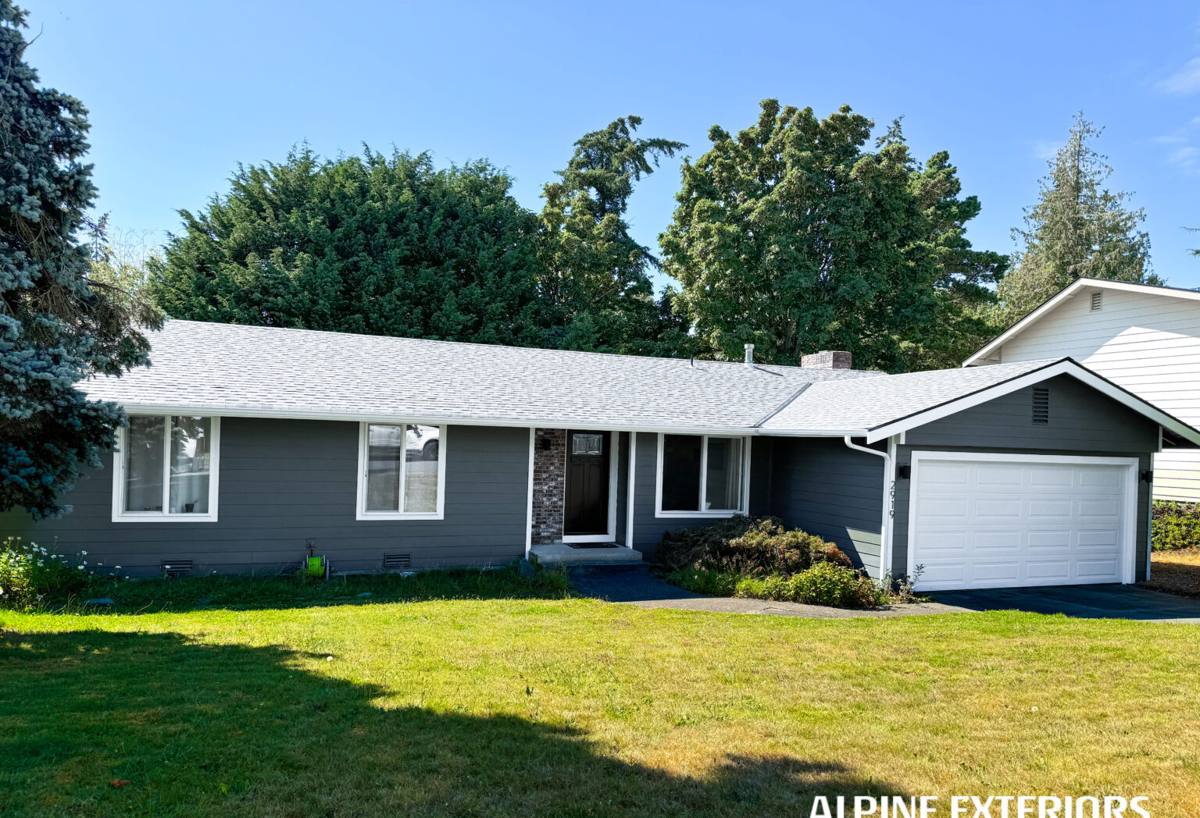
What Silver Beach Homes Actually Need From Their Siding
Given the local conditions, the priority list for siding here is fairly specific:
- Resistance to moisture absorption at the plank's core, not just a surface coating
- Fasteners and trim details that won't corrode from salt exposure over time
- A factory finish that holds color and doesn't need repainting every few years
- A material that doesn't feed mold, algae, or moss growth in shaded, damp areas
- Enough dimensional stability that it doesn't swell, cup, or buckle when it's wet for weeks at a time
This is the exact reason we standardized on James Hardie fiber cement siding and stopped installing anything else. It's not brand loyalty — it's that Hardie's product line was engineered specifically for climates like this one, and we've seen the difference in how it holds up on homes near the water compared to wood-based or vinyl alternatives.
Why We Install Only James Hardie Fiber Cement
Fiber cement itself is a mix of cement, sand, and cellulose fibers, which makes it dimensionally stable and non-combustible. But not all fiber cement is engineered the same way, and Hardie's HZ5 product line in particular is built for climates with heavy moisture exposure — including coastal and marine conditions like Whatcom County sees. The factory-applied ColorPlus finish is baked on under controlled conditions, which gives it far better fade and chip resistance than a field-applied paint job, and it comes with a long manufacturer finish warranty on top of the substrate warranty.
We've made the call not to install LP SmartSide, vinyl, or other cementitious boards like Cemplank or Allura. Each of those has legitimate uses elsewhere, but for the moisture and salt exposure Silver Beach homes deal with, we'd rather install one product correctly and stand behind it than offer a menu of options with different long-term risk profiles. That's a standard we hold for every job we take, not a sales pitch specific to this page.
What a Correct Fiber Cement Installation Actually Involves
Fiber cement siding is only as good as the assembly behind it. A huge share of the siding problems we get called out to inspect on older homes trace back to installation shortcuts, not the material itself. A correct job includes:
Water Management Behind the Siding
A continuous water-resistive barrier, properly lapped and taped at seams, with flashing integrated at every window, door, and penetration so water is directed out and down rather than trapped behind the cladding. This matters more in Silver Beach than in a drier inland location, because any gap in the drainage plane has more water to deal with over the course of a wet season.
Correct Clearances and Gaps
Hardie siding needs proper clearance from grade, roof lines, decks, and other flatwork — typically several inches minimum — plus small gaps at butt joints and trim to allow for expansion and drainage. Installers who nail siding tight to grade or hard against flashing are setting up a wicking point that stays wet longer than it should.
Fastening Specific to the Product
Hardie specifies fastener type, placement, and spacing for each product line and exposure. In a salt-air environment, using the wrong fastener metal or missing the specified nailing pattern is how you get streaking, popped nails, or premature corrosion at the fastener heads.
Caulking and Sealant Discipline
Sealant belongs at specific transitions — not everywhere, and not as a substitute for proper flashing. Over-caulking traps moisture; under-caulking leaves gaps. Both show up as problems within a few wet seasons.
Our Process, Start to Finish
- On-site assessment — we look at existing siding condition, sheathing and framing where accessible, moisture history, and the specific exposures on your lot (water-facing walls, shaded sides, drainage around the foundation).
- Scope and estimate — a written estimate that spells out product line, trim package, and what's included in tear-off, prep, and disposal, with no vague allowances.
- Prep and tear-off — removal of existing siding, inspection of sheathing for rot or damage, and repair of any compromised substrate before anything new goes up.
- Water-resistive barrier and flashing — installed and inspected before a single piece of siding goes on, since this layer is the one you won't see again once the job is done.
- Siding, trim, and fastening — installed to Hardie's published specifications for clearance, fastening, and joint treatment, not generic "close enough" practice.
- Final detailing and walkthrough — caulking review, cleanup, and a walk of the finished job so you know what was done and why.
Fiber Cement Compared to Other Siding Options
Homeowners researching siding options often ask how fiber cement stacks up against the alternatives. Here's an honest comparison for a moisture-heavy, coastal-influenced climate like Silver Beach's:
| Material | Moisture Behavior | Finish Longevity | Maintenance |
|---|---|---|---|
| James Hardie Fiber Cement | Dimensionally stable; does not rot or swell | Factory ColorPlus finish holds color for years | Occasional wash; no repainting on ColorPlus lines |
| Vinyl Siding | Doesn't absorb water but can warp or crack in temperature swings | Color molded in but fades over time; can't be repainted easily if it does | Low, but panels can crack, fade, or blow off in wind |
| Wood/Cedar | Absorbs moisture readily; prone to rot in shaded, damp areas | Requires field-applied paint or stain | Repainting or restaining every few years; ongoing rot inspection |
| Primed Spruce / LP-Style Panels | Engineered wood; sensitive to sustained moisture at edges and seams | Field-applied or factory finish; edge sealing critical | Regular inspection of seams and cut edges for swelling |
Maintenance Realities in a Marine, Moss-Prone Climate
Fiber cement siding is low-maintenance, not no-maintenance. In a neighborhood like Silver Beach, a short annual routine keeps it looking and performing the way it should:
- Rinse siding annually, focusing on shaded and north-facing walls where moss and algae tend to establish first
- Keep gutters clear so overflow doesn't run down the siding face repeatedly
- Trim back vegetation and tree limbs that keep a wall shaded and damp longer than the rest of the house
- Check caulking at trim and penetrations every year or two, since sealant is the one component that ages faster than the siding itself
- Watch for any staining or streaking at fastener heads, which can signal a fastener or flashing issue worth a closer look
What Fiber Cement Siding Costs to Install
Every home is different, but the main cost drivers on a Silver Beach fiber cement project tend to be the same handful of factors:
| Factor | Why It Matters |
|---|---|
| Tear-off and substrate condition | Rot or moisture damage found during tear-off adds repair scope before new siding can go on |
| Trim and detail complexity | Gable ends, dormers, and multiple trim profiles take more labor than a simple rectangular wall |
| Product line and profile | Lap width, texture, and color selection affect material cost per square |
| Site access | Tight lots, slopes, or water-adjacent access can affect staging and labor time |
| Height and stories | Multi-story walls require more scaffolding or lift time than single-story sections |
As a broad range, fiber cement siding installed to spec typically runs somewhere in the low-to-mid teens per square foot on up, depending on the factors above — but the only way to get a real number for your home is a site visit and a written estimate.
Why Local Experience in Silver Beach Matters
A crew that has worked on homes in this specific area already knows which walls tend to take the worst weather, how moss establishes on shaded elevations near the water, and what clearance and drainage details matter most for this microclimate. That's different from general siding knowledge — it's the accumulated judgment of having seen how houses in this exact setting age over time. It also means fewer surprises during tear-off, because we've seen the moisture patterns this area produces before and know what to check for.
If you're weighing your options for your Silver Beach home, we'd be glad to take a look and walk you through what we find — no pressure, no obligation. A free estimate gets you a clear, honest picture of your siding's condition and what correcting it the right way would involve.