 Bellingham Window
 Why Decks in Barkley Wear Out Faster Than People Expect
Barkley sits inland enough from Bellingham Bay to feel sheltered, but it still gets the same weather pattern that wears down decks all across Whatcom County: long stretches of low-intensity rain, short winter days that keep wood surfaces damp for weeks at a time, and a moss season that can run from October through April in a wet year. Add in Bellingham's proximity to salt water, and even neighborhoods set back from the shoreline pick up enough airborne moisture and salt to accelerate corrosion on fasteners, hardware, and any metal flashing that wasn't installed correctly the first time.
Homes in Barkley also tend to sit on lots with mature landscaping and tree cover — attractive, but it means decks here deal with more shade, more leaf litter, and slower drying times than a deck out in open sun would. That combination of moisture, shade, and organic debris is exactly what moss and rot need to get established. A deck that looks fine from a distance can have soft framing, corroded connectors, or a failing ledger board underneath, and none of it shows until someone notices bounce underfoot or staining on the siding above the ledger.
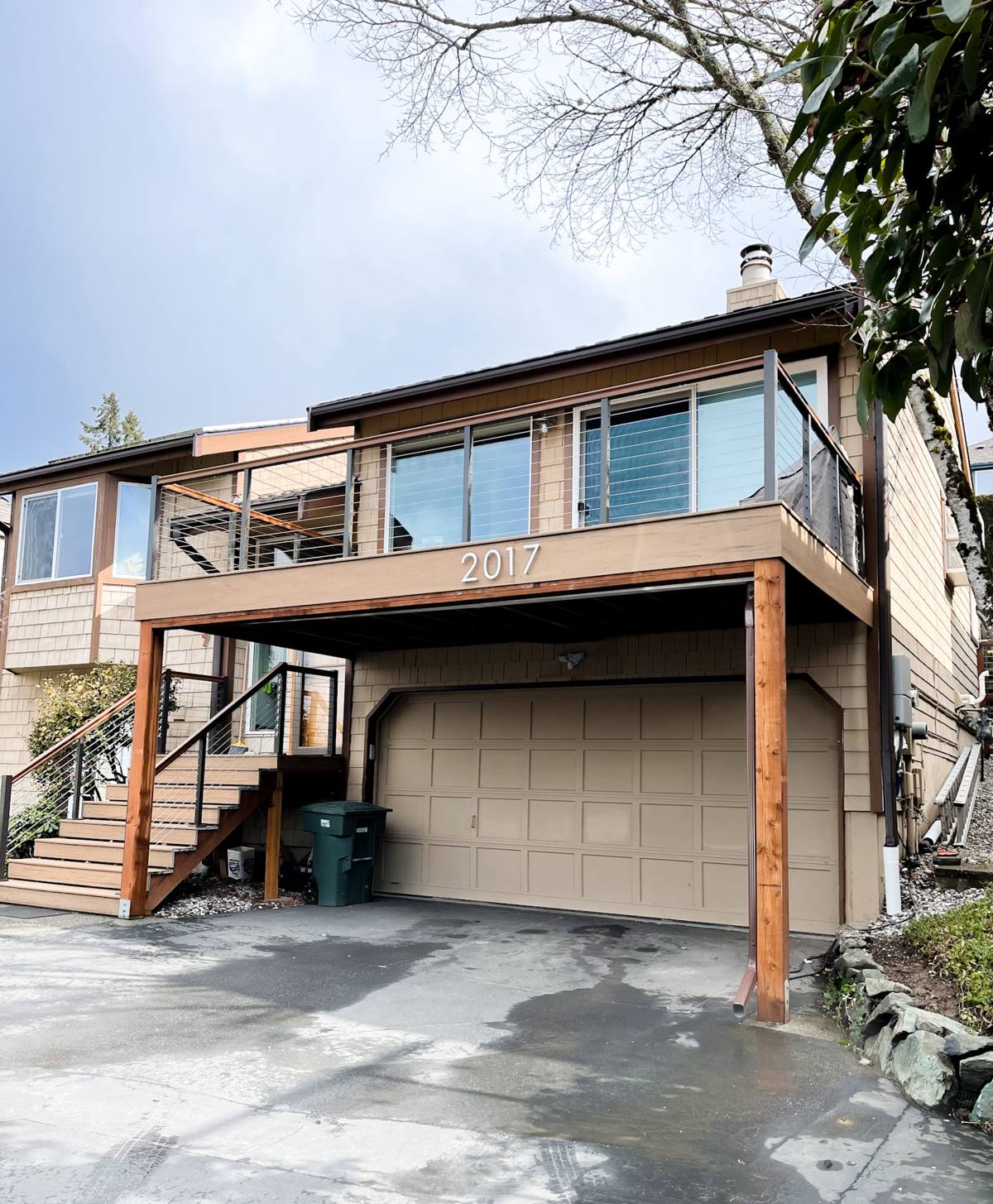
Signs Your Deck Needs Replacement, Not Another Repair
Not every tired-looking deck needs to be torn out. But there's a point where patching boards or re-staining stops being worth it, and replacing the structure is the more honest recommendation. Here's what we look for:
- Soft, spongy, or spring-back decking boards, especially near the house or in shaded corners
- Visible gaps opening up between boards that weren't there when the deck was built
- Rust streaks running down from fasteners or ledger bolts
- Moss or algae that regrows within weeks of cleaning, even after treatment
- A ledger board attached with nails instead of lag bolts or structural screws (common on older decks, and a real safety concern)
- Visible daylight or water staining where the deck meets the house
- Wobble in the railing posts or stair stringers
- Footings that have shifted, cracked, or were never poured below frost depth
If you're only seeing one or two of these, repair may still make sense. If you're seeing several at once, especially anything involving the ledger connection or footings, that's usually a structural conversation, not a cosmetic one.
What a Correct Deck Replacement Actually Involves
A deck replacement done right is a full rebuild of the structure, not a resurfacing job. That distinction matters, because a lot of the deck failures we see in Bellingham trace back to a previous "replacement" that only swapped the visible decking boards and left the framing, ledger, and footings untouched.
Ledger Attachment
The ledger board — where the deck ties into the house — is the single most important structural connection on a deck, and it's also the point most exposed to water running off the house wall. A correct installation uses proper flashing to direct water away from the house framing, structural lag screws or through-bolts rather than nails, and a gap or flashing detail that keeps water from wicking behind the siding. This is the connection that, if done wrong, leads to hidden rot in the house's rim joist — a much more expensive problem than the deck itself.
Framing and Joists
Joist spacing, beam sizing, and post placement all need to match the actual span and load of the deck, not just whatever was there before. We also pay attention to joist tape and hardware coatings rated for the moisture exposure our climate creates — standard hardware corrodes faster here than it does in drier parts of the state.
Footings
Footings need to sit below frost depth and bear on undisturbed or properly compacted soil. Shifting or heaving footings are a common cause of a deck that suddenly feels uneven after several wet winters.
Drainage Beneath the Deck
Especially on decks close to grade or over living space, water management underneath the structure matters as much as what's visible on top. Poor drainage under a low deck keeps the framing damp long after a rain, which is part of why so many Barkley decks show rot on the underside before the top surface even looks bad.
Choosing Materials for Whatcom County Weather
There's no single "best" decking material — it depends on how much upkeep you want to take on, your budget, and how much shade and moss exposure your specific lot gets. Here's how the common options compare for a climate like ours:
| Material | Moisture & Moss Resistance | Maintenance | Typical Lifespan |
|---|---|---|---|
| Pressure-treated wood | Decent if sealed regularly; moss and mildew develop in shaded spots without upkeep | Annual cleaning and re-sealing recommended | 10–15 years |
| Cedar | Naturally rot-resistant but still needs sealing to hold up against constant rain | Regular sealing/staining | 15–20 years |
| Composite decking | Very good — doesn't absorb water like wood, resists rot | Occasional washing; moss can still grow on the surface film if shaded and never cleaned | 25–30 years |
| PVC/capped polymer | Best moisture resistance of the common options | Low — periodic washing | 25–30+ years |
We're honest with clients about trade-offs rather than pushing one product line. Wood costs less up front but asks for real annual maintenance to hold up in our rain — skip a season or two of sealing and you'll see it. Composite and PVC cost more initially but hold up with far less attention, which matters if your deck sits in a shaded, slow-drying spot the way a lot of Barkley lots do. What we won't do is install a beautiful surface material over a ledger, joists, or footings that don't meet code — that's the part that actually protects your home.
Our Deck Replacement Process
- On-site assessment: We inspect the ledger, framing, footings, and any moisture damage at the house connection before quoting anything.
- Honest scope conversation: We tell you plainly whether you're looking at a repair or a full replacement, and why.
- Design and material selection: We walk through decking, railing, and hardware options that fit your budget and how much maintenance you're willing to do.
- Permitting: We handle the permit process with the City of Bellingham (or Whatcom County if the property falls outside city limits) so the structural work is inspected and documented.
- Demolition and structural rebuild: Old decking, framing, and any compromised footings come out; new structure goes in to current code.
- Ledger flashing and waterproofing: This step gets done carefully, since it's the connection most likely to cause hidden damage if rushed.
- Decking, railing, and finish work: Final surface materials and railings are installed and inspected.
- Walkthrough: We go over care and maintenance specific to whatever material you chose.
Permits and Local Considerations in Barkley
Deck replacements that involve structural work — new footings, a rebuilt ledger connection, or a change in size or height — generally require a permit in Bellingham. We pull and manage that permit as part of the job, which also means the work gets inspected rather than just taking our word for it. If your property is part of a planned community or has an HOA, as many homes in Barkley do, it's worth checking whether there are guidelines on decking materials, colors, or railing style before we finalize a design — we're happy to help you confirm what's required.
Setbacks from property lines also come into play if a deck is being enlarged rather than rebuilt to its existing footprint. We check this during the assessment so there are no surprises once permitting starts.
Cost Factors to Expect
Every deck is different, but the line items that move the price most are consistent:
| Factor | Why It Matters |
|---|---|
| Size and shape | More square footage and complex angles mean more framing and cutting |
| Decking material | Composite and PVC cost more upfront than wood but less over time |
| Height off grade | Taller decks need more substantial framing, railings, and often stairs |
| Ledger and structural repair | Hidden rot at the house connection adds cost once it's exposed |
| Railing style | Cable, glass, and metal railings cost more than standard wood balusters |
| Permit and inspection requirements | Structural rebuilds require permitting time and inspection scheduling |
We'll give you real numbers after we've actually looked at your deck — broad online estimates rarely account for what's happening underneath the surface, which is often where the real cost lives.
Why Hire a Crew That Already Works in Barkley
A deck built for Bellingham's climate looks different underneath than one built for a drier region, even if the visible decking looks identical. Crews who work regularly in Whatcom County know to flash ledgers for constant rain exposure, choose hardware that won't corrode as fast in our salt-air-influenced humidity, and account for the shade and moss patterns specific to lots like the ones in Barkley. That local familiarity shows up in the details — where water gets directed, how footings are set for our soil and frost conditions, and which materials actually hold up here rather than just on paper.
It also means we're not learning the local permit process on your project. We know what the City of Bellingham expects for a structural deck permit, which keeps the timeline predictable instead of stalled on paperwork.
Ready for an Honest Look at Your Deck?
If your deck is showing soft spots, rust stains, persistent moss, or just feels tired after years of Bellingham weather, we'll come take a real look at it — structure, ledger, footings, and all — and tell you plainly whether it needs repair or replacement. Reach out below for a free, no-pressure estimate.