 Bellingham Window
 Why Birch Bay's Shoreline Climate Is Hard on Siding
Birch Bay sits right on the water, which means every wall on a home here deals with three things at once: salt-laden air coming off the bay, wind-driven rain that hits siding sideways instead of straight down, and a moss season that can stretch across most of the year in the shade of mature trees and north-facing walls. Any one of these is manageable on its own. Together, they're the reason siding that holds up fine in a drier inland town can fail early just a few miles from the water.
Salt air is corrosive to exposed metal fasteners and trim, and it accelerates the breakdown of coatings that aren't built to handle it. Wind-driven rain doesn't just run down a wall — it gets pushed up and sideways into laps and gaps that would stay dry in calmer conditions, which is why water management behind the siding matters as much as the siding material itself. And moss and algae thrive in the damp, shaded conditions common throughout Whatcom County, feeding on organic material in siding and paint and holding moisture against the wall long after a storm has passed.
We install James Hardie fiber cement siding exclusively because it's built to take on exactly these conditions — but the product is only half the answer. The other half is installing it correctly for a shoreline home, which is where a lot of siding jobs in this area go wrong.
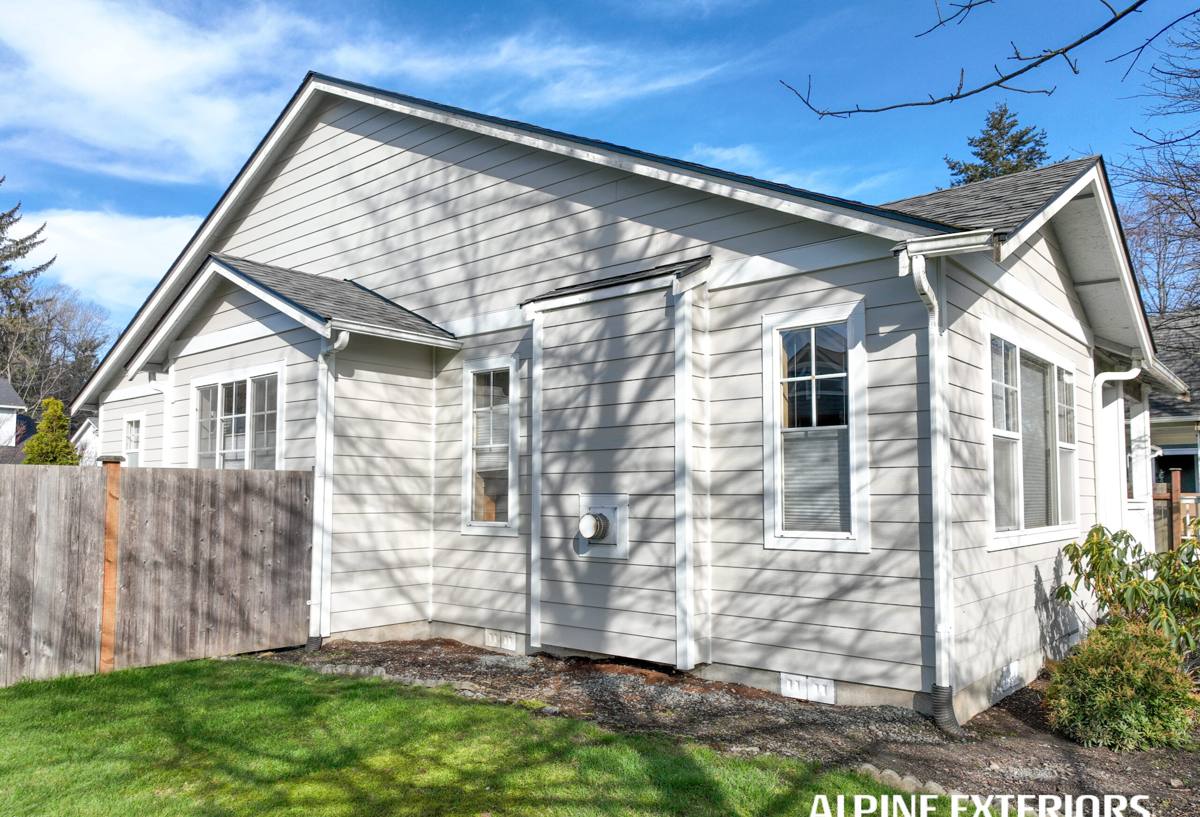
What James Hardie Siding Brings to a Birch Bay Home
James Hardie fiber cement is a mix of cement, sand, and cellulose fiber, cured into a rigid board that doesn't rot, delaminate, or feed the moss and mildew that vinyl and wood siding are prone to in this climate. It's also non-combustible, which matters increasingly as wildfire smoke and ember exposure become a regional concern even outside the driest parts of the state.
Climate-engineered product lines
James Hardie doesn't sell one siding for the whole country. Its HZ climate-zone system engineers the board composition and finish for the conditions of the region it's installed in. Whatcom County's marine climate — high humidity, heavy annual rainfall, mild but persistent damp — calls for the HZ5 product line, engineered for moisture-heavy, temperate coastal conditions rather than the deep freeze-thaw cycling of colder inland regions. Installing a generic fiber cement product not engineered for this kind of climate is one of the quieter ways siding jobs underperform here.
ColorPlus factory finish
Most of what we install uses James Hardie's ColorPlus finish — a coating baked onto the board at the factory under controlled conditions, rather than painted on site. It resists fading and chalking far longer than field-applied paint, and because it's fully cured before the boards ever reach a truck, there's no wet-paint window where a coastal storm can compromise the finish mid-install. For a home exposed to salt air and UV off the water, that durability difference shows up years sooner than most homeowners expect.
What a Correct Installation Actually Involves
Fiber cement siding is only as good as the installation behind it. James Hardie's own warranty is conditioned on installation meeting its published specifications, and on a shoreline home the margin for error is smaller than it is further inland.
Clearance and gapping
Hardie siding needs specific clearances from grade, roofing, decks, and other trim, along with consistent gapping at butt joints and penetrations. Skipping these clearances is one of the most common ways an installer accidentally invites wind-driven rain and standing moisture into a wall assembly.
Flashing and water management
Every window, door, and horizontal trim transition needs flashing that sheds water outward, not just caulk covering a gap. On a home taking wind-driven rain off the bay, flashing details at penetrations matter more than the siding material itself — this is where most real-world leaks actually originate.
Fastening
Fasteners need to be corrosion-resistant and driven to the manufacturer's specified depth and pattern — not overdriven, not underdriven, and placed in the fastener zone the plank is designed for. In a salt-air environment, the wrong fastener material shortens the life of the whole assembly even when the siding itself is holding up fine.
Weather-resistive barrier
A correctly lapped and sealed weather-resistive barrier behind the siding is the last line of defense if water does get past the cladding. It's invisible once the job is finished, which is exactly why it's the detail most likely to get shortcut by a crew in a hurry.
Our Process for a Birch Bay Siding Project
- On-site assessment. We look at existing siding condition, any moisture damage, trim details, and how the home is oriented to prevailing wind and rain off the bay.
- Tear-off and sheathing check. Old siding comes off and we inspect the sheathing underneath for rot or hidden moisture damage before anything new goes up.
- Weather-resistive barrier and flashing. We install and properly lap the water-resistive barrier, then flash every window, door, and penetration before a single plank is hung.
- James Hardie installation to spec. Planks, panels, and trim go up with correct clearances, fastening, and joint treatment per James Hardie's published installation guidelines.
- Final walkthrough and warranty registration. We walk the finished job with the homeowner and register the installation so the manufacturer's warranty is properly in force.
Cost Factors for a Birch Bay Hardie Siding Project
Every home is different, but the variables that tend to move price on a Birch Bay job are usually the same ones:
| Factor | Why It Matters Here |
|---|---|
| Existing siding removal | Tear-off and disposal cost more when old siding or trim is hiding moisture damage that needs repair before new siding goes on. |
| Sheathing repair | Homes that have been fighting wind-driven rain for years sometimes need sheathing replaced, which isn't visible until tear-off. |
| Home size and stories | More wall area and taller walls mean more material, more staging, and more labor. |
| Trim and architectural detail | Homes with more windows, corners, and trim transitions need more flashing and cutting, which adds labor time. |
| Product line and finish | HZ5-engineered boards and factory ColorPlus finish cost more upfront than field-painted options but need far less ongoing maintenance. |
| Site access | Waterfront lots, tight side yards, or limited equipment access can add time to staging and material handling. |
We walk through every one of these with the homeowner during the estimate, so there are no surprises once tear-off exposes what's actually behind the old siding.
Signs Your Current Siding Is Already Losing the Battle
Because Birch Bay's climate accelerates siding wear, it's worth checking your home for early warning signs before small problems turn into sheathing repairs:
- Persistent moss or dark streaking on north-facing or shaded walls that returns within weeks of cleaning
- Soft or spongy spots when you press on siding near the ground, around windows, or below decks
- Paint that's chalking, peeling, or fading noticeably faster on the side of the house facing the bay
- Visible gaps, warping, or separation at butt joints and corners
- Rust staining around fasteners or trim nails
- Musty smell or staining on interior walls that share an exterior wall with the affected siding
Why a Crew That Already Works Birch Bay Matters
Installation quality is only half the story — the other half is knowing what this stretch of Whatcom County actually throws at a house. A crew that mainly works drier, inland climates may install Hardie siding correctly on paper and still miss the details that matter here: how far wind-driven rain travels up a wall facing open water, which elevations need the most flashing attention, and how quickly moss re-establishes itself on a shaded wall near the bay.
We also know the practical side of working in this area — coordinating around county permitting, working efficiently on the smaller coastal lots common around Birch Bay, and scheduling around the wetter stretches of the year so a home isn't left exposed mid-project. None of that shows up in a product brochure, but it shows up in how long a siding job actually lasts.
The Warranty, and What It Actually Protects
James Hardie backs its siding with a strong, transferable limited warranty, but that coverage is tied to correct installation per its specifications. A job that looks great with the wrong fastener pattern, missing flashing, or incorrect clearances can still lose warranty protection even though the siding itself is exactly what was promised. Because we only install this one product, our crews aren't splitting attention across several manufacturers' installation requirements — Hardie's specifications are the only ones we work to, on every job.
That focus is also why we don't install vinyl, LP SmartSide, or other fiber cement alternatives. We'd rather do one product exceptionally well on a coastline that doesn't forgive shortcuts than offer a menu of options and hope every crew remembers which rules apply to which material.
Get a Straightforward Look at Your Birch Bay Siding Project
If your siding is showing its age, or you're planning ahead for a home near the water, we're happy to take a look and walk you through what a correct James Hardie installation would involve for your specific house — no pressure, no inflated scope. Use the form below to request a free estimate.