 Bellingham Window
 Why Birch Bay Roofs Wear Differently Than Roofs Inland
Birch Bay sits right on the water, and that changes what a roof has to survive. A roof a few miles inland in Whatcom County deals with rain and cold. A roof in Birch Bay deals with rain, cold, salt-laden air blowing straight off the water, and shade from mature evergreens that keeps sections of the roof damp for days after a storm passes. Those conditions don't just make a roof look worse faster — they shorten its actual service life if the wrong materials or details were used the first time around.
Salt Air and Metal Corrosion
Salt air accelerates corrosion on any exposed metal — nail heads, flashing, vent caps, and gutter hardware. On a roof that's ten or fifteen years old near the water, it's common to find rusted fasteners and pitted flashing well before the shingles themselves are due for replacement. Once flashing starts to fail, water finds its way underneath the roofing material long before a homeowner sees a stain on the ceiling.
Driving Rain and Wind-Driven Water
Storms coming off the Strait of Georgia don't just fall straight down — wind pushes rain sideways and up under laps, ridge caps, and anywhere the roofing material isn't sealed with the water direction in mind. A roof built for calmer inland weather, with standard nailing patterns and minimal underlayment, is more likely to leak during a real Birch Bay windstorm than one detailed for driving rain from the start.
Moss, Shade, and a Long Wet Season
Whatcom County's wet season runs long, and shaded, north-facing roof sections in Birch Bay can stay damp for much of the year. That's exactly what moss and algae need to take hold. Moss isn't just cosmetic — as it grows, it lifts shingle edges, holds moisture against the roof deck, and works its way into fastener holes, which is how a moss problem quietly turns into a rot problem underneath.
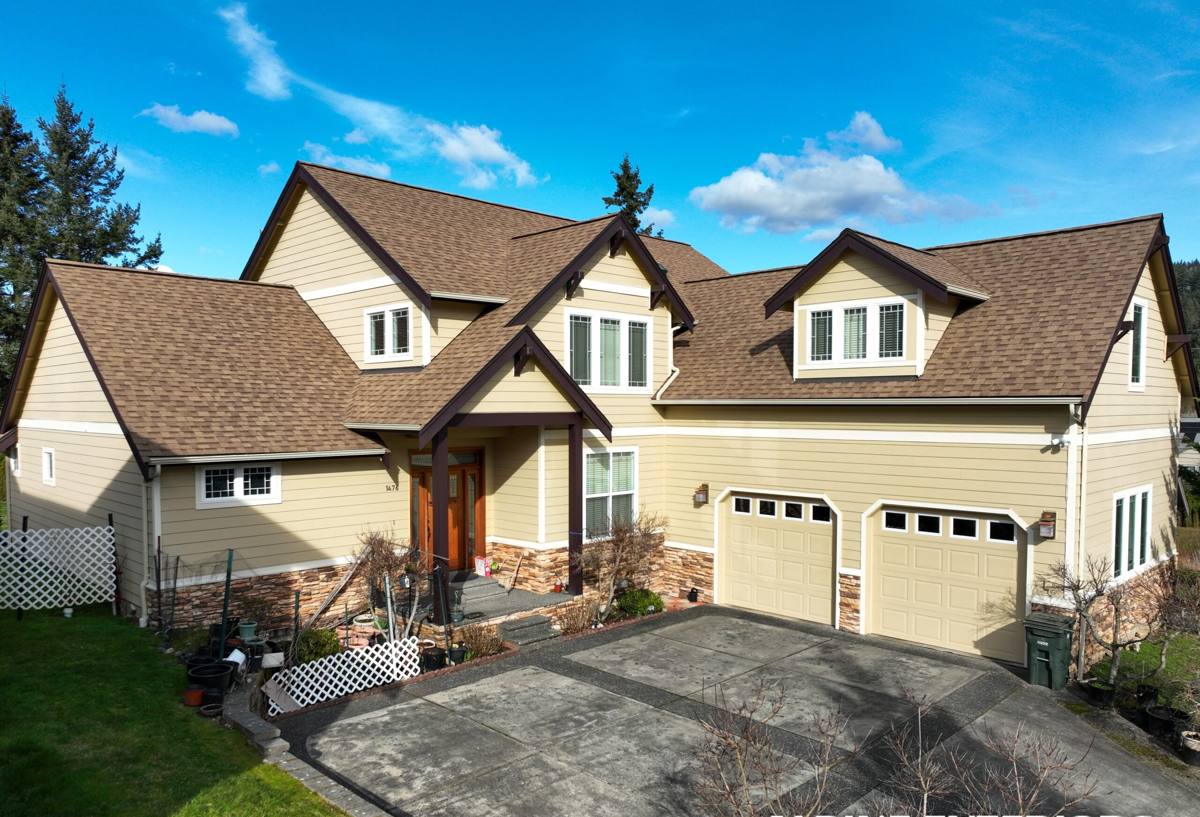
Signs a Birch Bay Roof Needs Replacement, Not Another Repair
Not every roof problem calls for a full replacement, and we won't sell one if a targeted repair will genuinely hold. But there's a point where patching keeps throwing money at a roof that's fundamentally past its service life. Some signals we look for:
- Granule loss heavy enough that you can see bare asphalt on multiple slopes, not just one worn spot
- Shingles that are cupping, curling, or cracking across large sections rather than isolated spots
- Moss growth that's returned within a year or two of being cleaned, especially on shaded slopes
- Rusted or lifting flashing around chimneys, skylights, and roof-to-wall transitions
- Soft spots, sagging, or visible daylight in the attic where there shouldn't be any
- A roof already past 20–25 years old (for asphalt) that's had multiple repair visits in the last few years
Choosing Materials That Actually Hold Up Near the Water
Material choice matters more in Birch Bay than it does a few miles inland. We install what performs honestly under salt air, wind-driven rain, and long-term moss exposure — not just what looks good on day one.
| Material | Salt-air / corrosion behavior | Moss & algae resistance | Typical maintenance |
|---|---|---|---|
| Asphalt composition shingle (algae-resistant, coastal-rated) | Good, when paired with corrosion-resistant flashing and fasteners | Better with copper or zinc granule strips; still benefits from periodic cleaning | Low to moderate |
| Standing seam metal | Very good with marine-grade coatings and stainless or coated fasteners | Very good — smooth surface sheds moss and debris | Low |
| Synthetic/composite shake | Good — doesn't corrode, but hardware still needs coastal-rated fasteners | Good — resists moisture absorption better than real wood | Low to moderate |
| Natural cedar shake | Fasteners and flashing need upgrading; the wood itself doesn't corrode | Poor without regular treatment — absorbs moisture and holds it | High — needs regular cleaning and treatment near water |
We're honest about the trade-off with untreated cedar in a shaded, coastal spot like Birch Bay: it can look great, but it asks for more upkeep than most homeowners want to keep up with, and skipping that upkeep is exactly how moss and rot get a foothold. If a homeowner wants the cedar look, we'll talk through composite alternatives that get closer to that appearance without the same maintenance burden.
What a Correct Roof Replacement Involves Here
A roof replacement done right in Birch Bay isn't just stripping old shingles and nailing down new ones. The details underneath the surface are what determine whether the new roof actually outperforms the one it's replacing.
Full Tear-Off and Deck Inspection
We remove the existing roofing down to the deck rather than layering over it. That's the only way to actually see what's happening underneath — soft or rotted sheathing, especially around old flashing points, is common on coastal roofs that have had slow leaks for years without an obvious interior sign.
Upgraded Underlayment
Given the wind-driven rain Birch Bay sees, we use synthetic underlayment with self-adhering, waterproof membrane at vulnerable spots — eaves, valleys, and roof-to-wall transitions — rather than relying on standard felt across the whole deck. This is the layer that protects the house if wind ever drives water under the shingles themselves.
Corrosion-Resistant Flashing and Fasteners
Given the salt air, we spec flashing and fasteners rated for coastal exposure rather than standard-grade hardware. This is one of the most common shortcuts on roofs that fail early near the water — it's cheap to do right at install time and expensive to fix later once rust has already let water in.
Ventilation That Matches the Home
Proper intake and exhaust ventilation keeps the roof deck dry from underneath, which matters even more when the outside air is already damp for long stretches of the year. Poor ventilation traps moisture in the attic, which shows up as premature shingle aging and, in bad cases, deck rot that has nothing to do with the roofing material itself.
Dealing With Moss Before It Comes Back
Replacing the roof is the right moment to address moss at the source rather than just cleaning it off and hoping. That means correct ventilation and moisture control as covered above, and it can also mean zinc or copper strips at the ridge, which release trace metal ions with rain runoff that discourage new moss growth on the slopes below. It's not a magic fix — shaded, north-facing slopes will still need occasional attention — but it meaningfully extends the time between cleanings.
Our Process, Start to Finish
We keep the process straightforward because a roof replacement is disruptive enough without added confusion:
- On-site inspection of the current roof, deck, ventilation, and flashing — not just a look from the ground
- A written estimate that spells out material options and what's actually driving the price
- Scheduling that accounts for Whatcom County's weather windows, since roofing needs a dry stretch to do right
- Full tear-off, deck repair where needed, and installation with coastal-rated underlayment, flashing, and fasteners
- Daily site cleanup, including magnetic sweeps for stray nails
- Final walkthrough so you know exactly what was done and what to watch for going forward
What Affects the Cost of a Birch Bay Roof Replacement
Every roof is different, but a few factors consistently move the price on jobs in this area:
- Roof size and pitch — steeper roofs take longer and require more safety setup
- Number of layers being removed and condition of the deck underneath
- Material chosen — asphalt, metal, and composite shake carry different material and labor costs
- Amount of flashing work around chimneys, skylights, and dormers
- Ventilation upgrades needed to bring an older roof system up to current standards
- Site access — tree cover and driveway layout affect staging and cleanup time
We'll walk through these specifics for your roof during the estimate rather than quoting off a square-footage number alone — two roofs the same size in Birch Bay can have very different scopes of work once flashing, deck condition, and access come into play.
Why It Matters That We Already Work in Birch Bay
A crew that mostly works dry, inland roofs can still do competent work — but they may not think twice about fastener grade, underlayment placement at the eaves, or where moss actually takes hold on a shaded coastal roof. We work this area regularly, so those details aren't an afterthought — they're just how we build a roof here. That matters both during installation and afterward, since a company that knows Birch Bay's conditions is also positioned to service what it installed if a storm ever causes an issue down the road.
If your roof is showing its age, or you just want a straight answer on whether repair or replacement makes more sense for your home, we're glad to take a look. Fill out the form below for a free, no-pressure estimate.