 Bellingham Window
 Why Columbia's Climate Is Hard on Siding
The Columbia neighborhood sits close enough to Bellingham Bay that salt-laden air is a constant factor in how exterior materials age. Add Whatcom County's long wet season, driving rain that comes in sideways off the water, and a moss season that can stretch for months under our tree cover and cloud ceiling, and you get a climate that punishes anything less than a correctly installed, moisture-tolerant siding system. Homes in this part of Bellingham don't fail because of one big storm. They fail slowly, from siding that held moisture against sheathing, joints that never should have been caulked shut, or paint film that couldn't keep up with the freeze-thaw and UV cycle here.
Older homes in Columbia often carry original wood siding or early-generation composite products that were never engineered for this specific mix of salt exposure, rainfall volume, and shade-driven moss growth. When we're called out to look at siding problems in this neighborhood, the pattern is almost always the same: moisture got behind the cladding and stayed there, because the material, the installation, or both weren't built for a marine climate.
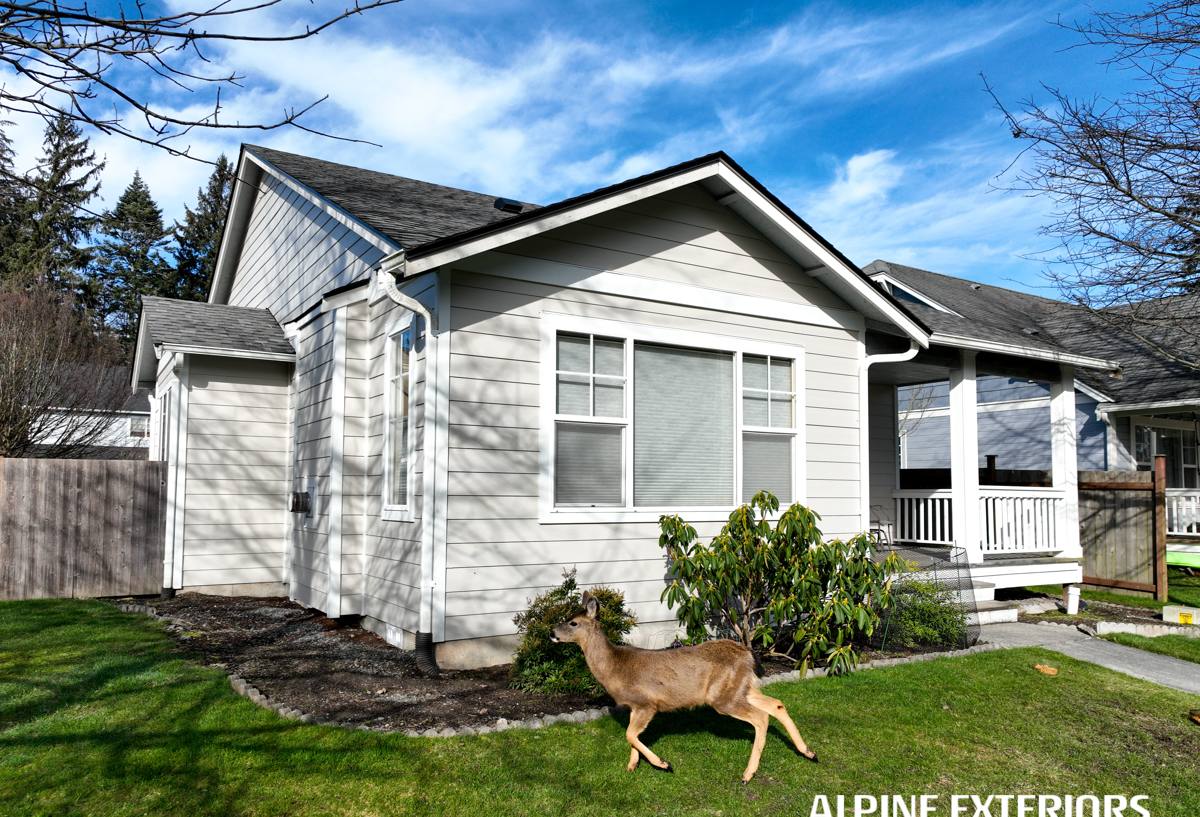
What Fiber Cement Siding Needs to Do Here
Fiber cement is not automatically the right answer just because it's cement-based. It has to be the right product line, installed to a spec that accounts for Columbia's specific exposure. That means:
- Rain-screen or properly drained water-resistive barrier behind the siding, not siding fastened tight to sheathing
- Factory-applied finish that resists salt-air oxidation and UV fade without homeowner repainting on a short cycle
- Correct clearance from grade, roofing, decks, and hardscape so splash-back and standing moisture don't sit against the bottom course
- Joint and butt-seam treatment that sheds water instead of trapping it, especially at inside corners and window returns
- A surface and formulation that resists moss and mildew growth in shaded, low-airflow wall sections
Skip any one of these and you can end up with siding that looks fine from the street for a few years and then delaminates, swells, or grows moss at the laps — problems that are expensive to fix because they usually mean pulling boards to find out how far the moisture already traveled.
Why We Only Install James Hardie
We install James Hardie fiber cement exclusively — not LP SmartSide, not vinyl, not Cemplank or Allura, not primed spruce or cedar. That's a deliberate standard, not a brand preference for its own sake. Hardie's HZ5 product line is engineered specifically for climates like ours: freeze-thaw cycling, sustained damp, and salt-air exposure near coastal water. The fiber cement core itself is non-combustible and dimensionally stable, so it doesn't swell, cup, or rot the way wood-based and wood-composite sidings can when they take on moisture repeatedly over a wet season.
The ColorPlus factory finish matters just as much as the substrate. It's baked on in a controlled environment rather than field-applied, which gives it better adhesion and UV resistance than a job-site paint job — a real advantage in a neighborhood where salt air accelerates finish breakdown on lesser coatings. Hardie also backs the product with a strong transferable warranty, which only holds up if the installation itself was done to their specification. That's the part most siding failures actually come down to.
We won't install the alternatives because we've seen what they cost homeowners in maintenance, moisture callbacks, or shortened lifespan in exactly this kind of marine climate — not because those products have no legitimate use anywhere. In Columbia's specific mix of salt air, rain volume, and shade, Hardie is what we're willing to put our name behind.
Hardie Product Lines We Use
| Product | Best Use | Why It Fits Columbia |
|---|---|---|
| HardiePlank lap siding | Primary wall cladding | HZ5 formulation resists moisture cycling and salt exposure |
| HardiePanel vertical siding | Accent walls, gables, modern facades | Fewer horizontal laps means fewer water-collection points |
| HardieTrim boards | Corners, fascia, window and door surrounds | Matches the plank's moisture and finish performance at vulnerable transitions |
| HardieSoffit panels | Eaves and overhangs | Resists the moss and mildew growth common under shaded overhangs |
What a Correct Installation Actually Involves
Most fiber cement problems we get called to inspect aren't product failures — they're installation shortcuts. A correct Hardie install in a climate like Bellingham's includes:
Before the First Board Goes Up
We check the sheathing for existing moisture damage, confirm flashing at every window, door, and roof intersection, and install a drainage plane that lets any incidental moisture find its way back out rather than sitting against the wall assembly. This step gets skipped more than any other on lower-cost jobs, and it's the one that determines whether the wall stays dry for the next 30 years.
During Installation
Fastener placement, board overlap, and gapping at butt joints all follow Hardie's published spec — not a generic "close enough" approach. Caulk is used where Hardie calls for it and left out where it isn't, since over-caulking a system designed to shed water can trap moisture instead of releasing it.
At Trim and Penetrations
Corners, window returns, and anywhere a pipe or vent penetrates the wall get the most attention, because they're where water intrusion actually starts. Rushed trim work here is the single most common cause of the moisture damage we find behind older siding in this area.
Our Process for Columbia Homeowners
- On-site assessment — we look at your current siding, sheathing condition, and any moisture history before recommending anything
- Product and color selection — matched to your home's exposure (sun side vs. shaded, wind-driven rain side vs. protected side)
- Tear-off and sheathing check — old siding comes off and we inspect for rot or existing moisture damage before closing the wall back up
- Weather barrier and drainage plane installation — the step that protects the wall for decades, done to spec every time
- Hardie installation — plank, panel, trim, and soffit installed to manufacturer fastening and clearance requirements
- Final inspection and walkthrough — we go over the completed work with you before calling the job done
Why a Crew That Already Works in Columbia Matters
Siding installation isn't identical from neighborhood to neighborhood, even within the same city. A crew that regularly works Columbia and the surrounding Bellingham waterfront-adjacent areas already knows how much clearance to build in for splash-back off hardscape near the bay, how aggressive moss growth gets on north- and shade-facing walls here, and how the prevailing wind-driven rain pattern off the water affects which wall faces take the worst of it. That local pattern recognition changes real decisions — where extra flashing attention goes, which walls get closer inspection for existing rot, how aggressively drainage needs to be prioritized on a given elevation.
It also matters for permitting and inspection. Bellingham and Whatcom County have their own permitting expectations for exterior work, and a crew that pulls permits here regularly moves through that process without surprises that delay your project.
Cost Factors to Expect
Every home is different, but the main variables that move a fiber cement siding project's cost are consistent:
| Factor | Why It Affects Cost |
|---|---|
| Existing sheathing condition | Rot or moisture damage found during tear-off requires repair before new siding goes on |
| Home size and wall complexity | More corners, dormers, and trim details mean more labor and material cuts |
| Product mix | Plank vs. panel vs. added trim and soffit work changes material cost |
| Access and site conditions | Tight lots, slopes, or limited staging area near the water affect labor time |
| Color and finish selection | ColorPlus finish options are priced differently across the Hardie line |
Signs It's Time to Replace, Not Patch
- Visible swelling, cupping, or soft spots in current siding boards
- Recurring moss or mildew staining that returns within a season of cleaning
- Paint or finish failing faster than it should between recoats
- Visible gaps or separation at butt joints and corners
- Interior signs of moisture — musty smell, staining, or soft drywall near exterior walls
If you're seeing more than one of these, patching individual boards is usually a short-term fix. The underlying moisture management is what actually needs addressing, and that's a whole-wall conversation, not a board-by-board one.
If you're weighing a siding replacement for a home in Columbia, we're happy to take a look and give you a straightforward, no-pressure estimate — including an honest assessment of whether repair or full replacement makes more sense for your situation. Fill out the form below to get started.