 Bellingham Window
 Ferndale's Climate Asks More of Your Siding Than People Realize
Ferndale sits close enough to Bellingham Bay and the Strait of Georgia that salt-laden air is a regular part of the weather here, not an occasional coastal event. Combine that with the driving, wind-pushed rain that comes through Whatcom County for much of the year, and a moss and algae season that can stretch from fall through spring, and you have a set of conditions that will find every weakness in a home's exterior. Siding on a Ferndale home isn't just cladding for looks — it's the primary barrier standing between that weather and the wood framing underneath.
Salt air accelerates corrosion of fasteners and metal flashing, and it settles into porous or damaged siding surfaces where it holds moisture longer than it would in a drier inland climate. Driving rain doesn't just fall straight down — wind pushes it sideways and up under laps, trim, and poorly sealed joints, which is why proper overlap and flashing detail matters more here than in milder climates. And moss, which thrives in Whatcom County's damp, shaded conditions, holds water directly against siding surfaces for weeks at a time, which is a slow but steady path to rot if the material underneath can't handle sustained moisture contact.
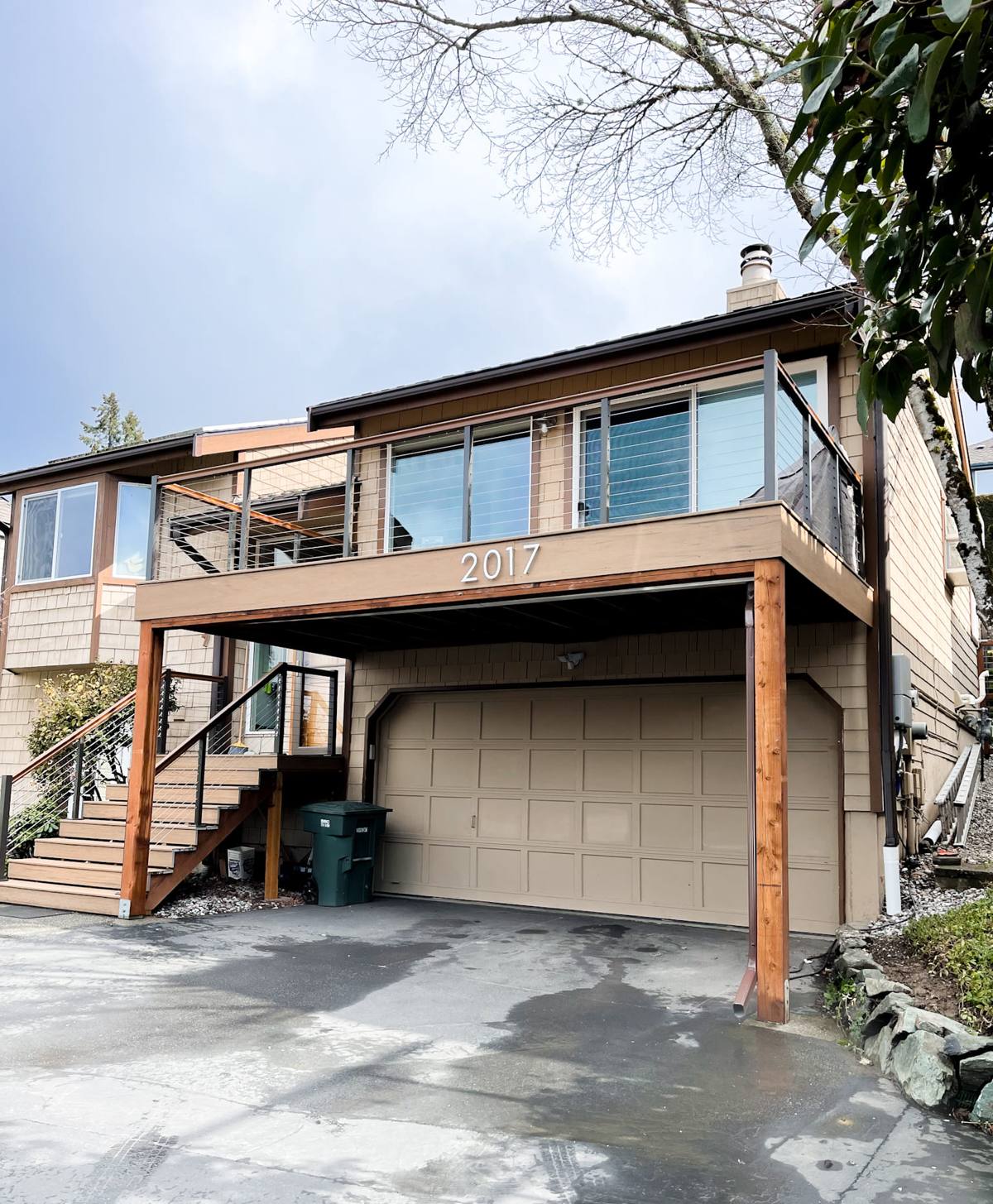
What Actually Fails on Ferndale Homes
We see a consistent pattern when we're called out to look at failing siding in and around Ferndale. It's rarely one dramatic problem — it's usually a combination of small, slow issues that compound over years.
- Fastener corrosion — salt air attacks exposed or under-driven nails and staples faster than a typical inland environment, leading to streaking and loose panels.
- Moss and algae buildup — especially on north-facing walls and under eaves that don't get much sun or airflow, holding moisture against the siding surface.
- Swelling and delamination in wood-based or engineered wood siding where water has worked past the paint film at seams, butt joints, or cut edges.
- Caulk failure at trim and window flashing, which lets wind-driven rain behind the siding plane instead of shedding it.
- Paint and finish breakdown from repeated wet-dry cycles, leaving bare material exposed to the next rain event.
None of these are unique to Ferndale, but the frequency and speed at which they show up here — with the salt air and the extended wet season — is higher than what you'd see on the same home fifty miles inland.
What a Correct Siding Replacement Actually Involves
Siding replacement isn't just removing old boards and nailing up new ones. Done correctly, it's a system, and every layer matters:
Tear-off and inspection
Once the old siding is off, we inspect the sheathing and framing underneath for rot, soft spots, or prior water damage. This is the point where problems that were hidden for years finally get found — and it's also the only point where they can be fixed properly, before new siding goes back on and covers them up again.
Water-resistive barrier
A correctly lapped, correctly taped water-resistive barrier (WRB) goes over the sheathing before any siding is installed. This layer is what actually stops bulk water that gets past the siding surface — the siding itself is the first line of defense, not the only one.
Flashing at every penetration
Windows, doors, hose bibs, vents, and any other penetration in the wall need proper flashing integrated with the WRB, so water is directed out and down rather than trapped behind the siding. This detail work is where driving rain either gets managed correctly or turns into a slow leak.
Correct fastening and clearances
Fastener type, spacing, and depth all matter — over-driven or under-driven fasteners are a common cause of early siding failure. Proper clearance from grade, decks, and roof lines also keeps splashback and standing water away from the bottom edge of the siding, which is often the first place moss and rot take hold.
Why We Install Only James Hardie Fiber Cement
We made a decision as a company to install James Hardie fiber cement siding exclusively, and we don't install vinyl, LP SmartSide, primed spruce, cedar, or other fiber cement brands. That's a deliberate standard, not a sales pitch, and it's worth explaining why in the context of a climate like Ferndale's.
Fiber cement is non-combustible and dimensionally stable — it doesn't swell, warp, or delaminate the way wood-based products can when they take on repeated moisture. James Hardie's HZ5 product line is specifically engineered for the kind of wet, coastal Pacific Northwest conditions Ferndale sits in, with a moisture and freeze-thaw performance profile suited to this region rather than a generic national spec. The factory-applied ColorPlus finish is baked on under controlled conditions, which gives it better long-term color retention and resistance to the wet-dry cycling that breaks down field-applied paint faster in a marine climate. And Hardie's warranty structure is transferable, which matters to homeowners who may sell within the life of the siding.
None of this means other products are without merit — vinyl is inexpensive and low-maintenance in mild conditions, and cedar has real aesthetic appeal. But when we weigh installation sensitivity, long-term moisture behavior, and maintenance burden against what Ferndale's salt air and rain actually do to a home over twenty or thirty years, fiber cement engineered for this climate is what we're willing to put our name behind.
Our Process for Ferndale Siding Replacement Projects
- On-site assessment — we look at the current siding condition, sheathing access points, drainage and grading around the foundation, and any moss or moisture patterns specific to the home's orientation.
- Scope and product selection — we walk through the right Hardie plank, shingle, or panel profile and ColorPlus color for the home, and give a clear, written scope of work.
- Tear-off and sheathing repair — old siding comes off, damaged sheathing or framing is repaired before anything new goes up.
- WRB and flashing installation — a fully lapped water-resistive barrier and correctly integrated flashing at every window, door, and penetration.
- Hardie installation to manufacturer spec — correct fastener type, spacing, clearances, and joint treatment, installed to James Hardie's published installation requirements so the warranty stays intact.
- Final walkthrough — we go over the finished work with you before calling the job done.
Signs a Ferndale Home Needs Siding Replacement Now
| What You See | What It Usually Means |
|---|---|
| Persistent moss or algae that returns after cleaning | Siding surface or shaded wall area is staying wet longer than the material can tolerate |
| Soft or spongy spots when pressed | Moisture has reached the substrate underneath — often further along than it looks from outside |
| Peeling, bubbling, or chalky paint | Finish has broken down and is no longer shedding water effectively |
| Visible fastener rust or streaking | Fasteners are corroding, often accelerated by salt air exposure |
| Gaps or warping at panel seams | Material is moving with moisture cycles — a sign of a product not suited to sustained wet conditions |
Cost Factors for a Ferndale Siding Replacement
Every home is different, but the same handful of factors drive most of the cost variation we see on Ferndale projects:
| Factor | Why It Matters |
|---|---|
| Sheathing/framing condition | Hidden rot found at tear-off adds repair scope before new siding can go on |
| Home size and wall complexity | More corners, gables, and dormers mean more cutting, flashing, and labor time |
| Siding profile and trim detail | Lap width, shingle-style accents, and trim board choices affect material and labor cost |
| Access and site conditions | Tight lot lines, landscaping, or multi-story walls affect staging and scaffolding needs |
| Existing siding removal | Multiple layers of old siding or extensive moss/mold remediation add to tear-off time |
We give a firm, written scope and price after the on-site assessment — not a rough phone estimate — because the sheathing condition alone can change the real cost of a job significantly.
Why Hiring a Crew That Already Works Ferndale Matters
A contractor who works Ferndale regularly already understands the drainage patterns, wind exposure, and moss behavior specific to this part of Whatcom County — not just Pacific Northwest siding in general. That local familiarity shows up in small but important decisions: which walls need extra attention to flashing detail because they take the brunt of driving rain, which north-facing sections are going to hold moisture the longest, and how grading and gutter placement on a specific lot affects splashback at the base of the siding. It also means a crew that's installed Hardie in this exact climate long enough to know how it performs here, not just how it's supposed to perform on paper.
If you're weighing siding replacement for a Ferndale home, we're happy to come take a look and walk you through what we're seeing and what we'd recommend — no pressure, no obligation. Reach out using the form below for a free estimate.