 Bellingham Window
 Fiber Cement Siding Built for South Hill's Hillside Homes
South Hill sits above downtown Bellingham on rising ground, close to Western Washington University, with a mix of older character homes and newer infill sitting on sloped lots under a heavy tree canopy. That elevation and tree cover give the neighborhood some of the best views in the city, but they also create a specific set of demands on exterior siding that a flatter, more sheltered lot doesn't face in the same way. Wind off Bellingham Bay reaches these hillside walls with less to slow it down, rain gets driven into lap joints and trim at an angle rather than falling straight down, and the shade from mature trees keeps moisture sitting on north- and east-facing walls longer than it does on open, sun-exposed lots elsewhere in the city.
This page is specifically about fiber cement siding for South Hill homes, not siding in general. We install one product system, James Hardie fiber cement, and this is what we've learned about getting it right on this particular stretch of hillside: what the climate actually does to a wall assembly here, what a correct installation requires, how our process works from first walkthrough to final inspection, and why a crew that already works this neighborhood catches things a crew passing through for one job usually misses.
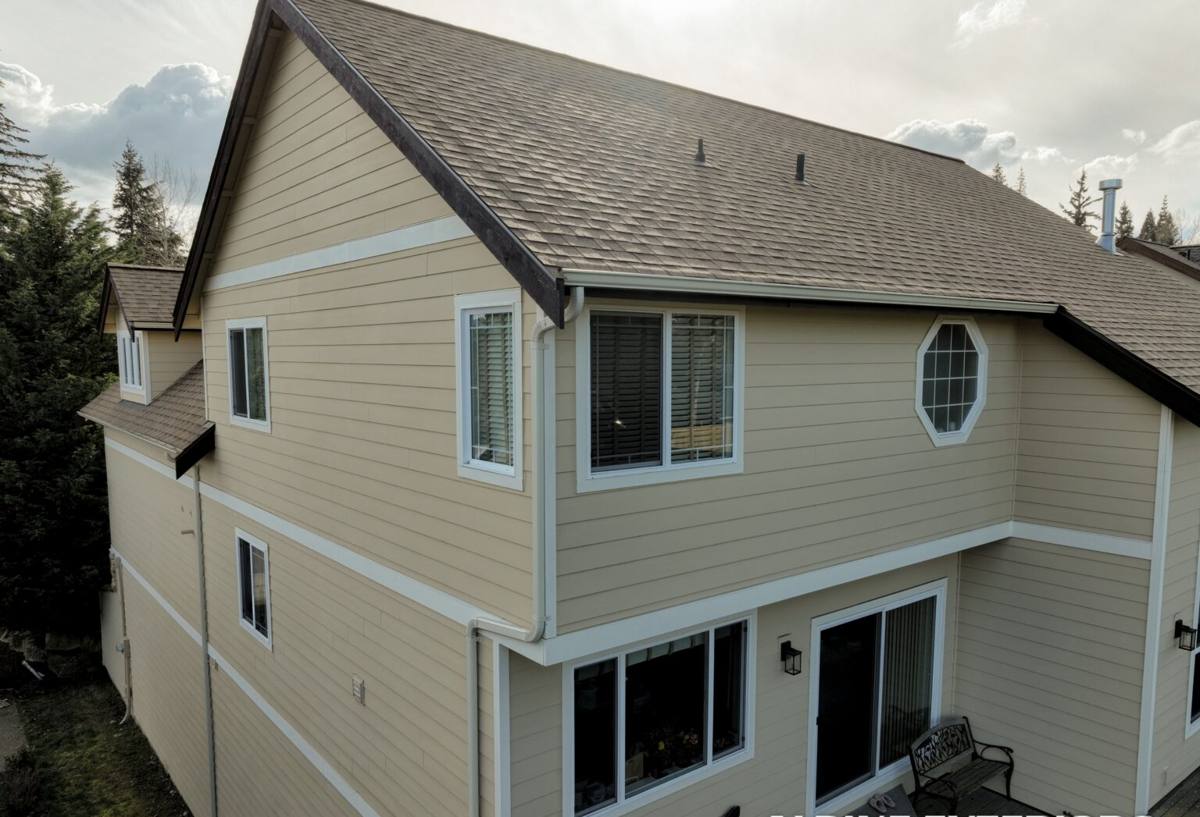
What South Hill's Climate Actually Does to Siding
Elevation and Wind Exposure
Homes higher up South Hill's slope catch more direct wind than houses tucked into lower, more sheltered parts of Bellingham. That matters for siding because wind is what turns ordinary rainfall into wind-driven rain, pushing water sideways into lap seams, corner trim, and anywhere a wall penetration hasn't been flashed with real care. A siding system that would perform adequately on a calm, low-lying lot can still let water in on an exposed hillside wall simply because the wind is attacking it from an angle a straightforward vertical-rainfall assumption doesn't cover.
Salt Air Off the Bay
Like the rest of Bellingham, South Hill sits close enough to Bellingham Bay and the Salish Sea to get a steady, low-grade dose of salt-tinged marine air, even on days without an obvious storm. Over years, that kind of sustained exposure works on fasteners, flashing, and lower-grade factory or field finishes in a way that's slow and easy to miss until it isn't. It's one more reason the finish on a siding board matters as much as the board itself.
Tree Canopy and a Long Moss Season
South Hill's older neighborhoods carry a lot of mature tree cover, which is part of what makes the area attractive and part of what makes siding maintenance harder. Shaded, tree-covered walls stay damp longer after a rain event than open walls do, and that extended dampness is exactly what moss, algae, and mildew need to establish themselves. Any siding material with even slight porosity, or one that traps moisture against the substrate instead of shedding it outward, becomes a growth surface on these shaded elevations, and it typically shows up first in spots nobody's looking at closely: behind shrubs, under eaves, on the north wall facing the trees.
Why We Install Only James Hardie Fiber Cement
We don't carry a lineup of siding brands and let price sort out the decision. We install James Hardie fiber cement, and the reason comes from what we've consistently found tearing old siding off hillside homes in this climate.
- Non-combustible core: Fiber cement doesn't feed a fire the way wood-based siding products can, which matters for household safety and can matter for insurance considerations as well.
- Factory-applied ColorPlus finish: The color coat is cured under controlled factory conditions rather than brushed on after installation, which holds up far longer against fading and moisture intrusion than field-applied paint exposed to this much sustained rain.
- Climate-engineered HZ product lines: Hardie's HZ5 formulation is built for regions with heavy sustained moisture and freeze-thaw cycling, which fits a wind-exposed, tree-shaded hillside neighborhood better than a generic national siding spec.
- Dimensional stability: Fiber cement doesn't swell, cup, or warp the way engineered wood products can after repeated wet-season moisture cycles, which matters on walls that stay damp longer under South Hill's tree canopy.
- Strong transferable warranty: Hardie backs its products with one of the more substantial warranty structures in the industry, provided the installation is done to spec.
We don't install LP SmartSide, vinyl siding, Cemplank, Allura, primed spruce, or cedar. Those are legitimate products, and other contractors install them competently. But standing behind one system we trust completely, rather than offering a cheaper alternative that quietly shifts maintenance risk onto the homeowner a few years down the road, is the professional standard we've chosen for a climate that's this consistently wet, windy, and salt-exposed.
What a Correct Fiber Cement Installation Requires on a Hillside Home
Buying the right material is only half the job. A James Hardie installation performs the way it's engineered to only when the fastening pattern, clearances, and flashing details are all done correctly, and hillside homes raise the stakes on a few of these details specifically.
- Grade and roofline clearance: Sloped South Hill lots can create tight or uneven clearance between siding and grade on the downhill side of a foundation, which needs to be addressed correctly rather than shimmed around.
- House wrap and flashing as one system: On a wind-exposed wall, house wrap, flashing, and the siding itself have to work together rather than as separate steps done in isolation, since wind-driven rain will find the one seam that wasn't sealed.
- Lapped and sealed joints: Every horizontal lap and vertical joint is a potential entry point; correct overlap and sealant application is what keeps water moving down and out instead of behind the wall.
- Fastening pattern matched to exposure: More exposed elevations on a hillside lot may call for a tighter fastening schedule than a sheltered wall, which is a judgment call that comes from experience with this specific terrain.
- Substrate assessment before install: Older South Hill homes often have original sheathing that's never been inspected since the house was built; siding goes on faster and lasts longer when hidden rot or moisture damage is caught and addressed first, not covered over.
Rushed or corner-cut installation is one of the most common reasons a well-engineered product develops problems, and it's why we treat install detail with the same seriousness as the material choice itself.
Our Process for a South Hill Siding Project
Every property on this hillside is a little different in age, exposure, and existing condition, so our process is built to catch that variation before it becomes a surprise mid-project.
- On-site walkthrough: We look at the whole exterior, not just the siding, and assess wind exposure, tree cover, existing moisture damage, and how the slope of the lot affects grade clearance and staging access.
- Substrate and moisture check: Where old siding is coming off, we check for soft sheathing, trapped moisture, or prior water intrusion before pricing the full scope, so the quote reflects reality rather than a best-case guess.
- Product and color selection: We walk through Hardie's plank profiles, panel options, and ColorPlus color selection based on the home's style and the specific wall exposures involved.
- Tear-off and prep: Old siding comes off, house wrap and flashing go in correctly, and any substrate repairs happen before a single new board goes up.
- Installation to manufacturer spec: Fastening, clearances, and joint detailing follow Hardie's installation requirements, adjusted for the specific wind and moisture exposure of that wall.
- Final walkthrough: We go over the finished job with you directly so you know what was done and why, not just that it's finished.
Fiber Cement Siding Cost Factors on South Hill
| Factor | What It Affects | Why It Matters on South Hill |
|---|---|---|
| Home age and original construction | Substrate repair scope | Older hillside homes may have original sheathing that's never been opened up or inspected for moisture damage |
| Slope and site access | Staging, equipment, and labor time | Sloped lots and mature trees common on South Hill can add setup time compared to a flat, open lot |
| Tear-off vs. overlay | Labor scope and what gets uncovered | Tear-off exposes hidden moisture damage that's common under decades-old siding on shaded walls |
| Wall exposure and orientation | Fastening pattern and flashing detail | Wind-exposed elevations on higher ground need tighter attention than sheltered walls facing away from the bay |
| Trim complexity | Material cost and installation time | Older character homes on the hill often carry more trim detail than newer flat-walled construction |
Real numbers depend on the specific house and lot, which is why we walk the property before quoting rather than pricing off square footage alone.
Signs Your South Hill Home's Siding Needs Attention
- Moss or dark staining that returns quickly after cleaning, especially on shaded, tree-covered walls
- Soft or spongy siding near the foundation line, particularly on the downhill side of the house
- Peeling paint, bubbling, or visible warping on siding boards
- Cracked, chipped, or missing sections after a windstorm off the bay
- Visible gaps at seams, corners, or trim joints where wind-driven rain can track in
- Rising heating bills that may point to a wall assembly that's no longer sealing properly
Roofing, Windows, and Decks Alongside Your Siding
Siding problems on a hillside home rarely start with the siding itself. A roof valley shedding water toward the wrong wall, a window flashed incorrectly years ago, or a deck ledger trapping moisture against the house can all surface as siding damage even though the siding is just where the water finally shows itself. Because we also handle roofing, windows, and decks, we can look at a South Hill property as one connected exterior system and trace a problem back to where it actually starts, instead of siding over a leak that's still active underneath.
Why a Crew That Already Works South Hill Matters
A crew that regularly works this hillside knows which elevations catch the worst of the wind off the bay, which walls stay damp longest under the tree canopy, and where the extra ten minutes of flashing attention on install day saves a callback two winters later. That kind of judgment doesn't come from a spec sheet; it comes from having actually worked the terrain. South Hill's mix of older housing stock, sloped lots, and heavy tree cover isn't identical to flatter, more open parts of Bellingham, and a crew with hands-on experience here accounts for that instead of applying a one-size-fits-all approach to every job.
If your South Hill home needs new siding, a repair, or just an honest look at what's actually happening behind an aging wall, we're glad to take a look. Reach out using the form below to schedule a free, no-pressure estimate.