 Bellingham Window
 Roofing in Lynden's Nooksack Valley Climate
Lynden sits inland from Bellingham Bay in the Nooksack River valley, but the roofs here still answer to the same weather system that soaks the rest of Whatcom County. Moisture pushes in off the Salish Sea and settles into the valley, driving rain sideways during winter storms and leaving a low, damp haze over rooftops for weeks at a stretch. That combination of humidity, shade from mature trees on older lots, and long stretches without direct sun is exactly what asphalt shingles need in order to grow moss, algae streaking, and soft, waterlogged spots that a drier climate would never produce.
None of that means asphalt shingles are a poor fit for Lynden. It means the installation has to account for how this valley actually behaves through a full year: heavy fall and winter rain, freeze-thaw swings in January and February, wind events that come through the flatter farmland with less tree cover to block them, and a moss season that can run from October through May if a roof isn't set up to shed water and dry out between storms.
What a Correct Shingle Roof Has to Get Right Here
Underlayment and Water Barrier
A shingle is the visible layer, but the underlayment underneath it is what actually keeps a Lynden roof dry through a wet winter. We use a synthetic underlayment across the full roof deck and add self-adhering ice and water barrier at the eaves, valleys, and any low-slope transitions — the spots where wind-driven rain and ponding water are most likely to find a way in. Skipping or skimping on this layer is one of the most common reasons an otherwise decent-looking shingle roof develops leaks within a few years.
Ventilation
Trapped attic moisture is a year-round problem in this climate, not just a summer heat issue. A roof that isn't properly balanced between intake vents at the eaves and exhaust at the ridge holds humid air against the underside of the deck, which shortens shingle life from below and can lead to rot, mold, and premature sheathing failure — problems you won't see until they're expensive. We check and correct ventilation as part of every reroof, not as an upsell.
Flashing at Every Penetration
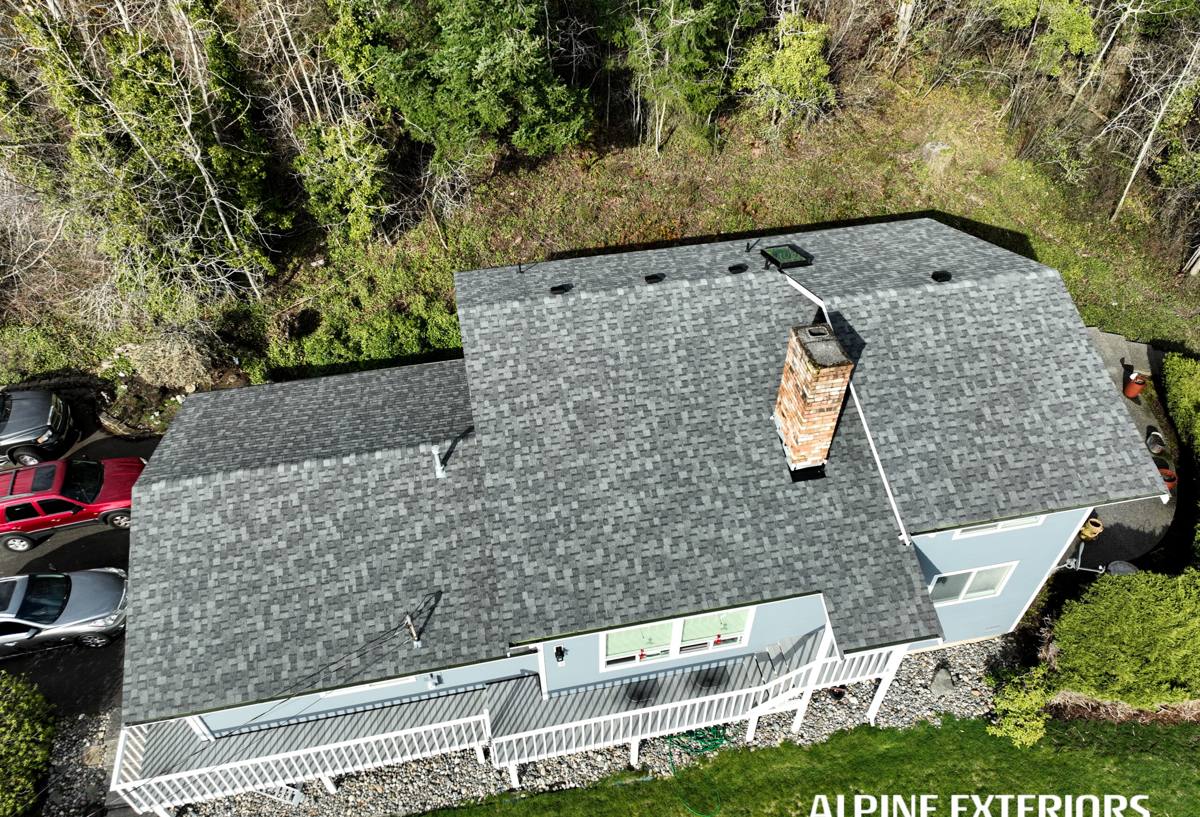
Chimneys, skylights, plumbing vents, and roof-to-wall transitions are where nearly every roof leak in this region actually starts — not in the open field of shingles. Correct step flashing, counter-flashing, and pipe boots, installed and sealed properly rather than just caulked over, matter more to a roof's actual lifespan here than the shingle brand printed on the wrapper.
Signs Your Lynden Roof Needs a Look
Most roof problems in this climate show themselves gradually. Catching them early is the difference between a repair and a full replacement.
- Granules collecting in gutters or at the base of downspouts
- Shingles that look cupped, curled at the edges, or cracked
- Dark streaking or thick moss growth, especially on north-facing slopes
- Soft or spongy spots when walked, or visible sagging between rafters
- Daylight visible through the roof deck from inside the attic
- Water stains on interior ceilings, especially after a heavy rain event
- Missing or lifted shingles after a windstorm
- Rust or gaps around flashing at chimneys, vents, and skylights
Choosing Shingles for a Wet, Mossy Climate
Not every asphalt shingle product performs the same way once it's dealing with Whatcom County humidity year after year. The table below compares the shingle classes we most often discuss with Lynden homeowners.
| Shingle Type | Typical Lifespan Here | How It Handles This Climate |
|---|---|---|
| 3-tab (economy) | Shorter end of the range | Lighter weight and less wind resistance; moss and algae show more visibly on the flat profile |
| Architectural / dimensional | Mid to long range | Heavier mat, better wind rating, more forgiving of the freeze-thaw and wind exposure common in the valley |
| Algae-resistant (copper- or zinc-infused granules) | Mid to long range | Specifically slows the dark streaking and moss growth that shaded, damp Lynden roofs are prone to |
| Impact-resistant (Class 4) | Longer range | Extra resistance to hail and wind-driven debris; often eligible for an insurance discount, worth asking your carrier |
For most homes in this area, we recommend an architectural shingle with algae-resistant granules as the practical baseline — the added cost over economy 3-tab is modest, and the moss and streaking resistance directly addresses the problem this valley's climate causes fastest.
Our Process, Step by Step
- On-site inspection. We walk the roof and the attic, checking the deck, flashing, ventilation, and current shingle condition rather than quoting from the ground or a satellite photo.
- Written scope and material plan. You get a clear explanation of what's being replaced, what underlayment and flashing package is being used, and why — no vague line items.
- Tear-off and deck inspection. Old material comes off down to the deck so we can actually see and repair any soft or rotted sheathing before anything new goes down.
- Underlayment, ice barrier, and flashing. This is the layer that does the real work of keeping water out, installed before a single shingle is nailed.
- Shingle installation. Installed to manufacturer nailing and exposure specs, which is what keeps the wind warranty valid.
- Ventilation check and correction. Intake and exhaust are balanced as part of the job, not treated as separate work.
- Cleanup and magnetic nail sweep. The yard and driveway get checked for debris and stray fasteners before we consider the job finished.
- Final walkthrough and warranty paperwork. You see the finished roof with us before we leave, and you get manufacturer and workmanship warranty documentation in writing.
Repair or Replace? Cost Factors to Weigh
Not every roof problem in Lynden requires a full tear-off. The table below outlines the factors that usually tip the decision one way or the other.
| Factor | Leans Toward Repair | Leans Toward Replacement |
|---|---|---|
| Age of current roof | Under roughly half its expected lifespan | Near or past its expected lifespan |
| Extent of damage | Isolated to one area, slope, or penetration | Spread across multiple slopes or the whole roof |
| Deck condition | Sheathing is sound underneath | Soft, rotted, or delaminated decking found during inspection |
| Moss and algae staining | Surface-level, recently treated | Long-term growth that's degraded the granule layer |
| Number of existing layers | Single layer, straightforward repair access | Multiple old layers requiring full tear-off anyway |
When a roof is borderline, we'll say so plainly, including when a repair is the honest answer even though a replacement is the bigger job for us. A roof that's clearly past its usable life gets a straightforward recommendation to replace, with the reasoning laid out so you can make the call with real information.
Moss Season Maintenance That Actually Helps
A well-installed shingle roof still benefits from basic upkeep in this climate, especially given how long moss season runs in a river valley with plenty of shade trees. None of this needs to be complicated or frequent.
- Clear gutters and downspouts before the fall rains start, and again mid-winter if trees are nearby
- Remove moss buildup gently — no pressure washing, which strips granules and shortens shingle life
- Trim back overhanging branches to cut down on shade, debris, and squirrel or rodent access
- Check attic ventilation isn't blocked by insulation or stored items
- Have a soft-wash or moss treatment applied on a reasonable schedule rather than waiting until growth is heavy
- Walk the roofline after major wind events to look for lifted or missing shingles
Why a Crew That Already Works Lynden Matters
Roofing crews who mostly work drier climates or different building stock tend to under-spec ventilation and underlayment because it's never bitten them before. A crew that works Whatcom County roofs regularly has already seen what happens when those details get skipped in a valley climate like this one — the callbacks, the rot, the moss coming back within a season — and builds the job to avoid it from the start.
There's also a practical side to local experience: knowing which roof pitches and layouts are common on Lynden homes, understanding how local permitting and inspection work, and having existing relationships with material suppliers so the right shingle and underlayment package is available without delay. None of that shows up on a quote sheet, but it shows up in how the finished roof performs three winters later.
Workmanship and Warranty
Manufacturer warranties on asphalt shingles cover material defects, but most roof failures in this climate trace back to installation details — flashing, ventilation, and underlayment — rather than the shingle itself. That's why we back our installation work with our own workmanship warranty in addition to whatever the shingle manufacturer provides, and we register manufacturer warranties properly so they're valid if you ever need them.
If your Lynden roof is showing moss, granule loss, or you're just not sure how much life it has left, we're glad to take a look and give you a straight answer. Reach out for a free, no-pressure estimate using the form below.