 Bellingham Window
 Roof Replacement in Lynden: What This Valley's Climate Demands
Lynden sits inland in the Nooksack River valley, in the northern part of Whatcom County near the Canadian border. It doesn't take direct salt spray the way some of our waterfront service areas do, but it still sits inside the same marine-influenced weather system that shapes exterior work across this whole corner of Washington. Moist air moves up the valley off the Sound, rain arrives wind-driven more often than straight down, and mild temperatures give moss a long growing season on any roof plane that stays shaded or damp. A roof built without those loads in mind — or installed correctly for a drier inland climate but not this one — tends to show its age faster than the shingle warranty suggests it should.
A full roof replacement is a bigger decision than most exterior projects a homeowner makes, both in cost and in how long you'll live with the result. This page covers what a Lynden roof actually needs to hold up, what a correct replacement involves step by step, how we approach the job, and why the details matter more here than a generic install would suggest.
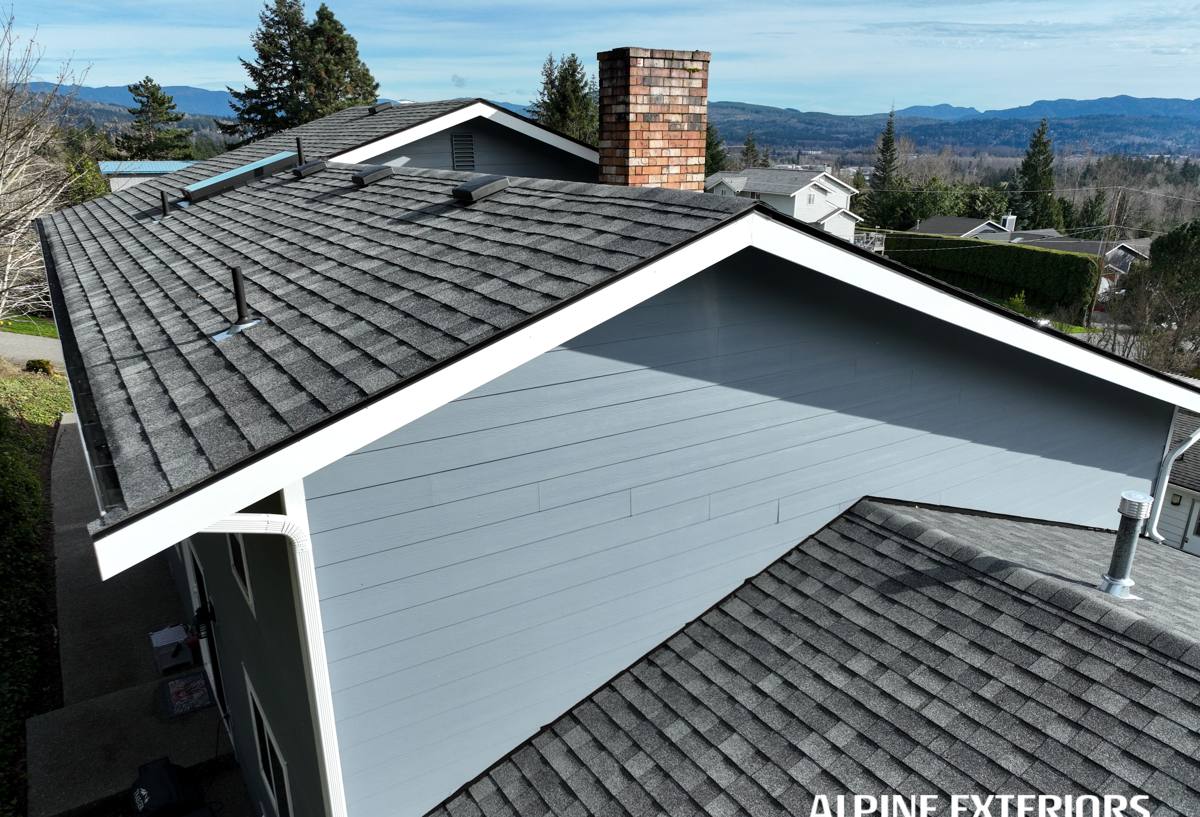
Signs a Lynden Roof Has Reached Replacement, Not Repair
Not every aging roof needs full replacement. But a combination of the signs below, especially on a roof already near or past its expected service life, usually means patching further is just delaying a bigger bill.
What You Can See From the Ground
- Shingles curling at the edges or cupping across large sections, not just one or two spots
- Bald patches where granules have worn away, exposing the asphalt mat underneath
- Granules collecting heavily in gutters or at the base of downspouts
- Moss covering entire slopes rather than just a shaded corner, especially if it returns quickly after cleaning
- Flashing at valleys, chimneys, or vent pipes that looks lifted, rusted, or repeatedly caulked over
- Visible sagging along the roofline or in a valley instead of a straight, even plane
What the Attic Tells You
The attic usually shows trouble before it reaches a ceiling. Daylight visible through the roof boards, dark staining on the underside of the deck or rafters, soft or spongy sheathing when pressed, and a persistent musty smell all point to moisture that's been sitting in the deck longer than it should. Rust on the tips of nails poking through the sheathing is another reliable tell. Because wind pushes rain sideways under shingle edges and around flashing here more than it would in a calmer climate, an attic check catches problems a ground-level look can miss entirely.
What a Correct Roof Replacement Actually Involves
A roof replacement is more than swapping old shingles for new ones. The steps that happen underneath the visible roofing are what determine whether the job lasts twenty-five years or fails at year twelve.
- Full tear-off to the deck. A layover job over old shingles hides deck damage and traps moisture between layers. Removing everything down to the sheathing is the only way to actually see what condition the roof structure is in.
- Deck inspection and repair. Any soft, rotted, or delaminated sheathing gets identified and replaced before anything new goes down. Roofing over damaged decking just buries the problem.
- Ice-and-water shield at eaves and valleys. These are the spots where water and debris collect and where wind-driven rain is most likely to find a way in. A self-adhered membrane here is cheap insurance relative to the cost of the job overall.
- Synthetic underlayment across the field. Modern synthetic underlayments handle sustained damp exposure better than older felt products, which matters on a roof that rarely gets a long, uninterrupted dry stretch to fully shed moisture.
- Flashing at every penetration and transition. Valleys, chimneys, skylights, vent pipes, and roof-to-wall intersections get properly lapped and sealed metal flashing — not just sealant applied over old flashing.
- Ventilation correction where needed. Balanced intake and exhaust ventilation lets attic moisture escape instead of condensing against the underside of the deck, which is one of the biggest drivers of premature roof failure in this climate.
- Roofing material installation. Shingles, panels, or shakes installed to manufacturer spec and local wind-exposure standards, with corrosion-resistant fasteners throughout.
- Cleanup and magnetic nail sweep. The yard, driveway, and landscaping get cleared of debris and stray fasteners before the crew leaves.
Skipping or shortcutting any one of these rarely shows up as a problem on day one. It shows up two or three winters later, as a leak that's harder and more expensive to trace than it would have been to prevent.
Choosing a Roofing Material for Lynden's Moss and Moisture Load
There's no single correct material for every roof — pitch, sun exposure, tree cover, and budget all factor in. What matters is understanding the real trade-offs before deciding, rather than defaulting to whatever's easiest to sell.
| Material | Moss & Moisture Behavior | Typical Maintenance | Realistic Lifespan Here |
|---|---|---|---|
| Architectural asphalt shingle | Performs well with proper ventilation; algae-resistant granule options help against moss and streaking | Periodic moss removal and gutter checks | 20-30 years |
| Standing seam metal | Sheds water and moss buildup effectively due to a smooth, non-porous surface | Low; occasional fastener and sealant checks | 40-60 years |
| Composite/synthetic shingle | Resists moisture absorption; performance varies meaningfully by product quality | Low to moderate | 30-50 years depending on product |
| Cedar shake | Absorbs moisture readily; needs airflow underneath to dry fully between rains | Higher; regular treatment and moss control required | 20-30 years with consistent upkeep |
On a shaded, north-facing roof plane that holds moisture longer, we'll often steer the conversation toward a material and ventilation setup that sheds moss more readily, rather than fighting the same maintenance battle every year. On a sun-exposed, steep roof, the calculation can look different. We'll walk through what fits your specific roof rather than applying the same recommendation to every house in Lynden.
What Drives the Cost of a Lynden Roof Replacement
Two bids for what looks like the "same" roof can differ by a meaningful amount, and the gap is rarely about one contractor simply charging more. It usually reflects real differences in scope and material grade.
| Cost Factor | What It Affects | Why It Matters Here |
|---|---|---|
| Tear-off scope | Labor time and ability to inspect the deck | Full tear-off exposes moisture damage that layover roofing hides for years |
| Deck repair | Sheathing replacement where rot or delamination is found | Sustained moisture exposure makes deck damage more common here than in drier climates |
| Underlayment and ice-and-water shield | Water resistance under the roof covering | Directly affects how well the roof handles wind-driven rain at eaves and valleys |
| Material grade | Wind rating, algae resistance, expected lifespan | Algae-resistant products matter given how long moss season runs here |
| Flashing scope | Valleys, chimneys, skylights, wall intersections | Most roof leaks in this climate start at flashing, not the field of the roof |
| Ventilation upgrades | Attic airflow and moisture control | Poor ventilation accelerates deck rot and moss growth from underneath |
| Roof pitch and access | Staging, safety equipment, and labor time | Steeper or harder-to-access roofs on older Lynden homes add real labor hours |
When bids differ significantly, ask each contractor to walk you through exactly what's included rather than comparing bottom-line numbers alone. A detailed written estimate that specifies tear-off depth, underlayment type, and flashing scope is worth more than a lower one-line quote.
The Details That Actually Prevent Leaks
Most roof leaks in this climate don't come from a bad batch of shingles — they come from a flashing detail or ventilation gap that was rushed. On every replacement, that means properly lapped step flashing at wall intersections, counterflashing set into masonry rather than surface-sealed, correctly sized and placed roof vents, and pipe boots rated for long-term UV and moisture exposure rather than the cheapest available option. It also means checking that existing gutters and downspouts can actually keep up with the volume of wind-driven rain this area sees, since a roof that sheds water correctly onto an undersized gutter system still ends up with moisture problems at the fascia and soffit.
None of these details add meaningfully to the overall cost of a job relative to the roofing material itself. Skipping them is what turns a twenty-five-year roof into a fifteen-year roof.
A Roof Doesn't Replace Itself in Isolation
A roof is one component of the exterior envelope, not a standalone product, and a replacement is a natural point to check what's happening around it. Fascia and soffit boards exposed by a tear-off sometimes reveal rot that's been hidden by the old roofing. Siding or trim at a roof-to-wall transition can show moisture staining that traces back to the roof, not the wall. We work on windows, siding, roofing, and decks across Whatcom County, so if a roof project turns up an issue at a nearby window head flashing or a section of aging trim, we can address it as part of the same conversation instead of sending you to find a second contractor for a problem we already found.
Our Roof Replacement Process
The process is the same whether it's a straightforward reroof or one complicated by deck damage found mid-project:
- An in-person inspection of the roof, attic, and visible flashing points — not a drive-by estimate from the street
- A written, itemized estimate covering tear-off scope, underlayment, flashing, ventilation, and material, before any commitment
- Scheduling that accounts for realistic weather windows rather than promising a date we can't hold to
- Tear-off and deck inspection, with any damage found photographed and explained before we cover it back up
- Installation of underlayment, flashing, ventilation, and roofing material to spec
- A final walkthrough so you can see the completed work and ask questions before we consider the job done
- Cleanup and a magnetic nail sweep of the property
If a repair turns out to be a more honest answer than a full replacement, we'll tell you that instead of pushing the larger job. That kind of honesty is part of what a crew with a long-term local reputation has to protect.
A Practical Checklist Before You Sign a Roof Replacement Contract
- Is the current Washington state contractor license active, and is general liability and workers' compensation coverage in place?
- Does the written estimate specify tear-off scope, underlayment type, and flashing detail, not just a total price?
- Is the exact roofing product and grade named, rather than a generic description like "architectural shingles"?
- Does the warranty spell out what's covered by the manufacturer versus the installing contractor, and for how long each?
- Is deck repair addressed as a contingency with a clear per-sheet cost, rather than a vague allowance?
- Is cleanup and nail sweep of the property included in the scope?
Why a Crew That Already Works Lynden Matters
A crew that works roofs across Whatcom County through every season sees how moss, wind-driven rain, and moisture actually behave on real houses over years, not just how a material performs on a spec sheet. That shows up in practical decisions on install day: which roof orientations in a valley town like Lynden need extra ventilation because of tree shade, how much ice-and-water shield a given valley actually needs, and which flashing details are worth the extra time so you're not dealing with a callback two winters later. Lynden's inland position in the valley means its exposure isn't identical to a waterfront town's, and a crew with genuine local experience accounts for that instead of applying the same approach to every roof in the county.
If your Lynden home needs a roof replacement, or you're not yet sure whether a repair will still hold, we're glad to take a look. Reach out using the form below to schedule a free, no-pressure estimate.