 Bellingham Window
 Siding Installation in Lynden: Built for This Valley's Weather
Lynden sits in the Nooksack River valley in the northern reaches of Whatcom County, close enough to the Canadian border and Puget Sound's marine air to catch the same weather patterns that shape exterior work across this whole corner of Washington. Homes here take on salt-tinged air moving up the valley, long stretches of wind-driven rain through fall and winter, and a moss and mildew season that can run most of the year on shaded or north-facing walls. That combination puts a lot of pressure on siding specifically, since siding is the single largest surface standing between a house and everything the climate throws at it.
Bellingham Window Co installs James Hardie fiber cement siding for homeowners throughout Lynden and the surrounding Whatcom County area. We don't install vinyl, LP SmartSide, Cemplank, Allura, primed spruce, or cedar. That's a professional standard we settled on after years of installing, repairing, and tearing off siding in exactly this kind of climate, and this page walks through what a correct siding installation actually involves for a Lynden home, not just what product goes on the wall.
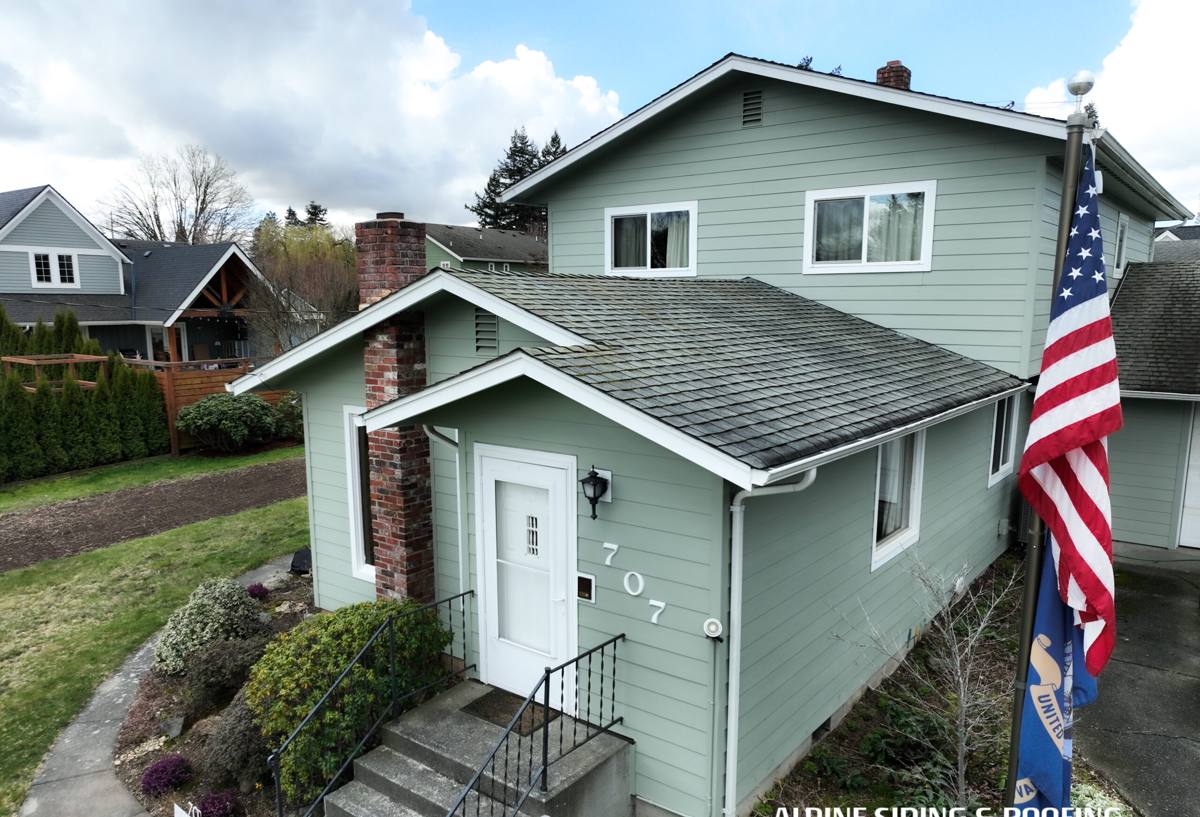
What Lynden's Climate Actually Does to Siding
Salt Air and Corrosion
Even set back from open water, Lynden gets a steady dose of salt-carrying marine air pushing up the valley. Salt accelerates corrosion on fasteners, flashing, and trim hardware, and it wears down lower-grade finishes faster than a drier inland climate would. Siding hardware and flashing details need to be chosen with that corrosion load in mind from the start, not upgraded later after rust stains start showing at the fastener heads.
Driving Rain, Not Straight-Down Rain
Rain in this part of Washington rarely falls straight down. Wind pushes it sideways into seams, laps, and trim joints, which is a much harder test of a siding system than total rainfall alone suggests. Materials and installation details that hold up fine in a calm, dry climate can fail here specifically because water finds its way in sideways, behind panels and around trim, rather than simply running off the face of the wall.
A Long Moss and Mildew Season
Mild temperatures, shade from mature trees, and near-constant moisture add up to a moss and mildew season that runs longer here than in most parts of the country. Shaded, north-facing walls are usually the first place it shows up. Any siding material that's even slightly porous, or that holds moisture against the substrate behind it, becomes a growth surface over time — and once moss or mildew gets a foothold, it holds moisture against the wall even longer, compounding the problem.
Why We Install Only James Hardie Fiber Cement
We used to install a broader range of siding products. We don't anymore, and that change came from what we kept finding on service calls and tear-offs in this specific climate, not from a supplier relationship or a sales pitch.
- Non-combustible core: Fiber cement doesn't feed a fire the way wood-based siding can, which matters for both safety and insurance considerations.
- Factory-applied ColorPlus finish: The color is baked on under controlled factory conditions rather than brushed on in the field, so it holds up longer against fading, chalking, and moisture than site-applied paint.
- Climate-engineered HZ product lines: Hardie's HZ5 formulation is built specifically for regions with heavy moisture exposure and freeze-thaw cycling, which describes northern Whatcom County well.
- Dimensional stability: Fiber cement doesn't swell, cup, or warp the way engineered wood products can after repeated exposure through a wet season.
- Strong transferable warranty: Hardie backs the product with one of the more robust warranty structures in the industry, provided the installation follows their published spec.
Vinyl, LP SmartSide, Cemplank, Allura, primed spruce, and cedar each have a place in the market, and plenty of homeowners are satisfied with them elsewhere. We've made a professional call that in a climate with this much sustained moisture and salt exposure, we'd rather install one system we fully stand behind than offer a cheaper option that shifts more long-term maintenance risk onto the homeowner.
What a Correct Siding Installation Actually Involves
The siding panel itself is only part of the job. Most of the failures we get called out to inspect trace back to what's underneath the panel or how the details around it were handled, not the panel material itself.
Tear-Off and Substrate Inspection
Before any new siding goes up, the old material comes off and the sheathing underneath gets inspected. In a climate this wet, it's common to find soft or water-stained sheathing behind older siding, especially around old window flashing or low on the wall where splash-back moisture accumulates over years. Any compromised sheathing gets repaired or replaced before installation continues — covering it up with new siding just hides the problem for another decade.
Weather-Resistive Barrier and Drainage Plane
A correctly installed weather-resistive barrier, lapped properly from the bottom of the wall up so water sheds outward rather than working its way in, is the layer that actually keeps a wall assembly dry. On top of that, a drainage plane or rainscreen gap lets any moisture that does get past the siding face drain and dry out instead of sitting against the sheathing. This layer does more long-term work than people expect, and skipping or rushing it is one of the most common corners cut on lower-bid siding jobs.
Flashing at Every Penetration
Windows, doors, hose bibs, light fixtures, and any other wall penetration need flashing that integrates with the weather barrier, not just caulk applied around the trim. Caulk is a maintenance item that degrades over years; flashing is a permanent detail that doesn't rely on periodic upkeep to keep water out. Given how much of Lynden's rain arrives wind-driven, flashing quality at these transition points is one of the biggest factors in whether a siding job holds up.
Fastening and Panel Spacing to Manufacturer Spec
James Hardie publishes specific fastener types, spacing, and clearance requirements, including gaps at panel butt joints and clearance from grade, roof lines, and other trim. Installing outside that spec can void the manufacturer's warranty even though the product itself is correct. We install to Hardie's published spec as a baseline, not an upsell.
Trim, Caulking, and Final Sealing
The last stage is trim work and sealant at the joints that do need it, using products rated for this climate's UV and moisture exposure. This is also where a crew's attention to detail shows most visibly, since sloppy trim work and inconsistent caulk lines are usually the first things a homeowner notices even before any performance issue develops.
Our Process for a Lynden Siding Project
- Walkthrough and assessment: We inspect the existing siding, look for signs of moisture intrusion, and evaluate the wall assembly before quoting anything.
- Written estimate: A clear scope of work and price, based on the actual home, not a generic square-footage rate.
- Material selection: We help homeowners choose the right Hardie plank profile, texture, and ColorPlus color for the home and its exposure.
- Tear-off and substrate repair: Old siding comes off, sheathing gets inspected, and any damage is repaired before moving forward.
- Weather barrier and flashing installation: The drainage plane and flashing details go in first, since these do most of the long-term protective work.
- Siding installation to spec: Panels are fastened, spaced, and finished according to Hardie's published installation requirements.
- Final walkthrough: We review the finished job with the homeowner before calling it complete.
Cost Factors for a Lynden Siding Job
| Factor | What It Affects | Why It Matters in This Climate |
|---|---|---|
| Home size and wall complexity | Material quantity, labor hours | More trim and corners mean more flashing detail, which takes real time to do correctly |
| Substrate condition | Whether repair or replacement is needed before siding goes on | Wet climates increase the odds of hidden sheathing damage behind old siding |
| Siding profile and texture | Material cost, appearance | Some profiles shed water and resist moss buildup better on shaded walls |
| Tear-off vs. overlay | Labor and disposal cost | Overlay is rarely advisable here since it traps moisture problems behind the new layer |
| Trim and detail complexity | Labor time, finish quality | More window and roof transitions mean more flashing points that need attention |
Exact numbers depend on the specific home, which is why we walk each property before giving a real estimate rather than quoting off a generic price list.
Signs a Lynden Home Needs Siding Attention
- Moss or dark staining that returns quickly after cleaning, especially on shaded walls
- Soft or spongy siding when pressed, particularly low on the wall or around window trim
- Peeling paint or bubbling on painted wood or engineered wood siding
- Visible warping, cupping, or gaps opening up between siding boards
- Staining or discoloration below windows or at wall-to-roof transitions
- Cracked, chipped, or missing caulk at trim joints and penetrations
Why Hiring a Crew That Already Works Lynden Matters
A crew that installs siding across Whatcom County day to day sees how salt air, wind-driven rain, and moss actually behave on real houses over a full year, not just how a product performs on a spec sheet. That repeated local exposure shapes practical decisions on install day: which wall orientations need extra flashing attention, how much drainage gap a given elevation really needs, and which trim details are worth the additional time so a homeowner isn't dealing with a callback two winters later. Lynden's mix of open farmland and tree-sheltered lots also means moisture and shade patterns vary more from property to property than in a denser neighborhood, and a crew with local experience accounts for that instead of applying the same approach to every job.
Bellingham Window Co is based in Whatcom County and works throughout it, which means the crew on your Lynden project has almost certainly installed siding on homes with similar exposure, similar tree cover, and similar weather within the past year, not for the first time on your house.
Get a Free, No-Pressure Estimate
If your Lynden home needs new siding or you're not sure whether what's on the wall now is holding up the way it should, we're glad to take a look and give you an honest, straightforward assessment. Reach out using the form below to schedule a free estimate — no pressure, no upsell script.