 Bellingham Window
 Building New in Ferndale? The Windows Deserve as Much Attention as the Framing
When a house is going up from the ground rather than getting a retrofit, windows get decided early and installed once. That's the advantage of new construction — you're not fighting an existing opening or patching around old trim — but it's also the risk. Whatever gets built into the wall assembly around each window stays there for the life of the house. In Ferndale, where lots range from in-town infill near I-5 to open properties out toward the coastal flats and farmland, that wall assembly has to deal with salt-laden air, wind-driven rain off the Strait of Georgia and Bellingham Bay, and a long stretch of the year when north and shaded elevations stay damp enough to grow moss. Get the install right during framing and it's a non-event for thirty years. Get it wrong and you're chasing rot, corrosion, or fogged glass behind brand-new siding.
We install new-construction windows on Ferndale builds as part of our regular Bellingham-area work, coordinating directly with builders and GCs rather than treating it as a one-off retrofit job. That distinction matters more than most homeowners realize.
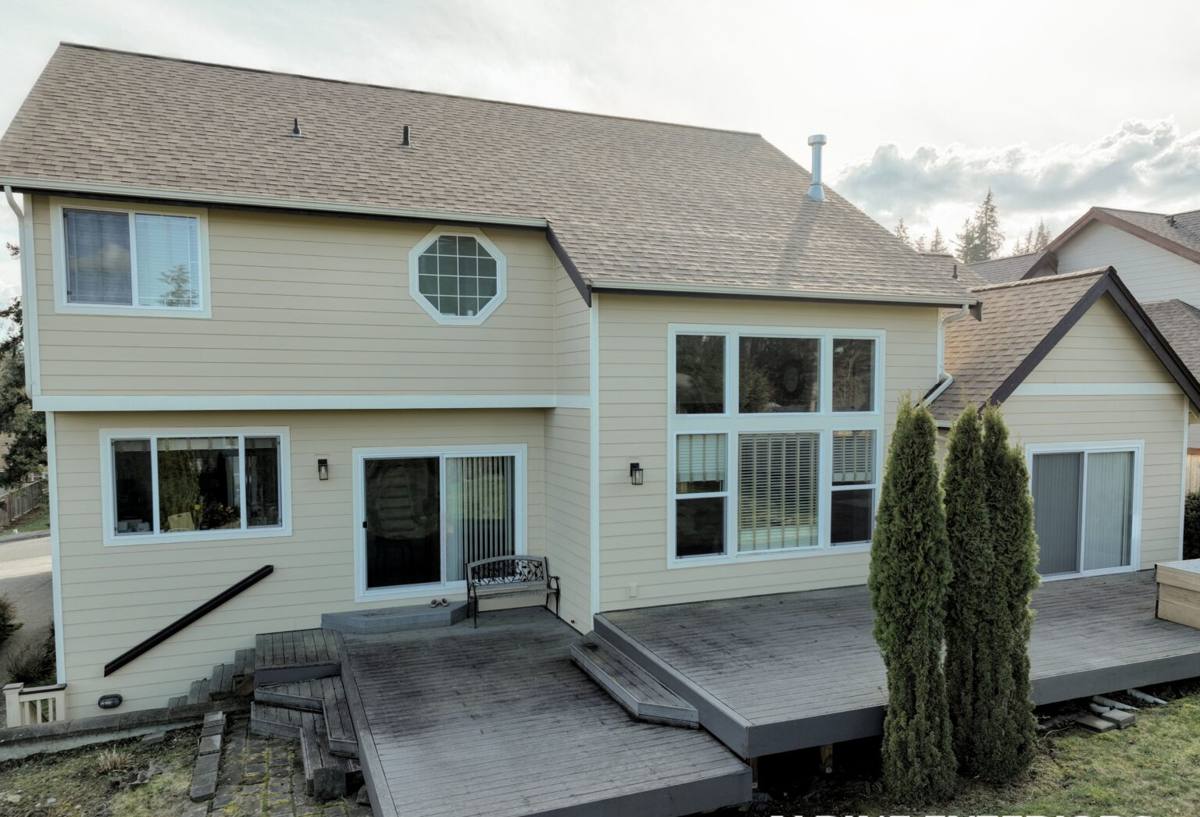
What Ferndale's Climate Actually Does to a New Window Opening
Ferndale sits close enough to the water and to Whatcom County's agricultural flats that a handful of climate factors show up consistently in window performance over time:
Salt Air and Corrosion
Properties nearer Cherry Point, the Nooksack delta, and the open coastline get measurable salt exposure in the air, even a few miles inland on windy days. Salt accelerates corrosion on hardware, cladding fasteners, and lower-grade aluminum components. It's not dramatic — nobody's window falls apart in a year — but over a decade it shows up as pitted hinges, stiff locks, and streaking on aluminum trim that a similar house forty miles inland wouldn't see.
Driving Rain
Whatcom County doesn't get the heaviest rainfall totals in Western Washington, but it gets a lot of wind-driven rain — storms that push water sideways into a wall rather than letting it run straight down. That kind of weather tests the flashing and sealant details around a window far harder than a calm, straight-down rain does. A window that's watertight in a still rain can still leak in a 30 mph gust off the water if the flashing sequence underneath it was done wrong.
The Long Moss Season
Shaded, north-facing, and tree-lined elevations around Ferndale stay damp for much of the year, which is exactly the environment moss and algae favor. On windows, that usually shows up on sills, in corner joints, and in the perimeter sealant line — not on the glass itself, but on the surfaces around it that hold moisture. Trapped moisture behind trim or sealant is what eventually leads to wood rot in the surrounding framing, even when the window unit itself is fine.
Getting the Install Right During Framing
New-construction window installation is fundamentally a sequencing job. The window itself is only one piece; what matters just as much is the order of operations around it — the weather-resistive barrier (WRB), the flashing, the sealants, and the siding that eventually covers it all.
Nailing Fin vs. Block Frame
Most new-construction windows in this region use a nailing fin (flange) that fastens directly to the sheathing and gets integrated into the WRB. Block frame windows, more common on masonry or some modern builds, set into a rough opening without a fin and rely entirely on the surrounding flashing and sealant for weather protection. We choose the approach based on the wall assembly the builder is using — the important part is that whichever method is used, it gets installed to match how the rest of the wall sheds water, not against it.
Flashing and the WRB
The order matters: sill pan first, then the window, then jamb flashing lapped over the fin, then head flashing lapped over the WRB above the window — always shingle-style, so every layer sheds water onto the layer below it, never the reverse. Given how much wind-driven rain this area sees, we don't shortcut the sill pan step even on standard builds. A sloped, sealed sill pan is cheap insurance against the one detail that causes most long-term window leaks.
Sealants and Backer Rod
Sealant is a backup to good flashing, not a substitute for it. We use backer rod behind exterior sealant joints so the sealant forms a proper bead rather than a thin skin, and we're deliberate about which joints get sealed and which are left as drainage paths — sealing everything solid can trap moisture instead of letting it escape.
Choosing Frame Material and Glass for This Environment
There's no single "best" window for Ferndale — it depends on budget, the style of the house, and how much long-term maintenance the homeowner wants to take on. Here's how the common options actually compare for this climate:
| Frame Material | Salt Air / Coastal Exposure | Maintenance | Typical Cost Position |
|---|---|---|---|
| Vinyl | Handles it well — won't corrode or pit | Low; occasional cleaning | Most affordable |
| Fiberglass | Excellent — very stable, resists moisture and salt | Low | Mid to upper-mid |
| Aluminum-clad wood | Good on the exterior face; hardware quality matters more here | Moderate — exterior is low-maintenance, but any exposed wood needs upkeep | Upper |
| Bare aluminum | Weakest choice near salt air unless marine-grade and well-finished | Higher — watch for pitting and hardware wear | Varies |
For glass, we spec double-pane, low-E units as the baseline on new builds, with the coating and gas fill (typically argon) selected to meet Washington State Energy Code requirements for the house's climate zone. Whatcom County falls into a zone where U-factor and solar heat gain targets are non-negotiable on new construction — this isn't an upgrade option, it's a permitting requirement, so we build it into the spec from the start rather than treating it as an add-on.
Working With Your Builder's Schedule
On a new build, windows have to show up on-site at the right moment — after the rough opening is framed and the WRB is on, but before siding starts. Order too late and you stall the framing crew waiting on product; order the wrong size or configuration and you're either reframing an opening or waiting on a remake, both of which cost real time on a build schedule.
We work directly off the builder's plan set and framing schedule, confirm rough opening sizes before windows are ordered (not after), and coordinate delivery and install around the dry-in date so the house can get closed in on schedule. On a Ferndale build specifically, we also try to time exterior sealant work for a dry stretch where possible — sealants cure better and adhere longer when they're not fighting rain during installation.
Our Process on Ferndale New-Construction Jobs
- Plan review — we go through the architectural plans or builder spec sheet to confirm window sizes, configurations, and energy code compliance before anything is ordered.
- Ordering — new-construction windows are typically built to order, so lead times get confirmed early and built into the builder's schedule.
- Rough opening check — we verify actual framed openings against the order before install day, catching framing discrepancies while they're still cheap to fix.
- Install with full flashing sequence — sill pan, window, jamb and head flashing, sealant, all installed in the correct shingled order.
- Walkthrough — every window gets checked for square, level, proper operation, and a clean weather seal before we call it done.
Why a Crew That Already Works Ferndale Matters Here
New-construction window install isn't exotic work, but it rewards familiarity. A crew that's done it repeatedly in this specific area already knows how Whatcom County's building department wants energy code documentation submitted, has a feel for how local framing crews typically build rough openings, and has seen firsthand which details actually fail under Ferndale's driving rain rather than guessing from a manufacturer's install manual written for a different climate. That's a different kind of value than a crew driving up from out of the area for a single job.
Before you sign off on window installation for a new build, a few things are worth confirming with whoever's doing the work:
- Do they install using a full flashing sequence (sill pan, jamb, head) or rely mainly on sealant?
- Are they specifying glass and frame packages that meet current Washington State Energy Code for this climate zone?
- Have they coordinated rough opening sizes against the actual window order before install day?
- Do they have a plan for sequencing install around the builder's dry-in and siding schedule?
- Will they document U-factor and SHGC values for the local permitting and inspection process?
- Are they familiar with how salt air and coastal wind affect hardware and cladding choices in this specific area?
If a contractor can't answer those clearly, it's worth asking more questions before the windows go in — because once siding covers the opening, most of that work is invisible until something goes wrong.
Get a Free Estimate for Your Ferndale Build
Whether you're a builder lining up window packages for a new development or a homeowner managing your own new-construction project in Ferndale, we're happy to walk through your plans, talk through frame and glass options for this climate, and put together a straightforward, no-pressure estimate. Use the form below to get started.