 Bellingham Window
 Roofing in Sehome: What the Climate Actually Demands
Sehome sits close enough to Bellingham Bay that salt-laden air is a constant factor, and close enough to Sehome Hill and the surrounding tree cover that shade, moisture, and organic debris are a fact of life for every roof in the neighborhood. Add in Whatcom County's long wet season — months of driving rain off the Strait of Georgia followed by a slow, damp spring — and you get a climate that is genuinely harder on roofing than most manufacturers' warranty testing accounts for. A roof in Sehome isn't just shedding water; it's fighting salt corrosion on metal components, constant moss and moisture intrusion, and repeated freeze-thaw cycling on top of everything else.
That combination is why roof replacement here isn't a one-size-fits-all job. The right materials, ventilation, and installation details for a home in a drier inland climate aren't automatically the right choice for a home a few blocks from the bay. We approach every Sehome roof replacement with that context built in from the first inspection.
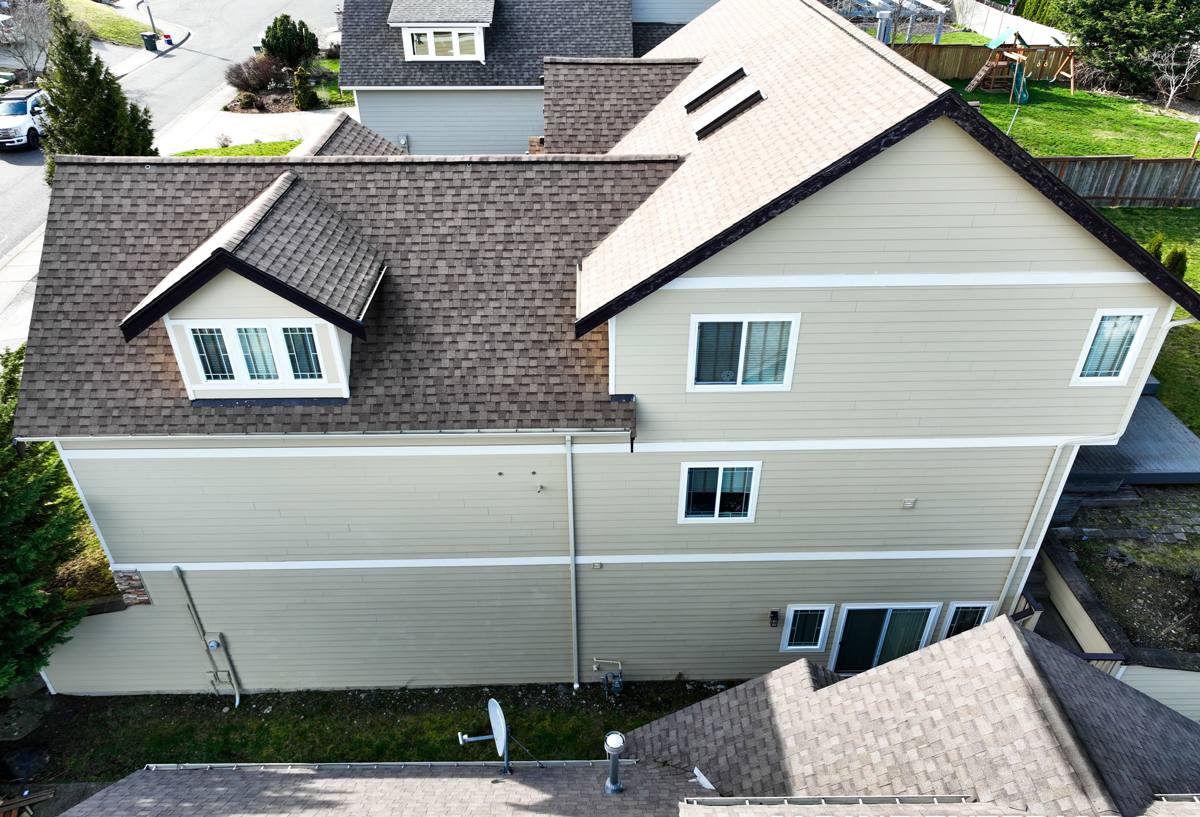
Signs a Sehome Roof Needs Replacement, Not Another Repair
Homeowners often ask us to patch a problem that's really a sign the roof system as a whole has reached the end of its service life. Some symptoms point to a localized fix; others tell you the whole roof is compromised.
- Granule loss heavy enough that you're finding grit in gutters and downspouts every time it rains
- Shingles that are cupping, curling, or cracking across multiple slopes, not just one exposed section
- Moss establishing itself in the shingle mat itself, not just sitting on the surface — this holds moisture against the roof deck
- Soft spots or sagging when walked on, which usually means the decking underneath has taken on water
- Daylight visible through the attic roof boards, or water staining on attic sheathing and insulation
- A roof approaching or past 20-25 years old for asphalt shingle, especially if it's never had a tear-off
- Repeated leaks around the same flashing points despite prior repairs
One or two of these on an otherwise sound roof usually means a repair is enough. Several at once, especially combined with age, is the point where continued patching stops being cost-effective and full replacement becomes the honest recommendation.
Roofing Materials That Hold Up Near the Bay
Every roofing material has trade-offs, and in a salt-air, high-moisture environment those trade-offs matter more than they would inland. We walk homeowners through the realistic pros and cons rather than pushing one product for every house.
| Material | Performance in Sehome's Climate | Maintenance Consideration |
|---|---|---|
| Architectural asphalt shingle | Good moisture and wind resistance when properly ventilated; the most common choice locally | Needs periodic moss treatment and gutter clearing; algae-resistant granules help but don't eliminate the need |
| Standing seam metal | Excellent water shedding and long service life; sheds moss growth better than shingle | Requires marine-grade fasteners and coatings near the bay to manage salt corrosion over time |
| Composite/synthetic shake | Holds up well to driving rain and resists moisture absorption better than wood shake | Higher upfront cost; installation detailing at valleys and penetrations is less forgiving |
| Cedar shake | Traditional look, but moisture retention in this climate accelerates decay without diligent upkeep | We're honest that shake here requires more frequent maintenance and shorter realistic lifespan than in drier regions |
For most Sehome homes, a well-ventilated architectural shingle system or a properly detailed metal roof strikes the right balance of upfront cost, longevity, and realistic maintenance. We size the recommendation to the specific home — roof pitch, tree cover, and how exposed it is to weather off the water all factor in.
A note on cedar shake and similar natural materials
We still install and repair shake roofs, but we're upfront that in a climate this wet, natural wood needs closer attention to ventilation, moss control, and periodic treatment than composite alternatives. That's a maintenance-and-moisture-behavior trade-off, not a knock on the product — it's simply what this climate asks of it.
What a Correct Roof Replacement Involves
A roof replacement is more than swapping old shingles for new ones on top of the same deck. Done right in this climate, it includes several steps that are easy for a rushed crew to shortcut and hard for a homeowner to verify after the fact.
- Full tear-off to the decking, so we can inspect and repair any rot or soft spots before new material goes down — never a layover on top of failing shingles
- Deck repair or replacement of any sheathing that's taken on moisture damage
- Ice-and-water shield at eaves, valleys, and around every penetration, which matters more here than in drier climates because of how long water sits during our wet months
- Synthetic underlayment across the full deck as a secondary water barrier
- New flashing at chimneys, skylights, sidewalls, and vent stacks rather than reusing old, corroded flashing
- Balanced attic ventilation — intake at the eaves and exhaust at the ridge — sized correctly for the attic volume, which is one of the biggest factors in how fast moss and moisture problems return
- Proper nailing pattern and fastener spacing per manufacturer specification, which is also what keeps a shingle warranty valid
Skipping any one of these doesn't always show up as a problem in year one. It shows up in year five or eight, as premature granule loss, a leak at a flashing point, or moss re-establishing itself faster than it should.
Our Roof Replacement Process
1. Inspection and honest assessment
We start on the roof and in the attic, not just with a drive-by look. We'll tell you plainly if a repair is a better use of your money than a full replacement.
2. Written scope and material selection
You get a clear, itemized scope — tear-off, decking allowance, underlayment type, flashing, ventilation changes, and material — so there's no ambiguity about what's included.
3. Scheduling around the weather
We plan tear-off and dry-in around Whatcom County's rain patterns as closely as we can, and we don't leave a roof deck exposed overnight without protection.
4. Tear-off, deck inspection, and installation
Old material comes off, decking gets inspected and repaired as needed, and the new system goes down to manufacturer spec — underlayment, flashing, field material, ventilation.
5. Cleanup and final walkthrough
Site cleanup includes magnetic sweep for nails and full debris removal, followed by a walkthrough so you can see the finished work and ask questions before we consider the job done.
Moss, Ventilation, and Long-Term Roof Health
Moss is the most visible symptom of Sehome's climate, but it's rarely the root problem by itself — it's usually a sign of moisture sitting somewhere it shouldn't, often because of shade, debris buildup, or inadequate attic ventilation. A roof replacement is the best opportunity to correct ventilation, because it's far more disruptive and expensive to fix after the fact than to build in correctly the first time.
Balanced intake and exhaust ventilation keeps the underside of the roof deck closer to outdoor temperature and humidity, which slows moss growth, reduces condensation risk in the attic, and helps shingles last closer to their rated lifespan. We evaluate existing soffit vents, baffles, and ridge venting as part of every replacement estimate — not as an upsell, but because it directly affects how long the new roof will actually perform.
Permits, Codes, and Working in Bellingham
Roof replacement in the City of Bellingham typically requires a building permit, and inspections check things like proper flashing, ventilation, and fire rating for the materials used. We handle the permit process as part of the job rather than leaving it to the homeowner, and we build our installations to current code, not just to whatever passed inspection when the last roof went on decades ago. Knowing the local permitting process well means fewer delays and no surprises partway through the project.
Why a Crew That Already Works Sehome Matters
A roofing crew that regularly works this neighborhood already understands the tree cover patterns, the wind exposure off the bay, and the mix of older and newer homes that make up Sehome. That familiarity shows up in practical ways: knowing which older homes are likely to need deck repair once tear-off starts, understanding how close-set lots and mature trees affect staging and material delivery, and having a realistic sense of how the local climate will treat a given material choice over the next twenty years — not just what a spec sheet says.
It also means we're not learning Whatcom County's permitting process or inspection expectations on your project. That familiarity translates into fewer delays and a smoother job from estimate to final walkthrough.
Questions to ask any roofer before you sign
- Will this be a full tear-off, and will you inspect and repair the decking as part of the scope?
- What underlayment and ice-and-water shield products are included, and where will they be installed?
- Will you evaluate and correct attic ventilation as part of the replacement?
- Is the permit and inspection process included in your price and timeline?
- What's your plan if rain moves in mid-tear-off?
- Do you carry current licensing and insurance you can provide documentation for?
Get a Straight Answer About Your Roof
If your Sehome roof is showing its age, dealing with recurring moss, or you just want an honest opinion on repair versus replacement, we're happy to take a look. There's no pressure and no obligation — just a straightforward assessment from a crew that knows what this climate does to a roof. Use the form below to request a free estimate.