 Bellingham Window
 Building Decks for South Hill's Particular Conditions
South Hill sits above the rest of Bellingham, and that elevation brings its own mix of challenges: mature tree canopy that keeps decks shaded and damp for much of the year, sloped lots that complicate framing and footings, and the same salt-laden air drifting up from Bellingham Bay that eats through hardware on homes closer to the water. A deck built to a generic spec sheet doesn't hold up here the way one built for this specific neighborhood does. We've worked on enough South Hill properties to know what fails first, what lasts, and what's worth spending a little more on up front.
This page covers deck building specifically for South Hill — the climate factors that matter, the build decisions that make a real difference, and what our process looks like from first visit to final walkthrough.
What Whatcom County's Climate Does to a Deck Over Time
Bellingham gets a lot of rain, and South Hill's tree cover means less direct sun to dry things out between storms. That combination creates a long moss season — moss and algae growing on decking boards, stair treads, and railings for much of the fall, winter, and spring. Left unchecked, moss holds moisture against the wood surface and turns stairs and landings slick and genuinely dangerous underfoot.
Add in the salt air moving up from the bay, and you've got a second slow-motion problem: corrosion. Cheap fasteners, connector hardware, and railing brackets that aren't rated for coastal exposure will rust, weaken, and stain the decking around them well before the structure itself is due for replacement. We see this most often on decks that were built with standard interior-grade hardware because it was cheaper or more available at the time.
The Two Failure Points We See Most Often
- Moisture trapped at the ledger board — where the deck attaches to the house, poor flashing lets water track behind the siding and rot the rim joist from the inside out.
- Corroded fasteners and hardware — screws, joist hangers, and bolts that weren't rated for wet, salt-air exposure fail years before the lumber does.
Sloped Lots and Elevation Change
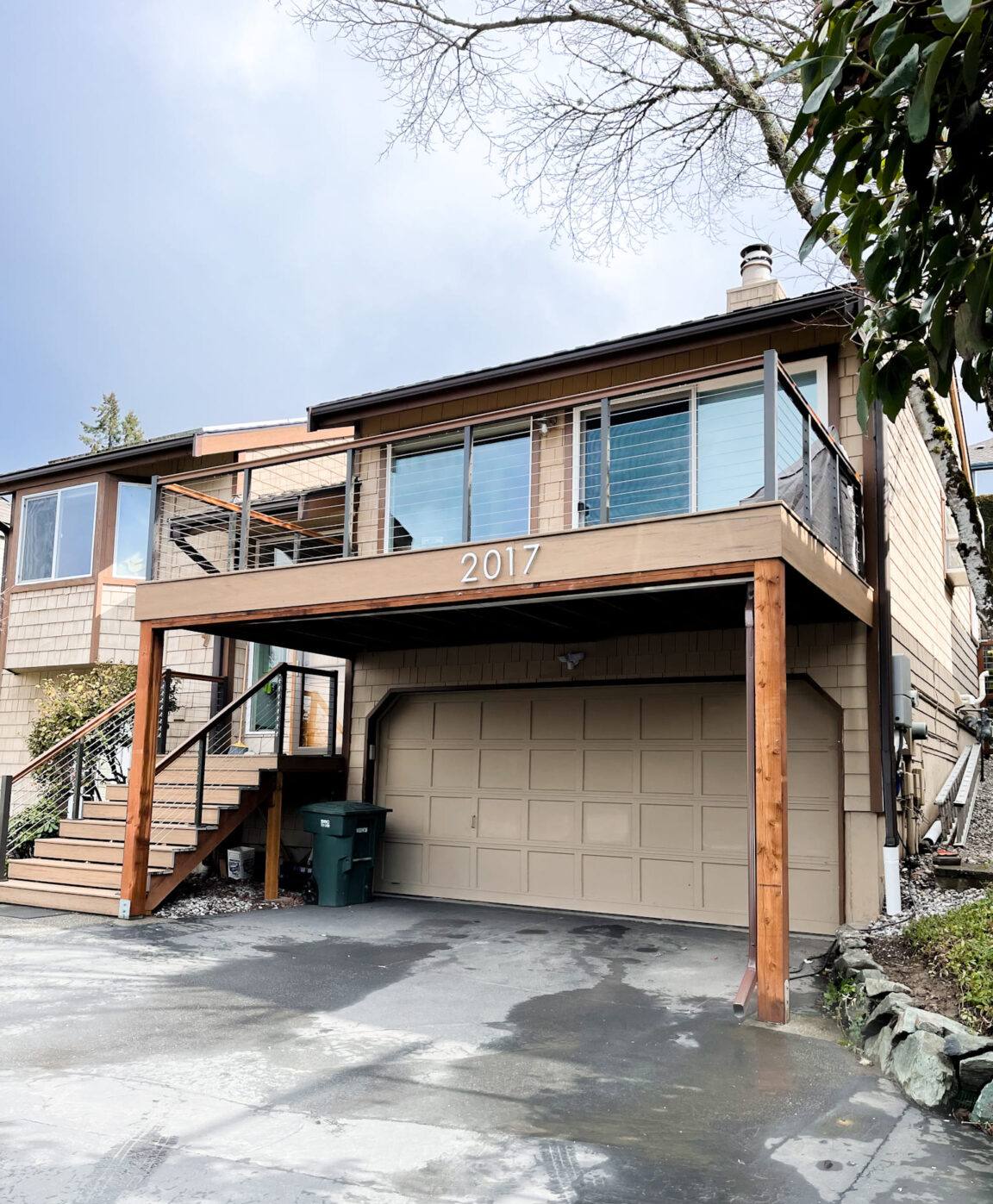
Much of South Hill is built on grade, which means a deck project here often involves more engineering than a flat-lot deck would. Footings may need to go deeper or be stepped to follow the slope, and taller support posts need proper bracing to handle wind and lateral load — especially with the added height that comes with a hillside view lot. Guardrail height and stair rise requirements also become more important with elevation change, since a code-compliant deck on a slope isn't optional the way it might feel on a low, flat patio-level deck.
We evaluate the slope, drainage path, and soil conditions on your specific lot before we ever talk about decking material or railing style. Getting the substructure right is what determines whether the deck feels solid for twenty years or starts to sway and settle within five.
Choosing a Decking Material for This Neighborhood
There's no single "best" decking material — the right choice depends on how much shade your lot gets, how much upkeep you're willing to do, and your budget. Here's how the common options actually perform under South Hill's shade-and-moisture conditions.
| Material | Moss/Algae Resistance | Maintenance | Typical Lifespan |
|---|---|---|---|
| Pressure-treated wood | Low in heavy shade — needs regular cleaning and re-sealing | Annual cleaning, periodic staining/sealing | 10–15 years with upkeep |
| Cedar | Moderate — naturally rot-resistant but still grows moss in shade | Periodic cleaning and oil/sealant | 15–20 years with upkeep |
| Capped composite | Good — cap layer resists moisture absorption and staining | Occasional washing, no sealing/staining | 25+ years |
| PVC decking | Very good — no wood fiber for moss or algae to root into | Occasional washing | 25–30+ years |
For heavily shaded South Hill lots specifically, we tend to steer homeowners toward capped composite or PVC. It's not that wood "fails" — cedar and treated lumber can look great and last a long time — it's that a shaded, moss-prone lot demands a maintenance schedule most homeowners underestimate when they choose wood for the lower upfront cost. That's a trade-off we'll walk through honestly rather than push one product because it's easier to install.
A Note on Fasteners and Hardware
Whatever decking material you choose, we spec stainless steel or coated, coastal-rated fasteners and connector hardware on every South Hill project — not standard interior-grade hardware. It costs a bit more upfront and it's the single biggest factor in whether your railings and stair stringers are still tight and rust-free a decade from now.
Framing, Flashing, and Getting the Ledger Right
The most important part of any deck is the part you never see once it's finished. Where the deck ties into the house, we install proper flashing and a water-diverting membrane behind the ledger board so rain gets directed away from the wall structure instead of tracking behind the siding. This is the single most common corner cut on older or budget deck builds, and it's the reason so many rebuilds start with a soft, rotted rim joist that looks fine from the outside until you probe it.
Joists, beams, and posts are sized and spaced to the load and span requirements for your deck's actual dimensions and elevation — not just "what's typically done." On sloped South Hill lots, that often means deeper or additional footings and cross-bracing that a flat-lot deck wouldn't need.
Railings, Stairs, and Code Requirements
Bellingham and Whatcom County follow the state building code for guardrail height, baluster spacing, and stair rise/run, and these requirements get stricter — not looser — the more elevation change your deck has. A hillside deck with a significant drop needs a code-compliant guardrail, and stair stringers need to be sized for the actual rise, not eyeballed. We handle permitting and inspection scheduling as part of the build so you're not left figuring out city requirements on your own.
Railing material matters here too. Metal balusters and cable rail systems look clean but need to be corrosion-rated for this climate; wood railings need the same moisture and moss consideration as the decking itself.
Our Deck Building Process
- On-site assessment — we walk the lot, check slope and drainage, and talk through how you actually plan to use the deck.
- Design and material selection — sizing, layout, railing style, and decking material chosen against your budget and shade conditions, not a one-size template.
- Permitting — we pull the required Bellingham/Whatcom County permits and schedule inspections.
- Site prep and footings — footings sized and placed for your specific soil and slope.
- Framing — ledger flashing, joists, beams, and posts built to span and load requirements.
- Decking, railings, and stairs — installed with corrosion-rated fasteners and hardware throughout.
- Final walkthrough — we go over care and maintenance specific to the material you chose before we consider the job done.
Maintenance That Actually Matters on South Hill
Whatever material your deck is built from, a little seasonal attention goes a long way in this climate. Here's what we recommend to every South Hill homeowner:
- Sweep leaves and debris off the deck regularly in fall — trapped organic matter is what feeds moss growth.
- Wash the deck surface at least once a year with a deck-safe cleaner to remove algae and moss before it takes hold, especially on shaded sections.
- Check and re-tighten railing hardware annually — even coated fasteners benefit from a visual inspection.
- If you have a wood deck, plan on re-sealing or staining on the schedule your specific wood species requires — don't wait until it's visibly gray and weathered.
- Keep gutters and downspouts near the deck clear so runoff isn't draining directly onto or under the deck surface.
- Watch for soft spots near the ledger board or stair stringers — that's the first sign of moisture getting in where it shouldn't.
Why a Crew That Already Works This Neighborhood Matters
Deck building on a sloped, shaded South Hill lot is a different job than building on a flat, sunny lot across town, and a crew that hasn't dealt with hillside footings, moss-prone shade patterns, or salt-air hardware corrosion is more likely to make decisions that look fine on installation day and cause problems in year three. We've built and repaired decks throughout Bellingham and Whatcom County, and South Hill's terrain and climate are part of what we plan for from the first site visit — not an afterthought once problems show up.
If you're planning a new deck or considering a rebuild of an aging one, we're happy to take a look and give you an honest read on what your lot and budget can support. Use the form below to request a free, no-pressure estimate.