 Bellingham Window
 Sunnyland's Roofs Work Harder Than Most
Sunnyland sits close enough to Bellingham Bay that salt-laden air is a constant, low-grade stress on every exposed surface of a house, and the roof takes the brunt of it. Add Whatcom County's long wet season, where driving rain off the water can drive moisture sideways under poorly lapped shingles, and a shady tree canopy that keeps roof decks damp for days after a storm, and you get a roofing environment that's genuinely tougher on materials than a lot of the country ever sees. None of this means a roof here needs to be exotic or overbuilt. It means the ordinary things — underlayment choice, fastening, ventilation, and moss control — have to be done right every single time, because this climate finds every shortcut eventually.
We work on roofs in this neighborhood regularly, which matters less as a marketing point and more as a practical one: we already know which slopes hold moss longest, which house styles in the area tend to have tight roof-to-wall details that need extra flashing attention, and what a shingle roof actually looks like after five Bellingham winters versus what the manufacturer's brochure shows.
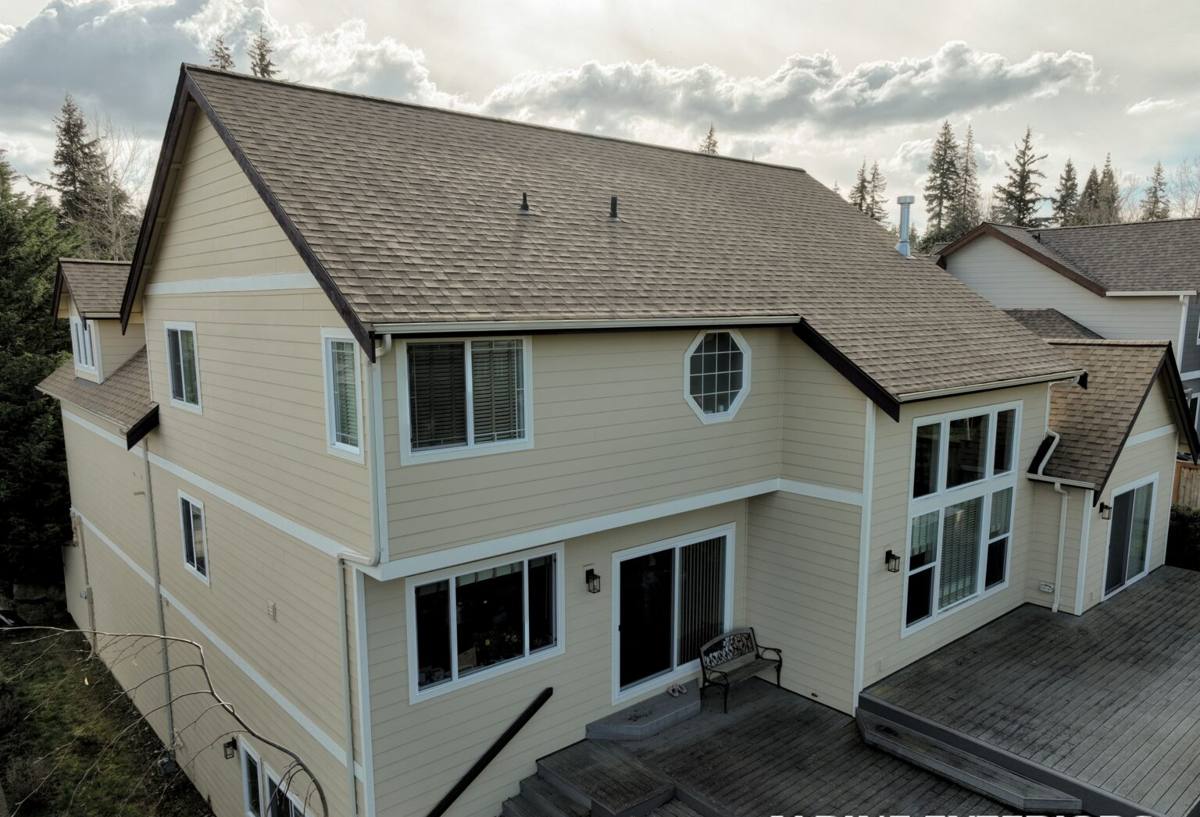
What Local Homes Actually Need From a Shingle Roof
An asphalt shingle roof in Sunnyland has to manage three things at once: shed a lot of rain over a long wet season, resist moss and algae growth in shaded, damp spots, and hold up to salt-influenced air without the fasteners, flashing, or shingle mat degrading early. A roof built for a dry inland climate and simply dropped onto a Sunnyland house — without adjusting underlayment coverage, ventilation, or flashing details — will show problems years before it should.
Rain Volume, Not Just Rain
Bellingham doesn't get the heaviest rainfall in the state, but it gets a lot of days of it, which is worse for a roof than fewer, harder storms. Sustained wetting is what finds bad laps, under-driven nails, and thin or missing ice-and-water membrane at vulnerable spots. We treat valleys, eaves, and any low-slope transition as places where a few extra dollars of membrane now prevents a much bigger repair later.
Moss and Shade
Sunnyland's tree cover is part of what makes the neighborhood pleasant to live in, and it's also exactly what keeps north-facing and shaded roof slopes damp long after the rain stops. Moss doesn't just look bad — its root structure lifts shingle edges and traps moisture underneath the mat, which is how a cosmetic problem turns into a leak.
Salt Air and Metal Components
The flashing, nails, and drip edge on a roof matter as much as the shingles themselves, and they're the components salt air attacks first. We spec corrosion-resistant fasteners and flashing on homes in this area as a standard practice, not an upgrade, because standard galvanized hardware can show rust streaking and early failure within a handful of years this close to the water.
What a Correctly Installed Roof Involves
A shingle roof is a system, and skipping any one layer undermines the rest. Here's what we consider non-negotiable on a Sunnyland re-roof or new install.
Underlayment and Water Barrier
We use synthetic underlayment across the full deck as a baseline, with self-adhered ice-and-water membrane at eaves, valleys, chimneys, skylights, and any low-slope section — the spots where wind-driven rain is most likely to work its way under the shingle field.
Ventilation
A roof deck that can't breathe traps moisture from inside the house, which rots sheathing from underneath regardless of how good the shingles look from the ground. We check intake at the soffits and exhaust at the ridge or roof vents as part of every estimate, and we'll tell you plainly if your current ventilation is inadequate rather than just laying new shingles over the same problem.
Flashing
Step flashing at walls, counter-flashing at chimneys, and proper valley metal or woven treatment are where most leaks actually originate — far more often than the shingle field itself. This is also where corrosion-resistant materials matter most given the salt air.
Fastening and Nailing Pattern
Manufacturer nailing patterns exist because they were tested to hold up under wind uplift, and shortcuts here (too few nails, wrong placement, staples instead of nails) are one of the most common causes of shingles blowing off in a windstorm — something Whatcom County gets its share of in fall and winter.
Signs a Sunnyland Roof Needs a Closer Look
- Granules collecting in gutters or at downspout outlets, which signals the shingle mat is wearing thin
- Dark streaking or moss patches, especially on shaded or north-facing slopes
- Curling, cupping, or lifted shingle edges, particularly at older moss-affected areas
- Rust staining below flashing or fasteners
- Soft spots or sagging when walked, which points to deck rot beneath the shingles
- Daylight visible through the roof deck from inside the attic
- Interior ceiling stains, especially near chimneys, valleys, or skylights after a heavy rain
- Shingles noticeably older than 15-20 years with no recent inspection
How Our Process Works
- On-site inspection. We walk the roof (or use a lift/drone where pitch or access requires it) and check the deck, flashing, ventilation, and shingle condition rather than quoting from a photo or a drive-by.
- Honest scope and estimate. We explain what's actually needed — repair versus full replacement — and what's driving that recommendation, including any deck repair or ventilation work uncovered during inspection.
- Material selection. We go over shingle class, color, and warranty options suited to a Sunnyland roof's exposure, not a one-size-fits-all recommendation.
- Tear-off and deck check. Old roofing comes off down to the deck so we can actually see the sheathing condition, not guess at it.
- Underlayment, flashing, and shingle installation to manufacturer specification, with the reinforced detailing described above at vulnerable areas.
- Cleanup and final walkthrough, including magnetic sweep for stray fasteners around the property.
Shingle Options and Cost Factors
Cost on any roofing job depends on roof size, pitch, number of layers being removed, deck condition, and access — a quote should reflect your specific roof, not a flat per-square rate. That said, here's how the common shingle classes compare for a home in this area.
| Shingle Class | Typical Lifespan Here | Best Suited For | Relative Cost |
|---|---|---|---|
| 3-tab | 12-18 years | Budget re-roofs, secondary structures | Lowest |
| Standard architectural (laminate) | 20-25 years | Most Sunnyland homes | Moderate |
| Algae-resistant architectural | 20-25 years, better appearance retention | Shaded, moss-prone slopes | Moderate-plus |
| Premium/designer laminate | 25-30+ years | Homes prioritizing longevity and curb appeal | Highest |
Algae-resistant shingles, which use copper or zinc granules to slow moss and algae growth, are worth the modest upcharge on any shaded slope in this neighborhood. On sun-exposed, well-ventilated slopes, the standard architectural line performs perfectly well and doesn't need the upgrade.
Moss and Salt Air: Ongoing Care That Actually Helps
Installing the right roof is half the equation; a bit of ongoing maintenance protects that investment over its full lifespan.
- Keep overhanging branches trimmed back to reduce shade and debris buildup on the roof
- Have moss physically removed (not just chemically treated) on affected slopes before it re-establishes each wet season
- Clean gutters at least twice a year so water doesn't back up under the eave edge
- Rinse rather than pressure-wash — high-pressure washing strips granules and shortens shingle life
- Have flashing and fastener condition checked every few years, particularly on homes closer to the water where salt exposure is highest
Why Hiring a Crew That Already Works Sunnyland Matters
Roofing crews that mostly work drier, inland climates sometimes under-spec underlayment coverage or skip the corrosion-resistant hardware that a Bellingham roof needs, not out of carelessness but because it simply isn't standard practice where they usually work. A crew that regularly works this neighborhood already builds those details into the base spec, which avoids the awkward conversation, later, about why a two-year-old roof has rust streaking or a leak at the valley. Local familiarity also means faster response for storm-related repairs and a better read on how a given house's tree cover, slope orientation, and exposure to the bay will affect long-term roof performance.
Repair, Re-Roof, or Replace?
Not every roofing problem in Sunnyland calls for a full tear-off. A localized leak at a single flashing point, or a small area of storm damage, is often a targeted repair. A full re-roof makes more sense once granule loss is widespread, multiple leaks have shown up in different areas, or the shingles are approaching the end of their expected lifespan and further patching would just be delaying the inevitable at added cost. Deck condition is often the deciding factor: if tear-off reveals rotted sheathing in multiple areas, that's a signal the roof has been compromised longer than the surface suggested, and full replacement becomes the more honest recommendation even if it wasn't the original plan.
If you're weighing a repair against a full replacement, or just want a straight answer on what your roof actually needs, we're happy to take a look. Reach out for a free, no-pressure estimate using the form below.