 Bellingham Window
 Why Windows in York Take a Different Kind of Beating
York sits close enough to Bellingham Bay that salt-laden air is a constant, quiet factor in how building materials age here — it works into hardware, finishes, and any exposed metal on a window assembly, not just siding and gutters. Add in the driving rain that comes sideways off the water during fall and winter storms, and you've got wind-driven moisture testing every seal and joint on a window multiple times a season. Then there's the long moss season that stretches from roughly October through April in Whatcom County, when constant damp and shade keep moss and algae actively growing on anything that stays wet — including window sills, frame bottoms, and the trim around them.
None of this is unique to York specifically, but it's a real combination for this part of Bellingham: salt air accelerating corrosion, wind-driven rain testing seals, and a moss season long enough to do real damage if water finds a way in and sits. A window that's rated "energy efficient" on a spec sheet still has to survive that combination physically before the efficiency numbers mean anything.
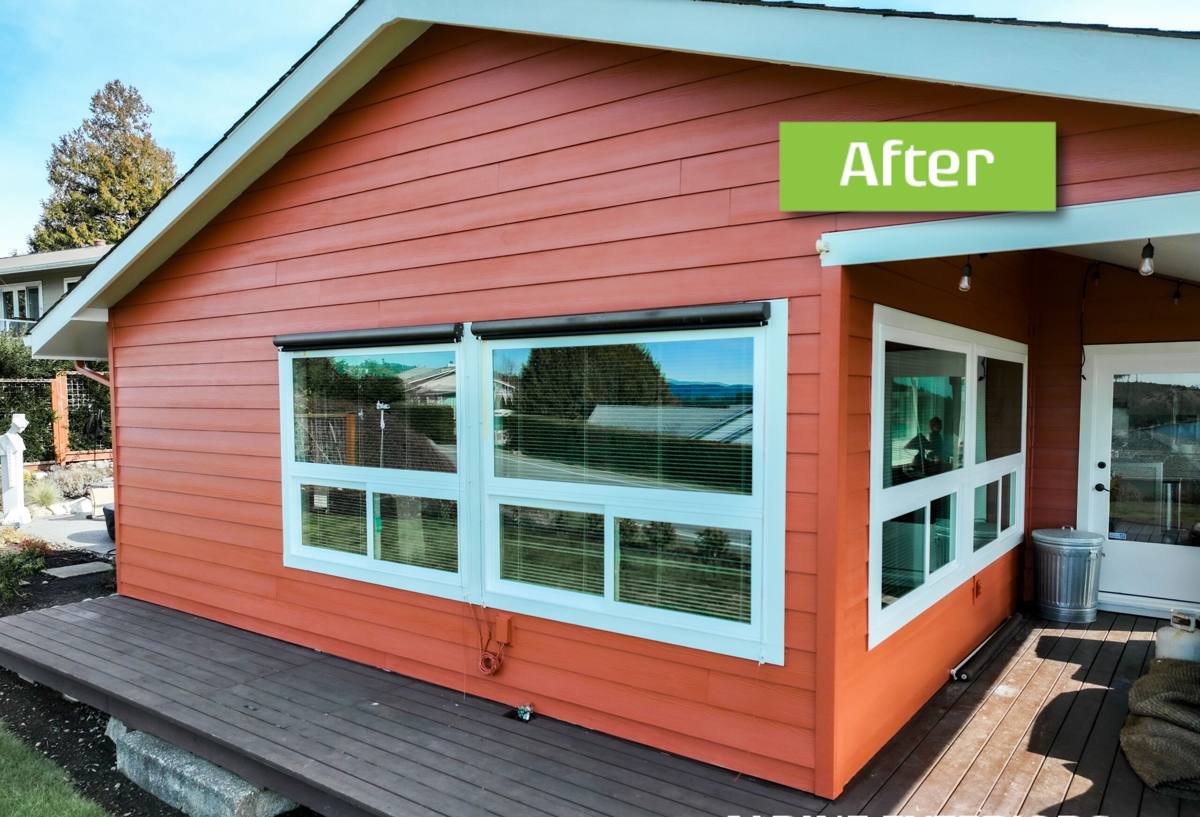
What "Energy-Efficient" Actually Means for a York Home
Energy efficiency in a window comes down to a handful of measurable properties, and it's worth knowing what they actually control before you're comparing quotes:
- U-factor — how much heat escapes through the window. Lower is better. This is the number that matters most for winter heating costs in a marine climate like ours.
- Solar Heat Gain Coefficient (SHGC) — how much solar heat passes through the glass. Matters more on south- and west-facing windows that catch direct sun.
- Air leakage rating — how much air moves through the assembly itself, separate from the glass. This is where installation quality can undo a good window.
- Low-E coatings and gas fills — a microscopically thin coating on the glass and an inert gas (usually argon) between panes, both working to slow heat transfer without changing how clear the glass looks.
For a Bellingham home, the priority is usually a low U-factor first — our climate is defined more by mild, wet, heat-loss conditions than by intense summer sun — with SHGC as a secondary consideration depending on which direction a room's windows face.
The Hidden Costs of the Wrong Window Choice Here
A window that's a poor fit for this climate doesn't usually fail all at once — it fails slowly, in ways that show up as separate problems before anyone connects them back to the window. Condensation between panes means a failed seal, which usually means the insulating gas has already leaked out and the "energy-efficient" rating on that unit stopped applying a while ago. Black staining or soft wood at the sill often means water has been sitting there through a wet season instead of shedding off, which is exactly the kind of standing moisture that moss and mildew need to take hold. Pitting or dulling on aluminum hardware and cladding is usually salt air doing what salt air does over years, not a manufacturing defect.
None of these are reasons to panic about a window that's a few years old — they're reasons to have someone who understands this specific set of conditions take a look before small issues turn into frame or sill replacement.
Frame Material Trade-Offs — What Actually Holds Up Here
There's no single "correct" frame material for every home — it depends on the house, the budget, and how much upkeep you want to take on. Here's how the common options actually compare under Bellingham's conditions rather than in a showroom:
| Frame Material | Moisture & Salt Air Resistance | Maintenance | Best Fit |
|---|---|---|---|
| Vinyl | Good — won't rot or corrode; seams can degrade with age | Low | Most homes prioritizing value and low upkeep |
| Fiberglass | Very good — dimensionally stable in temperature and moisture swings | Low | Homes wanting long-term stability, especially larger openings |
| Wood / Wood-clad | Fair — needs an intact exterior clad or finish to keep moisture out | Higher — finish upkeep matters in a wet climate | Homes prioritizing a traditional interior look |
| Aluminum | Fair — prone to pitting and corrosion near salt air over time | Moderate | Specific architectural or budget situations, used selectively |
We don't rule out any of these categories outright — we size the recommendation to the house and the budget. But we're upfront that in a salt-air, high-moisture environment like this, the maintenance schedule on wood and aluminum options is a real ongoing commitment, not a one-time decision, and we'd rather tell a homeowner that up front than let it surface as a surprise five years in.
What a Correct Installation Actually Involves
The window unit itself is maybe half the story. The other half is installation detail, and it's where energy performance is most often lost after the fact:
Flashing and Water Management
Proper flashing directs water that reaches the window opening back out and away from the wall assembly, rather than letting it track down into the framing. In a climate with as much wind-driven rain as ours, flashing sequence and overlap direction matter as much as the caulk bead most people focus on.
Air Sealing Around the Frame
A window with an excellent U-factor rating can still leak air around its perimeter if the gap between the rough opening and the frame isn't sealed correctly — with the right backer rod and sealant, not just spray foam packed in and left. This is one of the most common places a good window ends up performing like a mediocre one.
Sill Pan Protection
A sill pan under the window creates a secondary barrier and a drainage path for any water that does get past the primary seals over the years — cheap insurance against exactly the kind of slow sill rot that shows up in older homes after a few wet seasons.
Signs Your Windows Are Underperforming
Most homeowners notice a problem long before they can name it. If any of these sound familiar, it's worth having the windows looked at:
- A noticeable draft near the window even when it's fully latched
- Fogging or haze between the panes of a double- or triple-pane window
- Moss, algae, or dark staining building up on the sill or lower frame
- Difficulty opening, closing, or latching a window that used to operate smoothly
- A specific room that's noticeably colder or draftier than the rest of the house
- Rising heating bills without a clear other explanation
- Visible gaps or soft spots in the trim or caulk line around the frame
How Our Process Works
We keep the process straightforward and try not to make it more complicated than it needs to be:
- On-site assessment — we look at the existing windows, the condition of the surrounding trim and sill, and how the house is oriented to sun, wind, and rain exposure.
- Recommendation, not a sales pitch — we'll tell you honestly if a full replacement makes sense or if a repair covers the actual problem.
- Clear scope and pricing — you know what's being installed, what the installation detail includes, and what it costs before work starts.
- Installation — including flashing, sill protection, and air sealing done to the standard described above, not just dropping a new unit into an old opening.
- Walkthrough and cleanup — we check operation on every window before we consider the job done.
Why a Crew That Already Works in York Matters
A contractor who works in and around York regularly has already seen how homes in this part of Bellingham age — which conditions tend to show up first, what the wet season does to a poorly sealed sill, and how much salt air exposure really factors into hardware and frame choices over a decade rather than a single season. That's different from general window-installation experience gained somewhere with a drier or milder climate. It also means shorter response times if something needs a follow-up look after the first hard rain of the season, and a crew that isn't guessing about Whatcom County's typical weather patterns when they size up a job.
A Realistic Look at Cost Factors
Every home is different, but the main factors that move a quote up or down are consistent: the number of openings, the frame material chosen, whether the existing opening needs any repair work before a new window goes in, and how much of the trim and siding around the window needs to be disturbed to do the job correctly. A straightforward like-for-like replacement on a sound opening costs less than a job where rot repair or resizing is involved — which is exactly why an honest on-site assessment up front matters more than a phone estimate.
If you're weighing whether it's time to address the windows on a York home, we're happy to take a look and give you a straightforward, no-pressure estimate — no obligation, just an honest read on what your home actually needs. The form below is the easiest way to get started.