 Bellingham Window
 Building New in Birch Bay: What the Windows Have to Handle
Birch Bay sits right up against the water, and that changes what a window install has to get right from day one. Salt-laden air off the bay works on metal components and finishes in ways that inland Whatcom County homes never deal with. Driving rain off the Strait pushes water sideways into wall assemblies during winter storms, not just straight down. And the long, wet, shaded stretch of the year — especially on lots tucked under fir and cedar cover — keeps siding, trim, and window perimeters damp enough for moss and mildew to take hold if the details aren't right.
None of that is exotic knowledge. It's just specific. A window package that performs fine in a dry inland subdivision can underperform on a Birch Bay lot within a few winters if the material choices and flashing details weren't matched to the site. New construction is the one point in a home's life where you get to build that resistance in correctly, before siding and trim close everything up. Get it right here and you're not revisiting it for decades. Get it wrong and it's hidden behind finished walls until there's a stain, a soft spot, or a draft that finally gives it away.
New Construction vs. Replacement: Why the Process Is Different
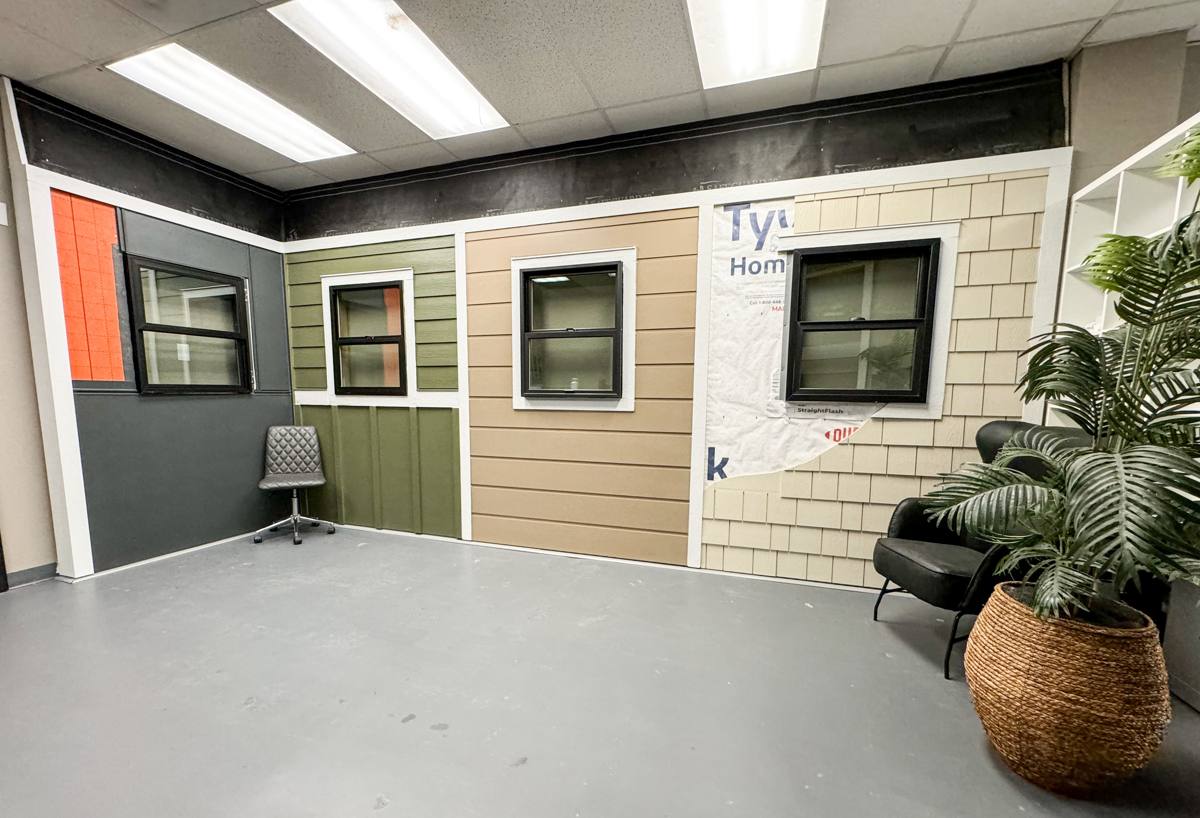
Replacement window work fits new units into an existing, already-clad wall — the trade is largely about matching the opening and sealing around what's there. New-construction window installation is a different job entirely. The windows go in before siding, before most trim, and often before the weather-resistive barrier (WRB) is fully lapped and taped. That means the window installer isn't just setting a unit level and plumb — they're building a piece of the home's water-management system.
On a new build, the window's nailing flange, the WRB, the flashing tape, and the eventual siding all have to integrate in a specific order. Skip a step, tape the wrong layer over another, or install before the sill pan is in place, and you've built a leak path into the wall that won't show itself until it's already caused damage. This is also the stage where window selection, opening sizes, and rough-opening tolerances still have flexibility — decisions that get locked in once framing and sheathing are done.
Where Timing Matters Most
Birch Bay's rain pattern makes sequencing matter more than it might on a drier site. A rough opening that sits exposed through a wet stretch, or a window set without temporary protection before the WRB is complete, can take on moisture that framing lumber holds onto for a long time. We coordinate window delivery and install with the framing and dry-in schedule specifically to minimize that exposure window.
Choosing the Right Window Material for a Birch Bay Build
There's no single "best" window material — the right call depends on the lot, the exposure, and the budget. For a coastal build in Whatcom County, we weigh corrosion resistance, moisture behavior, and long-term maintenance heavily, because those are the factors salt air and rain actually test.
| Material | Coastal/Salt Air Performance | Maintenance | Typical Trade-Off |
|---|---|---|---|
| Vinyl | Good — won't corrode or rust; UV-stable frames hold up well | Low — no painting, occasional cleaning | Frame color and size options more limited than wood or fiberglass |
| Fiberglass | Very good — dimensionally stable, resists salt and moisture damage | Low to moderate | Higher upfront cost than vinyl |
| Aluminum-clad wood | Good on the exterior face; wood interior needs protection from any water intrusion | Moderate — depends on the finish and how well the install kept water out | More install-sensitive; a flashing mistake affects the wood core, not just a surface |
| Bare aluminum | Weaker — aluminum can pit and corrode faster in direct salt exposure without a quality finish | Higher over time in this environment | We generally steer coastal Birch Bay clients away from unclad aluminum for this reason |
We don't push one brand or one material on every job. What we do insist on is matching the material to how exposed the specific opening is — a window on the water-facing wall of a bluff lot gets evaluated differently than one on a sheltered, tree-covered side of the same house.
Flashing and Water Management: The Detail That Actually Prevents Failures
Most window failures on new builds aren't a bad window — they're a flashing sequence that let water behind the window instead of over and around it. On a Birch Bay lot, where wind-driven rain is a real load and not just an occasional event, this step carries more weight than it would somewhere calmer.
A correct sequence, in order, generally looks like this:
- Sill pan flashing installed first, sloped to shed any water that gets past the window back out to the exterior, not into the wall cavity
- Window set into the opening, shimmed level, plumb, and square without racking the frame
- Side flashing tape lapped over the nailing flange in the correct shingle-style order
- Head flashing installed last, lapped over the WRB above it so water is always directed outward and down, layer over layer
- All flashing tape pressed and rolled for full adhesion — gaps or fishmouths are where water gets in
- WRB integration completed and inspected before siding closes the wall
Every one of those steps has to happen in that order. Reversing even one — head flashing tucked under the WRB instead of over it, for example — can turn a well-built wall into a slow leak that isn't visible for years.
Energy Code and Performance in Whatcom County
Washington's energy code sets minimum performance requirements for new-construction windows, including U-factor limits that affect how much heat the glass and frame lose. Whatcom County's cool, damp climate means condensation resistance matters almost as much as raw insulation value — a window that runs cold on the interior face invites moisture at the sill, which is exactly the kind of thing that feeds mold and rot in a house that's supposed to be brand new.
We select glass packages and frame assemblies that meet or exceed the current code minimums for the climate zone, and we size and place windows with an eye toward how much direct weather exposure each opening will see — not just what looks good on the elevation drawing.
Our New-Construction Window Process
1. Plan Review and Opening Verification
Before anything ships, we review the window schedule against the actual framed openings. Rough openings don't always match plans exactly, and catching a discrepancy before install day is far cheaper than discovering it with a crane truck in the driveway.
2. Material and Product Selection
We walk through material options with the builder or homeowner, factoring in the specific exposure of each elevation — water-facing walls get treated differently than sheltered ones.
3. Sequencing with the Build Schedule
We coordinate install timing with framing and dry-in so openings aren't left exposed to Birch Bay weather any longer than necessary.
4. Sill Pan and Flashing Installation
Every opening gets a sill pan and a full flashing sequence — no shortcuts, no "the siding will cover it" reasoning.
5. Window Setting and Fastening
Units are set level, plumb, and square, shimmed correctly, and fastened per the manufacturer's instructions so the warranty stays intact.
6. Final Integration Check
Before the wall closes up, we confirm every flashing lap is correct and every opening is fully weathered-in.
Common Mistakes We See on Coastal New Builds
Most of the problems that show up later on new Birch Bay homes trace back to a handful of recurring issues:
- Reversed or missing flashing laps — water gets behind the WRB instead of over it
- No sill pan — any water that reaches the sill has nowhere to go but into the framing
- Openings left exposed too long during a wet stretch, soaking sheathing before it's ever covered
- Fastening errors — over-driven or under-driven screws that rack the frame and cause operational problems or seal failure
- Material mismatched to exposure — an unclad aluminum or poorly protected wood window on a fully exposed, water-facing wall
- Ignoring moss and biofilm buildup around sills and trim on shaded lots, which holds moisture against the frame longer than it should sit
Every one of these is preventable with the right sequence and the right materials for the site — it's not about spending more, it's about not skipping steps that don't show up as a problem until years later.
Checklist: What to Confirm Before Your Windows Go In
If you're building in Birch Bay and want to sanity-check your window plan before install day, here's what we'd want confirmed:
- Window material and glass package are matched to each elevation's actual sun, wind, and rain exposure
- U-factor and performance specs meet current Washington energy code for your climate zone
- A sill pan is specified for every opening, not just the ones facing the water
- The flashing sequence is documented and matches manufacturer instructions, not just "standard practice"
- Install timing is coordinated with the dry-in schedule so openings aren't sitting exposed through a wet week
- Someone is inspecting flashing integration before siding closes the wall — not assuming it was done right
Why Hire a Crew That Already Works Birch Bay
A lot of window install problems on coastal builds aren't about skill in the abstract — they're about not having dealt with this specific combination of salt air, wind-driven rain, and shaded, moss-prone lots before. A crew that mostly works drier, inland jobs can do a technically fine install and still miss the details that matter here, simply because they've never had to.
We work in and around Bellingham and Whatcom County regularly, including Birch Bay's waterfront and near-waterfront lots, so the sequencing and material decisions above aren't theoretical for us — they're what we do on every coastal new-construction job. That familiarity shows up in small decisions: which openings get extra flashing attention, which materials we steer toward or away from on a given elevation, and how we schedule around the weather instead of hoping it cooperates.
If you're planning a new build in Birch Bay and want a straight answer on window materials, sequencing, or what your current plans call for, we're glad to walk through it. Reach out for a free, no-pressure estimate using the form below.