 Bellingham Window
 Why South Hill Roofs Wear Differently Than Roofs Inland
South Hill sits high enough to catch views of Bellingham Bay — and that same exposure means it catches everything the Bay throws at it. Homes up here take a steadier beating from salt-laden air moving off the water, wind-driven rain that hits roof planes at an angle instead of falling straight down, and long stretches of shade from mature trees that never let the north-facing slopes fully dry out. In Whatcom County, that combination adds up to one thing: moss season that barely ends, and roofing materials that have to shed water and resist corrosion at the same time, not just one or the other.
A roof that would hold up fine in a drier, more sheltered part of the county can struggle here. Asphalt shingles on a shaded South Hill slope will grow moss faster than the same shingles two miles away in full sun, and once moss takes hold, it lifts tabs, holds moisture against the deck, and shortens the roof's life. Metal roofing doesn't solve every problem on its own, but it changes the equation — smooth, hard, non-porous surfaces give moss spores far less to grab onto, and a correctly installed metal system moves water off the roof faster than most other materials, which matters when storms are coming in sideways.
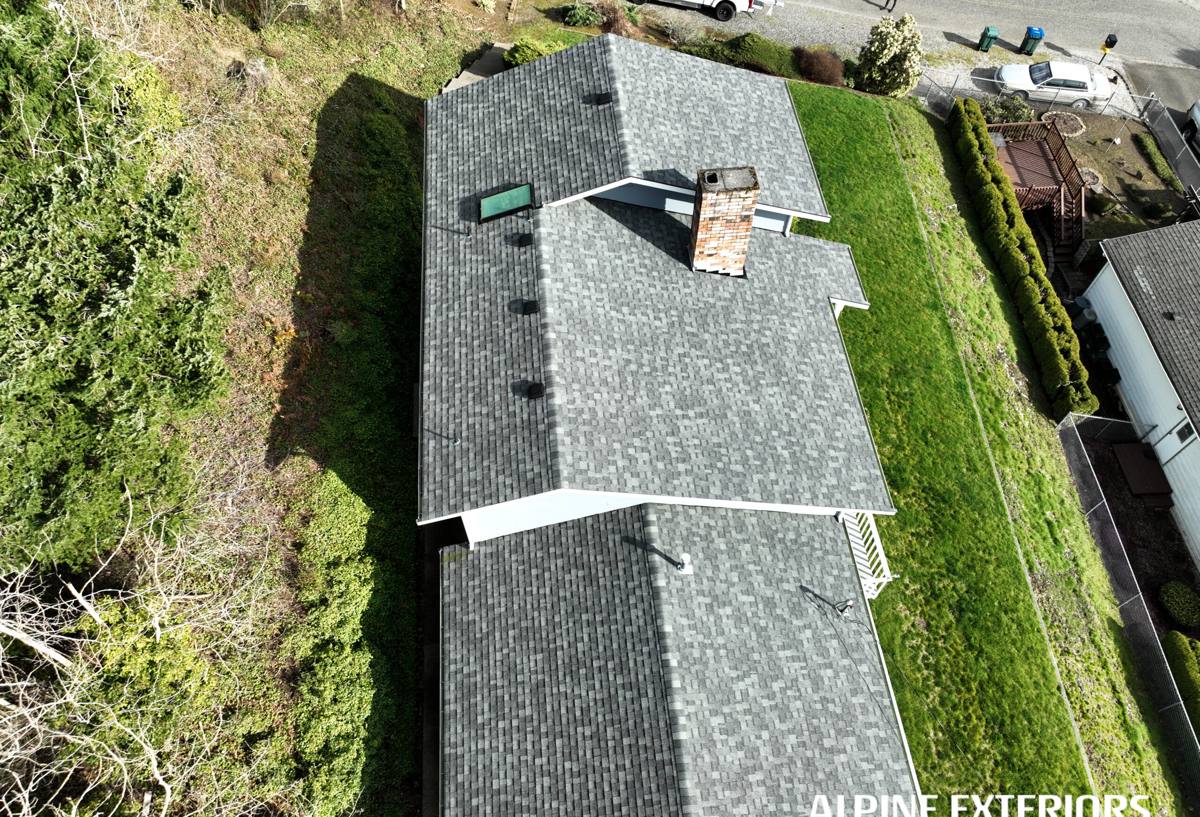
What a Metal Roof Actually Needs to Do on a South Hill Home
Before talking panels and colors, it helps to be clear about the job the roof has to perform here specifically:
- Shed wind-driven rain at low roof pitches without relying on gravity alone
- Resist corrosion from salt-influenced air near the Bay, especially at fasteners, flashing, and cut edges
- Discourage moss and organic growth on shaded, north-facing, or tree-covered slopes
- Handle the freeze-thaw swings that happen a few times most winters without cracking sealants or loosening seams
- Stay quiet and stable under the kind of steady, all-day rain Whatcom County gets from October through spring
Any metal roof that's specified and installed with those five things in mind will outperform a generic "metal roof is metal roof" approach. The panel profile, fastener type, and flashing details all get chosen differently once you're designing around salt air and driving rain instead of a dry inland climate.
Panel Types: What We Recommend and Why
Not every metal roofing product is a good fit for a coastal-influenced neighborhood like South Hill. We install a limited set of systems because we've seen what holds up here over years, not just what looks good on install day.
Standing Seam vs. Exposed-Fastener Panels
Standing seam panels use hidden clips and interlocking seams — no exposed screws punching through the panel face. Exposed-fastener panels are less expensive but rely on screws with rubber washers driven through the metal itself, and those washers are the first thing to fail as they age, especially with the freeze-thaw cycling and moisture exposure typical here. On a South Hill roof, where a compromised seal means water tracking into the deck under near-constant rain, we generally steer homeowners toward standing seam for main roof planes and reserve exposed-fastener panels for lower-stakes applications like sheds or carports where the trade-off makes more sense.
Material and Coating
Steel and aluminum are both viable, but the coating matters more than the base metal in this climate. A quality Kynar-type paint finish over a galvanized or Galvalume steel substrate, or a marine-grade aluminum panel, resists the salt-air corrosion that plain galvanized steel or bargain coatings won't hold up against over time. We won't put an uncoated or thin-mil panel on a home this close to the Bay — it's not a judgment on the product itself, it's just not matched to the environment.
| Factor | Standing Seam | Exposed-Fastener |
|---|---|---|
| Fastener exposure | Concealed clips, no face penetrations | Screws through panel face |
| Typical lifespan here | 40-60+ years with proper install | 20-30 years, shorter near salt air |
| Upfront cost | Higher | Lower |
| Best use on South Hill homes | Main roof planes, view-side elevations | Outbuildings, low-visibility roofs |
| Maintenance over time | Minimal — seams don't rely on washers | Washer/screw inspection recommended |
What a Correct Installation Involves
Metal roofing fails early almost always because of installation shortcuts, not because the material itself was wrong. On a South Hill home, a few details matter more than usual:
Underlayment and Deck Prep
We install a synthetic, high-temp-rated underlayment as the water barrier beneath the panels, with self-adhering membrane at eaves, valleys, and any low-slope transitions where wind-driven rain is most likely to work its way backward under the panel edge. If the existing deck has soft spots or old moisture damage from a prior leaky roof — common on older South Hill homes — we address that before a single panel goes down. Metal over a compromised deck just hides the problem.
Flashing and Penetrations
Every pipe boot, chimney, skylight curb, and wall transition is a place water can get in, and it's usually where roofs actually fail, not in the open field of panels. We use metal flashing matched to the panel system rather than generic universal boots wherever possible, since rubber components are the first thing salt air and UV degrade.
Fastener and Clip Corrosion Resistance
Fasteners and clips get matched to the panel material to avoid galvanic corrosion — mixing incompatible metals is a slow but real problem this close to the water, where any dissimilar-metal reaction is accelerated by salt exposure.
Ventilation
A metal roof still needs a properly vented attic underneath it. Trapped moisture under metal panels, especially on shaded South Hill roof planes that don't get much solar drying, can lead to condensation issues that have nothing to do with the roofing material and everything to do with airflow. We check and correct ventilation as part of the job, not as an afterthought.
Our Process on a South Hill Metal Roof
- On-site assessment: We walk the roof, check the deck condition, note tree cover and shading, and look at how water currently moves off the home during rain — that tells us more than a satellite photo ever will.
- System recommendation: Based on pitch, exposure, and budget, we recommend a panel type and finish, with the trade-offs explained plainly, not upsold.
- Deck and moisture check: Any soft decking, prior leak damage, or ventilation gaps get flagged and priced separately so there are no surprises mid-job.
- Installation: Underlayment, flashing, panels, and trim go in following the manufacturer's specifications for this climate zone — not a generic install sequence.
- Walkthrough: We go over the finished roof with the homeowner, including what routine maintenance (if any) it actually needs.
Cost Factors to Expect
Metal roofing costs more upfront than asphalt shingles, and it's worth understanding what actually drives the price on a South Hill job rather than just comparing a single number.
| Factor | Why It Matters Here |
|---|---|
| Roof pitch and complexity | Steeper or multi-plane roofs (common on older South Hill homes) take longer to flash correctly |
| Panel and coating grade | Marine-grade finishes cost more but resist salt-air corrosion far longer |
| Tear-off vs. overlay | Full tear-off lets us inspect and fix deck issues that shaded, moss-prone roofs often hide |
| Standing seam vs. exposed-fastener | Standing seam costs more but needs far less long-term attention |
| Access and site conditions | Tree cover, tight lots, and hillside grading can affect staging and labor time |
We give a real, itemized number after seeing the roof — broad ranges without an on-site look are more likely to be wrong than helpful.
Living With a Metal Roof in This Climate
One of the honest selling points of metal roofing here is how little it asks of a homeowner afterward. It won't need periodic moss treatments the way an asphalt or wood roof in a shaded South Hill lot typically does, and it won't shed granules or curl at the edges as it ages. That said, it's not zero-maintenance:
- Keep gutters and valleys clear of needles and debris so water has a clear path off the roof
- Have fasteners and flashing checked periodically if you have an exposed-fastener system
- Trim back branches that hold moisture against the roof or drop debris into valleys
- After major windstorms, a quick visual check for lifted trim or debris buildup is worthwhile
Why a Crew That Already Works South Hill Makes a Difference
South Hill's mix of older homes, tree cover, hillside lots, and Bay-adjacent air exposure isn't something you can plan for from a spec sheet — it's something you learn by doing roofs in this exact neighborhood and seeing how they age. A crew that knows which slopes hold moss longest, which panel and flashing details actually hold up against driving rain off the water, and how the older housing stock up here is typically framed will make fewer assumptions and fewer mistakes than a crew treating it like any other job. That local knowledge shows up in the details — flashing choices, fastener selection, ventilation fixes — long before it shows up as a callback.
If you're weighing options for a South Hill roof, we're happy to take a look and walk you through what your specific roof needs — no pressure, no generic sales pitch. Reach out for a free estimate using the form below.