 Bellingham Window
 Building Decks for Columbia's Marine Climate
Columbia sits close enough to Bellingham Bay that salt-tinged air, wind-driven rain, and a moss season that can stretch from October through April all show up in how a deck ages. A deck built the same way you'd build one in a drier inland climate will look tired within a few years here — cupped boards, rusted fasteners, slick green film on the walking surface, soft spots where water sat too long. A deck built for this specific neighborhood, with the right materials and the right details at every joint, will still look and perform well a decade or two later.
This page covers what actually matters for a Columbia deck: material choice, structural details, drainage, and the parts of the build that are easy to rush but expensive to fix later.
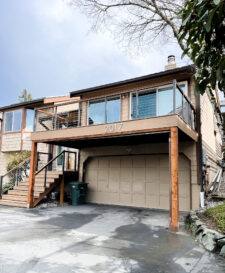
What Salt Air, Rain, and Moss Actually Do to a Deck
Each of these stresses attacks a deck differently, and a correct build accounts for all three at once:
- Salt air accelerates corrosion on any exposed metal — screw heads, joist hangers, bolts, railing hardware. Standard hardware store fasteners can start rusting and staining the wood around them within a season or two this close to the water.
- Driving rain doesn't just fall straight down here — wind pushes it sideways and up under rail caps, ledger boards, and stair stringers. Any gap or unsealed seam becomes an entry point for water that then has nowhere to dry out.
- Moss and algae need shade, moisture, and time — all three are in steady supply on a Bellingham deck through fall and winter. Beyond looking bad, moss holds moisture against the decking surface and makes stairs and walking surfaces genuinely slippery.
None of these are dealbreakers. They just mean material selection and installation detail matter more here than they would somewhere drier.
Choosing Decking Material for a Columbia Home
There's no single right answer — it depends on budget, how much upkeep you want to do, and how the deck will be used. Here's how the common options actually perform in this climate:
| Material | Upfront Cost | Maintenance in This Climate | Notes |
|---|---|---|---|
| Pressure-treated pine | Lowest | Needs re-sealing every 1–2 years; watch for moss buildup | Budget-friendly, but the shortest lifespan against sustained coastal moisture without diligent upkeep |
| Cedar | Moderate | Annual cleaning and periodic oil/sealer | Naturally rot-resistant and handles moisture well, but still needs real maintenance to stay ahead of moss and graying |
| Composite decking | Higher | Occasional washing, no sealing or staining | Doesn't absorb water or feed rot the way wood does; still needs cleaning to keep algae film off the surface |
| PVC decking | Highest | Lowest — periodic rinse | Fully synthetic, most resistant to moisture damage, but least "natural" look and highest cost |
For a lot of Columbia homeowners, composite strikes the best balance — it costs more up front than wood but removes the annual sealing cycle that's easy to fall behind on when it rains nine months a year. That said, we'll build a quality wood deck if that's the look and budget you want; the difference is we'll tell you honestly what upkeep it needs so there are no surprises in year three.
Fasteners and Hardware
Whatever decking material you choose, the hardware underneath matters just as much. In a salt-air environment, we use stainless steel or heavy hot-dip-galvanized fasteners and connectors rated for coastal exposure, not the general-purpose galvanized hardware that's fine further inland. Cheaper hardware is one of the most common places we see corner-cutting on decks that fail early — it's hidden once the deck is built, so it's an easy spot to save money that doesn't show up as a problem until the rust stains start bleeding through the decking.
Framing and Structure
The framing is what you don't see once the deck is finished, and it's also what determines whether the deck is still solid in fifteen years. For Columbia's climate, that means:
- Joists and beams sized correctly for the actual span and load, not just "what's typical" — a deck meant to hold a hot tub or a large gathering needs different framing than a small entry deck.
- Proper joist hanger hardware at every connection, rated for exterior/coastal exposure.
- Post bases that keep wood posts off direct ground or concrete contact, since standing water at the base of a post is one of the fastest ways to rot a structure from the ground up.
- Adequate airflow underneath the deck so the frame can actually dry out between rain events instead of staying damp for weeks at a stretch.
Drainage, Flashing, and the Ledger Connection
If a deck is going to fail early, it almost always starts at one of two places: the ledger board where the deck attaches to the house, or somewhere water is pooling instead of draining. Both are entirely preventable with correct detailing.
The Ledger Board
This is the board that bolts the deck to your house, and it's the single most important flashing detail on the whole structure. Done wrong, water gets behind the ledger and works its way into the house's wall framing and sheathing — a problem that can go unnoticed for years because it's hidden behind the decking. Done right, proper flashing and a small air gap keep water moving away from the house instead of pooling against it.
Surface Drainage
Decking boards need consistent spacing and a slight slope away from the house so water sheets off instead of sitting on the surface. On solid-surface or covered decks, that means an actual drainage system underneath, not just hoping gravity and gaps handle it.
Our Deck Building Process
- On-site assessment — we look at the site, sun/shade exposure, drainage patterns, and how the deck will be used before recommending materials.
- Design and material selection — sized and laid out for your space and budget, with honest trade-offs explained for each material option.
- Permitting — we handle the permit process with the City of Bellingham or Whatcom County as required for your specific project.
- Framing and structural work — footings, posts, beams, and joists built to span and load requirements, with coastal-rated hardware throughout.
- Ledger flashing and waterproofing — the details that determine whether your house stays protected where the deck meets it.
- Decking, railing, and finish work — installed with correct spacing and fastening for your chosen material.
- Final walkthrough — we go over how to maintain the specific material you chose so it holds up through the wet season.
Permits in Bellingham and Whatcom County
Most new decks above a certain height or attached to a structure require a building permit locally, and requirements can vary depending on your exact location, lot, and whether you're inside city limits or unincorporated Whatcom County. We handle this as part of the project rather than leaving it on the homeowner to sort out — it's a normal part of building a deck correctly and protects you if you ever sell the house.
Seasonal Maintenance Checklist for Columbia Homeowners
Whatever material your deck ends up being, a little seasonal attention goes a long way in this climate:
- Sweep leaves and debris off the deck regularly in fall — trapped organic matter is what feeds moss growth.
- Clean the surface at least once a year with a deck-safe cleaner to remove algae film before it builds up.
- Check that gaps between boards stay clear so water and debris don't pack in and hold moisture.
- Inspect the ledger board area and any visible flashing once a year for staining or soft wood.
- Re-seal or re-stain wood decking on the schedule appropriate to that product — don't wait until it's visibly gray and worn.
- Check railing and stair hardware periodically for rust bleed or looseness, especially after a hard winter.
Why a Crew That Already Works in Columbia Matters
A deck built by someone unfamiliar with this specific stretch of coastline often looks fine on day one and starts showing problems within a few wet seasons — the wrong hardware, insufficient ledger flashing, or a material choice that wasn't really suited to the exposure. A crew that regularly works in Bellingham's coastal neighborhoods already knows which details can't be skipped here, has relationships with suppliers who stock the right coastal-rated hardware, and can spot a site's specific drainage or exposure issues before they become expensive problems. That local familiarity is the difference between a deck that needs real repair work in five years and one that just needs normal seasonal care.
If you're planning a new deck or replacing an aging one in Columbia, we're happy to take a look and give you a straightforward, no-pressure estimate — just fill out the form below.