 Bellingham Window
 Why Lynden Roofs Need to Be Built for This Climate
Lynden sits inland from Bellingham Bay, but it doesn't escape what makes Whatcom County roofing different from roofing almost anywhere else in the country. Moist, salt-tinged marine air moves inland off the Salish Sea and settles over the whole county, driving rain comes sideways during fall and winter storms, and shaded, tree-lined lots hold moisture long after a storm has passed. Add a long moss season that can run from October through May, and you have a set of conditions that punishes roofing materials that aren't built for constant wet-dry cycling.
Asphalt shingles in this environment take on granule loss, moss intrusion under the tab lines, and algae streaking well before their rated lifespan is up. Metal roofing, installed correctly, handles this pattern better than almost any other residential roofing material available — it sheds water fast, gives moss and moisture far less to hold onto, and doesn't rely on a mat of organic material that slowly absorbs water the way shingle underlayment does. That's the case for metal roofing in Lynden specifically, not roofing in general.
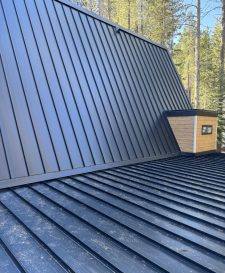
What a Correct Metal Roof Installation Actually Involves
Metal roofing has a reputation for being nearly maintenance-free, and it can be — but only if it goes on right the first time. A metal roof is a system, and every layer under the visible panel matters as much as the panel itself.
The Layers That Do the Real Work
- Deck inspection and repair — any soft, rotted, or delaminated sheathing gets replaced before anything else happens. Metal panels won't fix a bad deck; they'll just hide it until it fails.
- Ice and water shield at vulnerable points — valleys, eaves, and roof-to-wall transitions get self-adhering membrane, not just felt, because those are the spots where wind-driven rain gets pushed backward under the roofing.
- Synthetic underlayment across the field — a breathable, water-resistant barrier under the whole roof, sized and lapped for metal rather than reused from shingle practice.
- Proper fastening or clip spacing — exposed-fastener panels need the right screw pattern and torque; standing seam systems need clips spaced to the manufacturer's wind-load spec, not a generic default.
- Flashing detail at every penetration — chimneys, vents, skylights, and wall intersections are where the vast majority of metal roof leaks actually originate, not the panels themselves.
- Ventilation — intake and exhaust airflow that keeps the attic dry and prevents condensation from forming on the underside of the panels during cold, damp stretches.
Skipping or shortcutting any one of these doesn't show up on day one. It shows up two or three winters later as a leak at a valley, rust starting at a fastener head, or condensation staining on the underside of the deck.
Choosing the Right Panel System for a Lynden Home
Not every metal roofing product performs the same in this climate, and the right choice depends on the home, the roof pitch, and the budget. Here's how the common options compare for a property in this region:
| System | How It Sheds Water | Best Fit | Trade-offs |
|---|---|---|---|
| Standing seam | Concealed fasteners, raised interlocking seams — best performance in driving rain and wind | Homes wanting the longest service life and cleanest look | Higher upfront cost, requires precise installation |
| Exposed-fastener panel | Screws through the panel face with rubber washers; adequate but washers age over time | Outbuildings, shops, budget-conscious re-roofs | Fasteners need periodic inspection and eventual re-torquing or replacement |
| Stone-coated steel | Interlocking steel panels coated to resemble shingle or tile profiles | Homeowners who want a traditional look with metal's durability | More complex flashing details, higher material cost |
For most Lynden homes, we lean toward standing seam or a quality stone-coated steel system because the concealed-fastener and interlocking designs give the roof the fewest points where water can find a way in over a 40-plus year service life. Exposed-fastener panels have their place, especially on shops and secondary structures, but we're upfront that they carry a maintenance item — the washers — that standing seam doesn't have.
Moss, Trees, and Roof Maintenance in a Rural Setting
Lynden's mix of open farmland and tree-lined residential lots means roofs here deal with two different problems: moss that gets a foothold in shaded, damp areas, and debris — needles, leaves, cottonwood fluff — that collects in valleys and against roof penetrations. Metal roofing handles both far better than shingles because there's no granule surface for moss spores to grip and no organic mat to hold moisture against the deck. But "better than shingles" isn't the same as "zero maintenance."
A Simple Seasonal Checklist
- Clear gutters and downspouts before the fall rains start, so water isn't backing up under eave flashing
- Rinse off accumulated needles and debris from valleys once or twice a year — a garden hose is usually enough
- Trim back tree limbs that overhang the roof to cut down on shade and debris load
- Walk the roofline visually from the ground after major windstorms, checking for lifted flashing or dislodged panels
- Have fastener heads and sealant at penetrations checked every few years, especially on exposed-fastener systems
None of this is heavy labor, and it's a fraction of what a shingle roof needs in the same environment. But skipping it entirely and assuming metal means "install and forget" is how small issues turn into deck damage.
How Our Process Works
We keep the process straightforward because roofing decisions shouldn't feel complicated.
- On-site assessment — we walk the roof, check the deck condition where accessible, and look at ventilation, flashing points, and any existing moss or moisture issues.
- Written estimate — a clear breakdown of panel system, underlayment, flashing scope, and any deck repair, so there's no guessing at what's included.
- Material order and scheduling — metal panels are typically ordered to the exact roof measurements, which means less waste and a cleaner finished look than cut-to-fit systems.
- Tear-off and deck prep — old roofing removed, deck inspected and repaired as needed, debris hauled off-site.
- Underlayment, flashing, and panel installation — installed in the sequence that actually manages water, not just the fastest sequence.
- Final walkthrough — we go over the finished roof with the homeowner, point out anything worth knowing for future maintenance, and make sure everything matches what was quoted.
What Drives the Cost of a Metal Roof
Metal roofing costs more upfront than asphalt shingles, and it's fair to know why before committing to it.
| Factor | Why It Matters |
|---|---|
| Panel system | Standing seam runs higher than exposed-fastener panel due to material and labor precision |
| Roof complexity | Valleys, dormers, and multiple roof planes add flashing labor and material |
| Deck condition | Rot or soft sheathing found during tear-off adds repair cost not visible from the ground |
| Ventilation upgrades | Older homes often need added intake or exhaust venting to perform properly under metal |
| Roof pitch and access | Steep or hard-to-access roofs take longer and require more safety setup |
We won't quote a number without seeing the roof — anyone who does is guessing. What we can say honestly is that the higher upfront cost is offset by a roof that, installed correctly, is realistically looking at a 40-to-60-year service life with minimal upkeep, versus a shingle roof needing full replacement two or three times over the same span in this climate.
Why It Matters That We Already Work in Lynden
Roofing details that are optional in a dry climate aren't optional here. A crew that primarily works in places with mild, dry weather patterns may not default to ice and water shield at every valley, may not think twice about ventilation in a damp attic, or may treat moss as a cosmetic issue rather than a moisture-management one. Working across Whatcom County, including Lynden, means those aren't edge cases for us — they're the baseline on every roof we do.
It also means we're not guessing at how a given roof style holds up locally. We've seen how different panel systems, flashing approaches, and ventilation setups perform after several wet seasons in this specific climate, not just on a spec sheet. That local track record shapes what we recommend and what we steer homeowners away from.
Warranty and Long-Term Care
Metal roofing typically carries two separate warranties worth understanding: a manufacturer warranty on the panel finish (covering fading, chalking, and peeling) and a workmanship warranty from the installing contractor covering flashing, fastening, and water-tightness. The panel finish warranty is only as good as the installation underneath it — a leak caused by poor flashing work isn't a material defect, and manufacturers won't cover it as one. We're upfront about what our workmanship warranty covers and for how long, in writing, before any work starts.
Get a Straight Answer on Your Roof
If you're weighing metal roofing for a home in Lynden, we're happy to take a look and give you an honest assessment — what condition your current roof is in, what a correct metal roofing job would involve, and a real cost range based on your specific roof, not a generic estimate. The consultation is free and there's no pressure to move forward. Use the form below to request a time that works for you.