 Bellingham Window
 Why Sehome's Climate Is Hard on Exterior Siding
Sehome sits close enough to Bellingham Bay that homes here deal with a specific combination of punishment most inland neighborhoods never see: salt-laden air moving off the water, long stretches of driving rain that comes in sideways during winter storms, and a moss season that can run from late fall through spring. Individually, any one of these is manageable. Together, over years, they expose the weak points in whatever siding material is on the wall.
Salt air accelerates corrosion on fasteners and trim metal, and it degrades cheap coatings faster than a standard weathering estimate would suggest. Driving rain doesn't just wet the surface of a wall — it tests every seam, joint, and piece of flashing, looking for a path behind the siding. And moss, once established on a north-facing wall or a shaded eave, holds moisture against the surface for weeks at a time, which is exactly the condition that rots wood-based products and stains anything with a porous finish.
None of this means Sehome is an unusually harsh place to build. It means the margin for error in material choice and installation quality is smaller here than it is in a drier climate, and that shows up over a 10-, 15-, or 20-year timeline rather than in the first season.
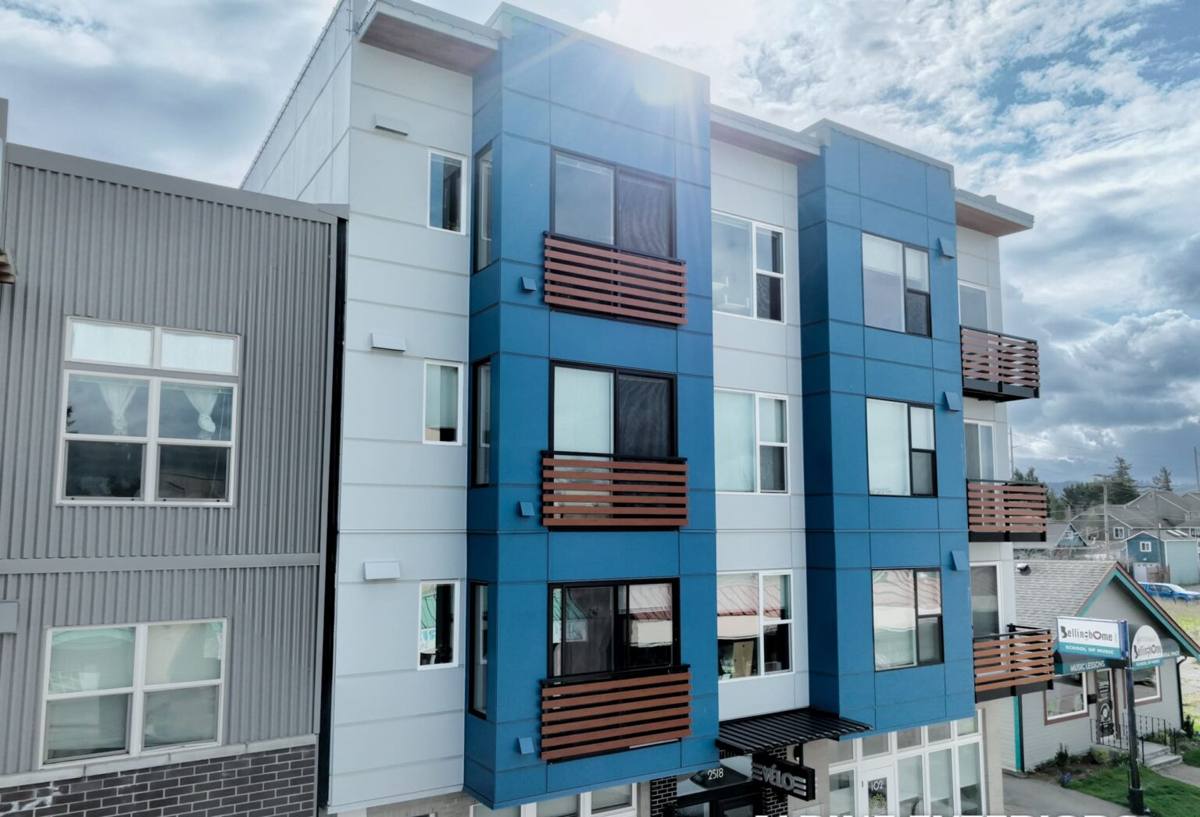
Why We Install Only James Hardie Fiber Cement
We made a decision as a company to install James Hardie siding exclusively — not LP SmartSide, not vinyl, not Cemplank or Allura, not primed spruce or cedar. That's a narrower product lineup than a lot of siding contractors carry, and we're upfront about why: in a climate like Whatcom County's, the material matters more than almost any other decision in the project.
What Fiber Cement Does That Wood-Based Products Don't
James Hardie siding is cement, sand, and cellulose fiber, engineered to be non-combustible and dimensionally stable. It doesn't swell, delaminate, or feed rot the way wood and wood-composite sidings can when they take on repeated moisture. That matters directly in Sehome, where a shaded or north-facing wall can stay damp for extended periods during moss season. It also holds a factory-applied finish far better than field-primed wood, which is relevant given how much UV and salt-air exposure a west- or south-facing wall gets over a Bellingham summer.
Engineered for This Region
Hardie's HZ product line is manufactured in different formulations for different climate zones, accounting for moisture exposure and freeze-thaw behavior specific to the region it's installed in. That's not a marketing detail — it's the reason we don't treat "siding" as a single generic product. The version of James Hardie siding installed on a Sehome home is not the same formulation you'd see in Arizona, and that distinction matters when the siding is expected to perform for decades in Pacific Northwest weather.
Product Lines and Styles That Work Well in Sehome
Sehome's housing stock is a mix — older bungalow and craftsman-era homes closer to the university area, alongside newer infill construction and remodeled properties. James Hardie's lineup covers both ends of that range without forcing a homeowner into a look that doesn't fit the house.
- HardiePlank lap siding — the most common choice for traditional homes, available in several exposure widths and textures (smooth, cedarmill) to match an existing profile or update it
- HardiePanel vertical siding — used for board-and-batten looks or as an accent on gables and entries
- HardieTrim — matches trim material to the siding system so expansion rates and finishes stay consistent at every joint
- HardieShingle — a straight or staggered shingle profile for homes that want that texture without the maintenance burden of real cedar shingles
ColorPlus Factory Finish
Most James Hardie products are available with a ColorPlus finish — a coating baked on at the factory under controlled conditions, rather than paint applied on-site after installation. It resists fading and chipping better than field-applied paint and carries its own finish warranty separate from the substrate warranty. In a neighborhood exposed to salt air and consistent moisture, that factory bond is worth more than it might sound like on paper — it's one less place for water to find an entry point through a compromised paint film.
What a Correct James Hardie Installation Actually Involves
The material is only half of what determines how siding performs over time. Installation quality is the other half, and it's where a lot of the real-world problems with any siding — Hardie included — actually originate.
Water Management Behind the Siding
James Hardie siding is not a waterproof membrane by itself; it's a durable cladding installed over a water-resistive barrier (housewrap) and flashing system designed to manage the water that inevitably gets past the outer layer. In a climate with as much driving rain as Sehome sees, the details matter enormously:
- Correct weather-resistive barrier installation and lapping, shingle-style, so water sheds outward at every seam
- Proper flashing at windows, doors, and any wall penetration — this is the single most common failure point on poorly installed siding jobs of any brand
- Manufacturer-specified gaps at butt joints, trim, and ground clearance so the assembly can handle expansion and drainage rather than trapping water
- Fastener placement and type per Hardie's published installation instructions, not generic siding nailing patterns
Common Mistakes That Cause Callbacks
Most siding failures we get called to look at — regardless of the original material — trace back to installation shortcuts, not the product itself: face-nailing where blind-nailing was specified, missing or reversed flashing, siding installed tight to grade or a deck surface with no clearance, or caulk used as a substitute for proper flashing detail. James Hardie publishes detailed installation requirements for exactly this reason, and following them isn't optional if you want the warranty to mean anything.
Our Process for a Sehome Siding Project
We run every job the same disciplined way, whether it's a small accent wall or a full re-side.
1. On-Site Assessment
We walk the exterior, check for existing moisture damage or rot in the sheathing, note moss buildup patterns that tell us which walls have the worst exposure, and assess trim, window flashing, and any areas where the current siding is already failing.
2. Tear-Off and Substrate Repair
Old siding comes off, and we address any compromised sheathing or framing before anything new goes on. Installing new siding over a wet or rotted substrate just hides a problem instead of fixing it — we don't do that.
3. Water-Resistive Barrier and Flashing
New housewrap, correctly lapped, with flashing integrated at every window, door, and penetration before the first piece of siding goes up.
4. James Hardie Installation to Spec
Panels or planks installed per Hardie's fastening, clearance, and joint requirements — the details that determine whether the product performs for its full service life.
5. Trim, Caulk, and Final Detailing
Trim and caulking finished last, at the joints designed to be sealed — not used to cover up a flashing detail that should have been done correctly underneath.
Cost Factors on a Sehome Siding Job
Every home is different, and we won't quote a number without seeing the property, but these are the factors that most often move a project's scope and cost:
| Factor | Why It Matters |
|---|---|
| Existing substrate condition | Rot or moisture damage found during tear-off adds repair scope before new siding can go on |
| Home size and wall complexity | More corners, gables, and dormers mean more cutting, flashing, and trim detail |
| Product line and profile | Lap siding, panel, and shingle profiles carry different material and labor costs |
| Trim and accent scope | Full HardieTrim packages and accent details add labor beyond field siding |
| Access and site conditions | Hillside lots, mature landscaping, and tight setbacks affect staging and labor time |
Why Hiring a Crew That Already Works Sehome Matters
Bellingham's neighborhoods aren't uniform, and Sehome's mix of home ages, hillside terrain, and tree cover means the moss and moisture patterns on a given wall are often specific to that lot. A crew that's worked in the neighborhood knows which orientations tend to hold moss longest, how to sequence a project around Bellingham's wet-season weather windows, and what permitting and inspection expectations look like locally. That local familiarity shows up in fewer surprises mid-project and a finished install that's set up to handle the specific conditions of the site, not a generic weather assumption.
Maintaining Your Siding After Installation
James Hardie siding is low-maintenance compared to wood, but "low-maintenance" isn't "no-maintenance," especially in a climate that grows moss well. A little attention keeps it performing and looking right for the long haul.
- Rinse the exterior periodically, especially north-facing and shaded walls where moss and mildew take hold first
- Keep gutters clear so overflow doesn't run down the siding face repeatedly
- Trim back vegetation and tree limbs that keep a wall section shaded and damp
- Inspect caulking at trim joints and penetrations every year or two and re-caulk as needed
- Address any impact damage or chipped finish promptly rather than letting exposed edges take on water
If your Sehome home's siding is showing moss staining, failing caulk lines, or you're just planning ahead for a replacement, we're happy to come take a look. The estimate is free, there's no pressure, and you'll get a straight answer about what your home actually needs.