 Bellingham Window
 Why Birchwood Siding Takes a Different Kind of Beating
Birchwood sits close enough to Bellingham Bay and the Salish Sea that homes here deal with a specific combination of weather stress that inland Whatcom County properties don't see as often: salt-laden air moving off the water, long stretches of driving rain pushed sideways by wind, and a moss season that can run from early fall through late spring. None of these are dramatic events on their own. The damage they cause to siding builds slowly, over years, which is exactly why so many Birchwood homeowners don't notice a problem until it's already inside the wall.
Salt air accelerates corrosion on fasteners, flashing, and any exposed metal trim. Driving rain finds the smallest gap in a joint, a seam, or a piece of trim and works it wider over time. And moss doesn't just sit on the surface looking bad — it holds moisture against the siding long after a storm has passed, which keeps wood-based products wet far longer than they were engineered to tolerate. On a Birchwood lot with tree cover or a shaded north wall, that moisture cycle can repeat itself for months without a real drying window.
What Early Siding Failure Looks Like
Most siding repair calls we get in this neighborhood start with something small the homeowner noticed and wasn't sure mattered. Usually it does. Catching these signs early is the difference between a repair that takes a day and one that turns into a wall-opening job.
- Soft or spongy spots when you press on the siding, especially near the bottom courses or under windows
- Paint that's bubbling, peeling, or flaking in a way that looks different from normal weathering
- Visible moss or dark green-black staining that keeps coming back after cleaning
- Gaps opening up at seams, corners, or where siding meets trim, window casings, or the foundation
- Streaking or discoloration below nail heads or fastener lines
- A musty smell near an exterior wall, especially in a closet or room that shares that wall
- Warped, cupped, or delaminating boards, particularly on the side of the house that takes the most weather
Any one of these on its own might be minor. Two or three together, especially on a wall that faces prevailing wind and rain, usually means water has already gotten past the surface.
Repair or Replace: How We Actually Decide
Not every siding problem in Birchwood needs a full re-side, and we don't push a bigger job than a home actually needs. But we also won't patch over something that's going to fail again in a year. The honest answer depends on how far the damage has spread and what's underneath it.
| Situation | Repair Usually Makes Sense | Replacement Is the Better Call |
|---|---|---|
| Damage location | Isolated to one or two boards, a corner, or a small section | Spread across multiple walls or the whole exposed side of the house |
| Underlying sheathing | Dry and solid once siding is pulled back | Soft, stained, or rotted — repair would just cover the real problem |
| Water barrier condition | Intact, just needs re-flashing or sealing at the repair site | Failed, missing, or improperly installed originally |
| Age and material of existing siding | Relatively recent, still structurally sound elsewhere | Original material is a known moisture risk (older wood composite, damaged vinyl, etc.) |
| Cosmetic match | Replacement boards can be color-matched closely enough | Faded or discontinued finish makes patch repairs visibly obvious |
We open up the affected area before quoting anything final. A wall can look fine from the outside and still have wet sheathing behind it — you don't know until you look.
What a Correct Repair Actually Involves
Checking What's Behind the Siding First
Any repair worth doing starts by pulling back enough siding to see the water-resistive barrier and sheathing underneath. If that layer has failed — torn housewrap, missing flashing, staining on the sheathing — replacing the visible boards without fixing what's behind them just resets the clock on the same failure.
Flashing and Fastening
A large share of the repair calls we run in Bellingham trace back to flashing that was missing, undersized, or installed in the wrong order relative to the water barrier — around windows, at horizontal seams, and where siding meets trim or roofline. We correct the flashing detail as part of the repair, not just the board that's visibly damaged. Fastener choice matters too, particularly this close to salt air: corrosion-resistant fasteners rated for the exposure are the only ones we use, since standard hardware can start failing in a fraction of the time.
Matching the Existing Finish
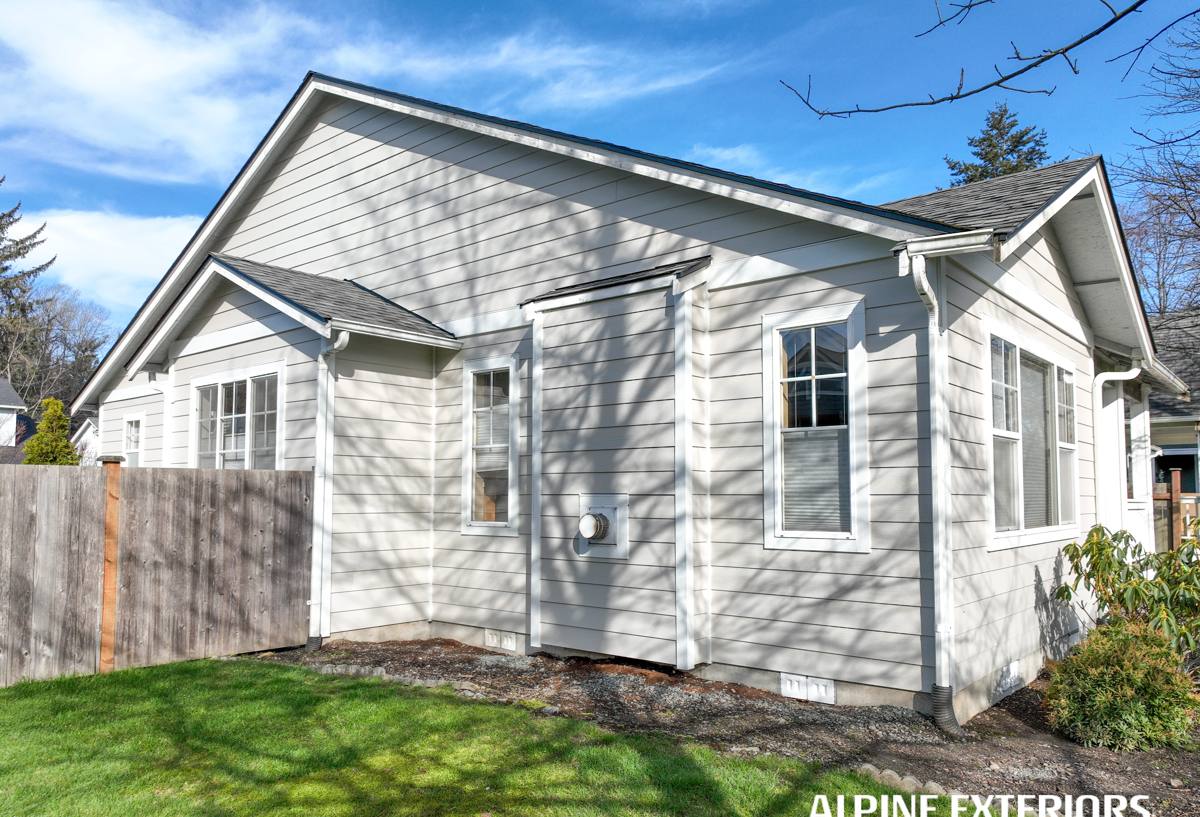
For a repair to actually look like a repair and not a patch, the replacement material and color need to match closely. With factory-finished fiber cement this is far more reliable than trying to field-match paint on a wood product, because the color comes from the manufacturer's finish system rather than a can mixed years after the original install.
Why We Repair Exclusively With James Hardie Fiber Cement
We don't install or repair with LP SmartSide, vinyl, Cemplank, Allura, primed spruce, or cedar. That's a deliberate standard, not a brand preference we picked at random, and it matters more in a climate like Bellingham's than it would somewhere dry.
Wood-based and wood-composite sidings depend on an intact paint or finish layer to keep moisture out. In a marine climate with this much driving rain and moss exposure, that finish layer takes constant abuse, and once it's compromised the substrate underneath absorbs water and doesn't fully dry between storms. Vinyl doesn't rot, but it moves with temperature swings, can crack in impacts, and doesn't hold up structurally the way a repair on this coast needs it to. James Hardie fiber cement is non-combustible, doesn't absorb water the way wood-based products do, and carries a factory ColorPlus finish that's engineered to hold up to UV and moisture exposure far longer than field-applied paint. It's also built in HZ5 formulations specifically for climates like ours, and it comes with a strong transferable warranty when installed to Hardie's specifications. When we do a repair, we're not just fixing today's problem — we're making sure the same failure doesn't happen again in three years.
Our Process for a Birchwood Siding Repair
- On-site inspection — we look at the damaged area and check adjacent siding, trim, and flashing for related issues before quoting anything
- Opening the wall — pull back affected boards to inspect the water barrier and sheathing directly, not guess from the outside
- Honest scope — a clear explanation of what's a straightforward patch versus what needs a wider section replaced, with reasons
- Correcting the cause — re-flashing, sealing, or barrier repair, not just swapping the visible board
- Matching materials — James Hardie fiber cement in a matching profile and factory finish
- Final check — confirming seams, caulking, and fastener lines are sealed against the next round of driving rain
Moss, Mildew, and Ongoing Maintenance in a Marine Climate
A repair fixes the damage that's already there, but Birchwood's moss season doesn't stop after the work is done. Trees, fences, and neighboring structures that shade a wall keep it damp longer, which is exactly the condition moss and mildew need to establish. A few habits go a long way toward protecting a fresh repair: keep gutters clear so water isn't sheeting down the siding face, trim back vegetation that's shading or touching the wall, and rinse visible moss or algae buildup before it gets a foothold rather than after. None of this is unique to fiber cement, but Hardie's factory finish and non-combustible, moisture-resistant composition give it a real head start over wood-based materials facing the same exposure.
Why a Crew That Already Works Birchwood Matters
Siding repair done wrong is worse than no repair at all, because it hides a problem instead of solving it. A crew that already does regular work in Birchwood and the surrounding Bellingham neighborhoods knows which wall orientations take the worst of the weather off the bay, what moss growth patterns to expect on shaded lots, and how local flashing and drainage details tend to fail in homes built to different eras' code requirements. That local pattern recognition is what keeps a repair estimate honest — knowing from experience what's likely hiding behind a given wall before we ever pull a board.
If you're seeing soft spots, recurring moss staining, or open seams on your siding, we're happy to take a look and give you a straight answer about what it actually needs. Reach out for a free, no-pressure estimate — there's a short form below.