 Bellingham Window
 Why Cordata Siding Takes a Different Kind of Beating
Cordata sits inland from Bellingham Bay, but "inland" in Whatcom County doesn't mean sheltered. Marine air moves through the whole Bellingham area, and it carries moisture that settles into siding seams, behind trim, and along the bottom courses closest to grade. Add the region's long stretch of driving rain each fall and winter, and siding here spends months at a time staying damp rather than drying out between storms.
Then there's moss. Whatcom County's mild, wet climate is close to ideal moss-growing weather for a good chunk of the year, and siding that stays shaded or damp — under eaves, behind landscaping, on north-facing walls — is exactly where it takes hold. Moss holds moisture against the surface long after the rain stops, which is a slow but steady problem for any siding material that isn't built to shrug it off.
None of this means Cordata homes need anything exotic. It means the siding, the water management behind it, and the installation details all have to be right for a climate that doesn't give siding much of a break. That's the standard we hold every replacement job to.
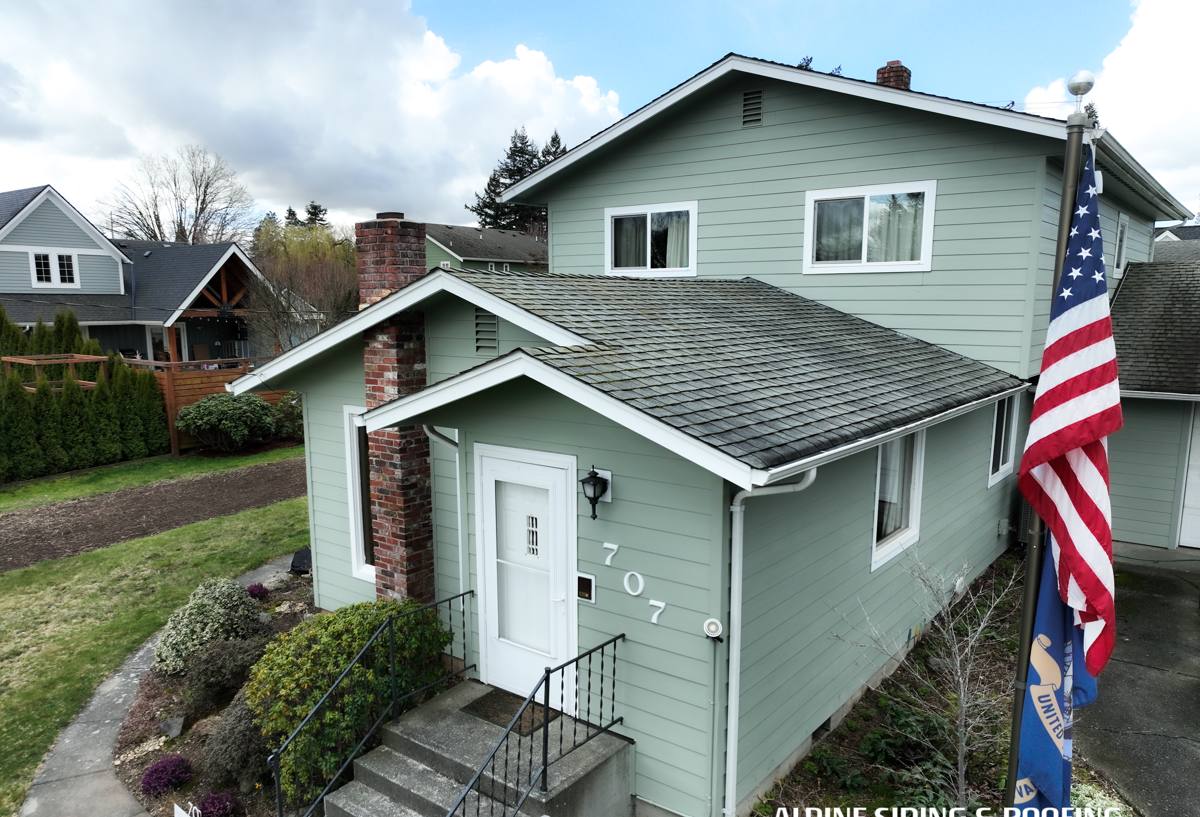
Signs Your Cordata Home's Siding Needs Replacing
Some siding problems are obvious. Others hide behind trim or under paint until they've been developing for years. Here's what we look for on inspections in this area:
- Soft or spongy spots when you press on the siding, especially near the bottom courses and around windows
- Paint that keeps failing in the same spots no matter how often it's repainted
- Persistent moss or algae growth that comes back within a season or two of cleaning
- Visible warping, cupping, or buckling of panels or lap boards
- Cracked or missing caulk at seams, corners, and trim joints
- Gaps or separation where siding meets window and door trim
- A musty smell or visible staining on interior walls near exterior corners
- Siding that's simply old enough — most wood-based and vinyl products are well past their functional life by 20-25 years in this climate, even if they still look okay from the street
Any one of these on its own might just need a repair. Several together, especially with soft spots or interior staining, usually means the water-resistive barrier behind the siding has already been compromised, and a repair is only going to buy a little time.
Why We Install Only James Hardie Fiber Cement
We don't install vinyl, LP SmartSide, primed spruce, cedar, or other fiber cement brands. That's a deliberate standard, not a lack of options. Fiber cement — specifically James Hardie's — is the only siding category that consistently holds up to the combination of moisture, temperature swings, and long wet seasons that define this part of Washington without the maintenance burden or failure patterns we've seen in other products.
James Hardie's siding is non-combustible fiber cement, which matters for fire resistance but also for how the material behaves in wet weather — it doesn't absorb and swell the way wood-based products do, and it doesn't become brittle in cold snaps the way some vinyl can. Hardie also engineers specific product lines (their "HZ" system) for different climate zones, so what goes on a Bellingham home is formulated for a wetter, milder climate rather than a generic national spec.
The factory-applied ColorPlus finish is another piece of it. Field-painted siding is only as good as the paint job and the schedule it gets repainted on — and repainting eventually gets skipped or delayed. ColorPlus finish is baked on at the factory with a finish designed to resist fading and moisture intrusion at the surface, which takes one long-term maintenance item off the homeowner's list.
What This Means in Practice
In plain terms: siding that resists moisture at the material level, holds its color without a repaint cycle, and comes backed by a transferable warranty gives Cordata homeowners a much better multi-decade outcome than a product that looks similar off the truck but behaves differently after five wet winters.
What a Correct Siding Replacement Actually Involves
Swapping old siding for new is the visible part of the job. The parts that determine whether it lasts happen underneath, and they're where corners get cut on rushed jobs.
Water Management Comes First
Before any new siding goes up, the old material and old barrier come off down to the sheathing, and we inspect for rot or moisture damage that needs to be addressed — not covered over. A new water-resistive barrier goes on, followed by correctly lapped and sealed flashing at every window, door, and penetration. In a climate that sees as much driving rain as this one, flashing details are the single biggest factor in whether water gets behind the siding over the next 20 years.
Fastening and Manufacturer Spec
James Hardie publishes specific installation requirements — fastener type and spacing, minimum clearance from grade and roof lines, gapping at butt joints, and caulking specs. Installing outside that spec doesn't just risk a worse-looking job; it can void the manufacturer's warranty. We install to Hardie's published spec as a baseline, not an upsell.
Trim and Transitions
Corners, window and door trim, and transitions to other materials are where most siding failures start. Correct treatment here — proper flashing, sealed but not sealed-shut joints that allow the assembly to manage incidental moisture — is what keeps water moving out instead of in.
Our Process, Start to Finish
1. Assessment and Product Selection
We walk the exterior, check for existing moisture or rot damage, and talk through which Hardie product line and profile fits the home — lap siding, panel siding, or a mix with trim and accent details.
2. Tear-Off and Sheathing Check
Old siding and barrier come off, sheathing is inspected, and any damaged material is documented and repaired before anything new goes on. This is the step that gets skipped on lowball bids.
3. Barrier, Flashing, and Installation
New water-resistive barrier, flashing at every opening, then siding installed to manufacturer spec with correct fastening and gapping.
4. Trim, Caulking, and Final Details
Trim work, caulking at appropriate joints only, and touch-up on any factory-finish cut edges per Hardie's guidelines.
5. Walkthrough
We walk the finished job with the homeowner before calling it done, so nothing gets discovered after the fact.
Cost Factors for a Cordata Siding Replacement
Every home is different, but these are the variables that actually move the price on a job like this — useful to know before you start collecting quotes:
| Factor | Why It Matters | Effect on Cost |
|---|---|---|
| Extent of existing damage | Rot or moisture damage behind old siding requires sheathing repair before new siding goes on | Increases cost; only known after tear-off |
| Home size and wall complexity | More corners, dormers, and trim details mean more labor and cut waste | Moderate to significant increase |
| Siding profile chosen | Lap, panel, and shingle-style Hardie profiles vary in material and labor cost | Moderate variation |
| Trim and accent scope | Trim boards, corner treatments, and accent siding add material and detail work | Moderate increase |
| Access and site conditions | Tight lots, landscaping, or multi-story sections affect staging and labor time | Minor to moderate increase |
| Tear-off and disposal | Removing and hauling old siding material, especially multiple layers | Included but varies with existing material |
We'd rather walk a home and give a real number than throw out a broad range that doesn't hold up once we see what's actually behind the old siding.
Why It Matters to Hire a Crew That Already Works in Cordata
Siding installation isn't uniform across climates. A crew used to installing in a dry climate, or one that treats every job the same regardless of region, is more likely to under-detail the flashing and water management that matters here. A crew that regularly works Bellingham and greater Whatcom County jobs already knows how much rain exposure to plan for, how moss and shading patterns affect different exposures on a home, and what local permitting and inspection expects.
There's also a practical side: a contractor with an established local presence is easier to reach if a warranty question comes up five or ten years down the road, rather than a crew that worked one job in the area and moved on.
Get a Straight Answer for Your Home
If your Cordata home's siding is showing any of the signs above, or you're just trying to plan ahead before it becomes an urgent repair, we're glad to take a look. We'll give you a clear, no-pressure assessment of what your siding actually needs and a real estimate based on your home — not a generic number. Use the form below to request a free estimate.